2010issue C0174-85
True-range-scaled construction of the vortex indicator
The vortex indicator scales two lookback sums of crossed bar extremes by the same true-range total. A vortex crossover is the change-of-direction hypothesis; some constructions also report the signed vortex spread.
- Each bar adds an upward vortex-movement increment from the current high to the prior low and a downward increment from the current low to the prior high.
- Vortex plus and vortex minus divide those lookback sums by the same true-range total, so both lines share one range budget.
- The two ratios are formed only when the lookback true-range sum is not zero, and a vortex crossover is the change-of-direction hypothesis.
- Companion rule sets place a stop entry at the signal bar's high after an upward cross and at the signal bar's low after a downward cross.
What the vortex pair reports
The vortex indicator is a two-line directional construction. It sums crossed bar extremes over a lookback, scales each sum by the same true-range total, and treats interaction of the lines as a directional signal.
Each bar contributes vortex movement in both directions. The upward increment is the absolute gap from the current high to the prior low. The downward increment is the absolute gap from the current low to the prior high.
One lookback and a shared budget
Each vortex line is the lookback sum of its increments divided by the lookback sum of true range, so both lines share one range budget. Lookback-length is the number of bars over which vortex movement and true range are summed before the two ratios are formed.
Implementations apply one integer lookback to both increment sums and the true-range sum, and they commonly default that lookback to 14 bars. The two ratios are formed only when the lookback true-range sum is not zero.
One implementation splits the construction into two independently configurable lookbacks: one for the vortex increment sums and another for the true-range sum.
How true range is taken
True range in the shared denominator is the largest of the current high-low span and the two distances from the prior close to the current high and current low. Vortex plus is that upward lookback sum divided by this true-range total. Vortex minus is the matching downward ratio.
Crossover, signed spread, and companion entries
A change-of-direction hypothesis is defined as a vortex crossover, the event in which the upward line crosses the downward line. Some constructions also collapse the pair into a signed vortex spread, a single series equal to the upward line minus the downward line.
Companion rule sets place a stop entry at the signal bar's high after an upward cross and at the signal bar's low after a downward cross.
Both increment series stay live
Relative to classic directional movement, this construction keeps both increment series live on every bar, including inside bars, instead of assigning zero to the smaller outside-range extension.
Annual futures-book returns: 14-bar vortex versus Wilder DMI
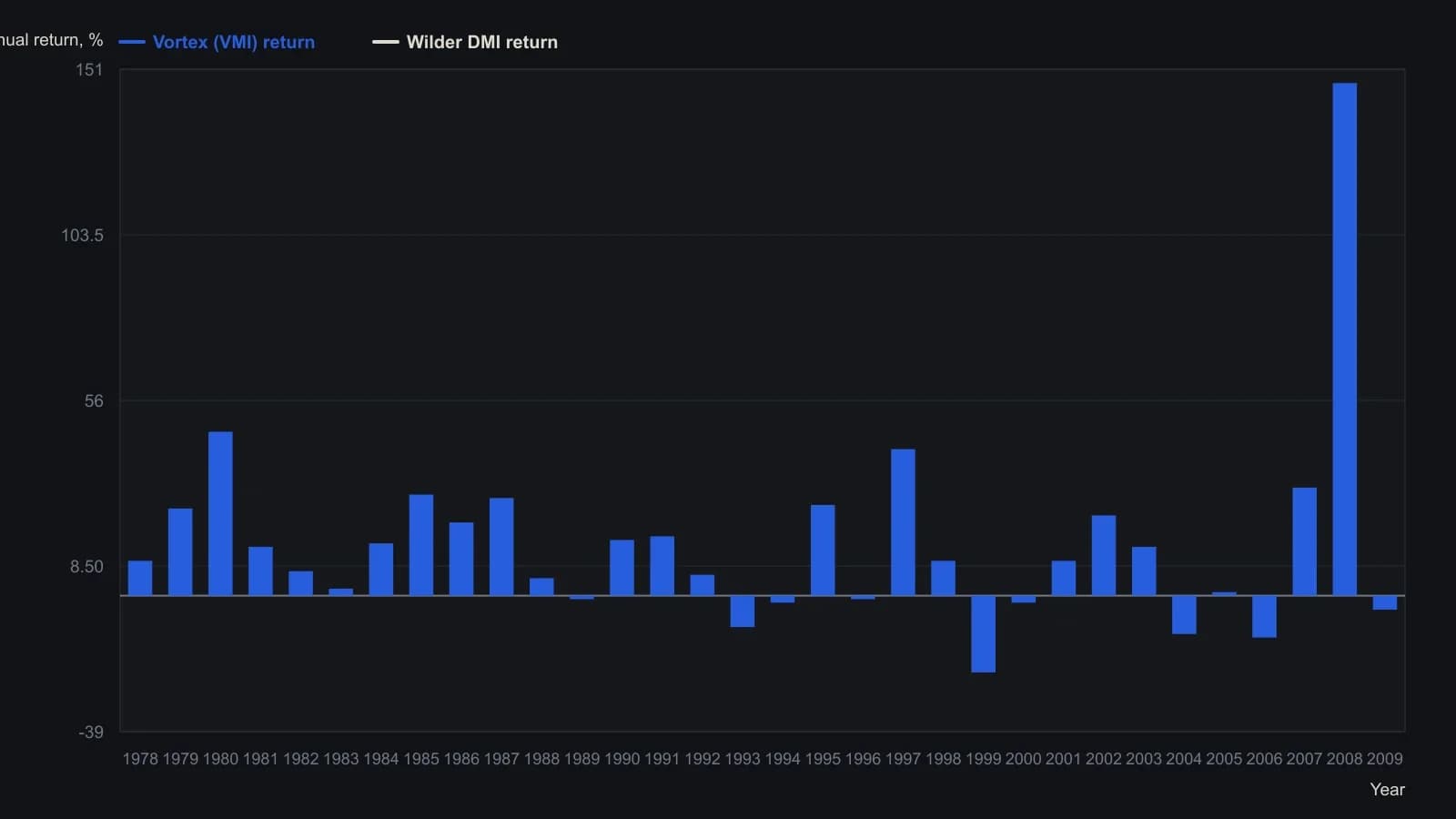
Lookback is 14 bars. The book is always long or short on the sign of VI+ minus VI− (or +DMI minus −DMI) and fills the next session on the open, one contract per trade. The 2009 row ends 6 November, not calendar year-end.
All readings on this track · 874 readings
- 1982Constructing moving averages with weights, alignment, and adaptive lookbacks
- 1982An odd-length smoother from a cycle cutoff
- 1982Spectrum-first construction of moving-average trend filters
- 1982Scale-free Commodity Channel Index construction
- 1984Constructing TRIX from a cutoff to one shared alpha
- 1984Constructing the slow stochastic from a five-session range
- 1984Matching average age across price filters
- 1984Residual-impact construction of exponential smoothers
- 1985Session windows, volume weights, and divergence in RSI construction
- 1985Constructing a recursive two-gain price smoother
- 1985Constructing excess and momentum difference-curve oscillators
- 1986Cycle-aligned directional trend indicator
- 1986Auditing stochastic crossovers with moving-average baselines
- 1986Constructing bounded relative-strength overlays from oscillator limits
- 1987Constructing a cycle-scaled trend oscillator
- 1987Relative strength evaluation under competing optimization criteria
- 1987Evaluating silver moving averages and RSI by scoring rule
- 1987Constructing scaled OHLC matrices for study overlays
- 1987Constructing a volume-confirmed Williams %R
- 1987Constructing parabolic stops and cycle-window averages
- 1987Constructing the commodity channel, average directional, and relative strength indexes on a shared cycle scale
- 1987Stochastic fast and slow construction as a rebuildable stack
- 1988Indicator smoothing: lookback, weight, and scale
- 1988A directional-line cross needs a trend filter, an extreme-point rule, and a dollar stop
- 1988Constructing tick-weighted money flow and price divergences
- 1988Constructing moving averages: weights, smoothing and crossovers
- 1988Payoff index checkpoints for open interest and divergence
- 1988Five reading rules for smoothed indicator charts
- 1988Relative strength, stochastics, and on-balance volume as a turning-point stack
- 1988Constructing unsigned true range for directional models
- 1988Constructing true range by offset addressing
- 1988Constructing simple and exponential moving averages as specified filters
- 1988Constructing volume-confirmation overlays on OHLC spreadsheet charts
- 1988Cycle lead from staggered exponential averages
- 1988Weekly MACD as a two-clock momentum confirmation stack
- 1988Constructing directional movement from bar range
- 1988Three-zone price channel from quadratic smoothing
- 1988Combining weekly and daily MACD divergences with on-balance volume
- 1988Average directional index construction: recursive smoothing and lookback offset
- 1988Staged Average Directional Index construction with Relative Strength Index confirmation and stop alerts
- 1988Rebuild MACD-Mo and MACD-H before treating them as signals
- 1988Average Directional Index construction with frozen true range and directional rules
- 1989Four-span MACD lookbacks as perishable parameters
- 1989Weekly then daily MACD confirmation on individual stocks
- 1989A variable-sensitivity stochastic built on three-sigma bounds
- 1989Smoothing filters, cutoff, poles, and sample delay
- 1989Constructing the money-flow index as a volume-weighted relative-strength oscillator
- 1989Building the stochastic oscillator from close location
- 1989Constructing alpha-beta price channels and trend filters
- 1989Equal-weight zero-cross from smoothed spreads
- 1989Alpha-beta lag parameters versus moving-average windows
- 1989Momentum overlays that speed moving-average oscillators
- 1989Testing relative-strength-index reversal rules against trend continuation
- 1989Smoothed three-day futures filter for index option bounces
- 1989Demand oscillator construction with a momentum overlay
- 1989Cycle-length windows for momentum, Relative Strength Index, and stochastic construction
- 1989Constructing a suggest-then-confirm Money Flow Index
- 1989Constructing lag-matched triangular moving averages
- 1989Close-minus-average oscillator for channel extremes
- 1989Constructing a volume percentage ratio from advance-decline flow
- 1989Volume confirmation windows and exponential average construction
- 1990Constructing stochastic %K and %D from range position
- 1990Monthly stochastics as a multi-year bond regime filter
- 1990Constructing fund cash and manager-preference filters
- 1990Bezier-curve price trend filter
- 1990Evaluating a weekly up-volume ratio and an hourly oscillator
- 1990Volume-adjusted moving average construction
- 1990A weekly resistance-index from hourly volume-per-point
- 1990Constructing a signed-range negative volume line
- 1990Integer construction of moving averages and exponential smoothing
- 1990Walk-forward screen for yen indicator rules
- 1990Recency weighting in simple, linear, and exponential moving averages
- 1990Constructing incremental moving average filters
- 1990Buying-share scale with on-balance volume
- 1990Constructing ease of movement from volume-scaled boxes
- 1990A laboratory template that constructs Rate of Change as a pane module
- 1990Lag-aligned MACD from triangular moving averages
- 1990Constructing a two-line relative volatility index
- 1990Constructing triangular moving average weights
- 1990Constructing a lag-aligned triangular MACD
- 1990Endpoint-pinned price paths are not forecasts
- 1990Constructing a second-hour session residual exponential index
- 1990Building a percent-difference moving-average oscillator
- 1990Seed and recurrence construction for moving averages
- 1990Constructing a five-day step-weighted moving average
- 1990Stacking moving averages, put-call regimes, and double bottoms
- 1990Friday-filtered on-balance confirmation lines
- 1990Split-sample tests for stochastic parameter grids
- 1990Constructing least-squares polynomial smoothers
- 1990Constructing stochastic K and D lines and divergence cues
- 1991Weekly close-to-close volatility as a horizon filter
- 1991Constructing a double-smoothed stochastic oscillator
- 1991Constructing an exponential average from a smoothing weight
- 1991Half-cycle average plot shift versus cycle attenuation
- 1991Constructing a variable-lookback random walk trend filter
- 1991Random Walk Index construction with an adaptive lookback
- 1991Constructing the average directional index from range expansion and true range
- 1991Constructing MACD signal lines and divergence tests
- 1991Building a two-stage stochastic oscillator from close location
- 1991Volume-scaled rate of change as a momentum construction
- 1991Constructing the relative strength index from seed and recursive averages
- 1991Constructing a coincident moving average as a lowpass filter
- 1991Constructing a double-smoothed momentum oscillator family
- 1991A two-speed breadth reading for intermediate market direction
- 1991Building variable-length moving averages from partitioned price changes
- 1991Variable-length moving average from change dispersion
- 1991Audit inverse-range oscillators before stacking stochastic %K and Williams %R
- 1991Ease of movement oscillator construction
- 1991Build the market clock before you read a price bar
- 1991Three-indicator market overview from tape, sentiment and rates
- 1991Three-component trend model with rate-of-change filters
- 1991Inverting relative-strength-index closes for same-session rules
- 1991Constructing standardized sentiment trend filters
- 1991Time-origin offset and residual-price divergence on a quadratic least-squares fit
- 1991Constructing an exponential smoother from a moving-average length
- 1991MACD parameter order and cycle phase lag
- 1991Equivalent relative-strength-index constructions from a ratio and from smoothed momentum
- 1991Constructing the true strength index from double-smoothed momentum
- 1991Signed midpoint range oscillator from stochastic and Williams
- 1991True strength index from signed, double-smoothed momentum
- 1991Seeded averages and the recursive-update
- 1992Constructing TRIX from triple exponential smoothing
- 1992Constructing a TRIX oscillator from daily declines
- 1992Eleven-bar commodity channel index from typical price and mean deviation
- 1992Constructing volatility-scaled bands with relative strength index confirmation
- 1992A KST oscillator from a weighted rate-of-change stack
- 1992Four-window weighted rate-of-change composite
- 1992Confirming currency-fund trends with a crossover and a filter
- 1992Constructing true strength from double-smoothed momentum
- 1992Constructing a double-smoothed true strength index
- 1992Constructing the mass-index range-reversal procedure
- 1992Constructing simple, weighted, and exponential moving averages
- 1992Constructing moving averages with weighting schemes and extra filters
- 1992Constructing a mass-index from nested exponential averages
- 1992Constructing TRIX as triple-smoothed log-price momentum
- 1992Constructing a damping-index trend filter
- 1992Constructing a nine-state trend, momentum, and breadth score
- 1992A moving-average slope filter for crossover signals
- 1992Constructing exponential averages from simple lookbacks
- 1992Constructing exponential averages by the smoothing constant, startup length and lag
- 1992Constructing multi-span smoothed rate-of-change filters
- 1992Occupancy and split-sample tests for average crossovers
- 1992Nested range smoothing and windowed high-low damping
- 1992Constructing a four-horizon summed rate of change
- 1992Constructing KST from four weighted smoothed rates of change
- 1992Building a random walk index trend filter
- 1992Variable lookback and average true range as a trend-filter construction
- 1992Constructing a composite from weighted smoothed rates of change
- 1992Three-horizon KST maturity alignment
- 1992Constructing a money flow index from volume-weighted RSI
- 1992Constructing indicator phase across averages, volume and bands
- 1992Phase diagrams for moving-average trend filters
- 1992Long-horizon MACD construction from paired exponential averages
- 1992Constructing a banded weighted open-TRIN oscillator
- 1992Constructing relative-strength KST from weighted rate-of-change
- 1992Fitting oscillator parameters to stock personality
- 1992Constructing fast and slow stochastic oscillator lines
- 1992TRIX lookback and momentum derivative parameters
- 1992Constructing nested stochastic lookbacks
- 1992Constructing volatility-adaptive exponential smoothing
- 1993Double-smoothed stochastics momentum index construction
- 1993Constructing a volume oscillator from average ratios and smoothed rate of change
- 1993When momentum structure and breadth break together
- 1993Constructing double-smoothed range and momentum oscillators
- 1993Constructing the true strength index with double exponential smoothing
- 1993Constructing a two-parameter relative momentum index
- 1993Five-rung money flow from signed print volume
- 1993Force on-balance volume to agree with itself at slower horizons
- 1993Building a bounded momentum oscillator with RSI smoothing
- 1993Constructing combined stochastics and point-and-figure relative strength
- 1993Evaluating a weighted dual rate-of-change momentum filter
- 1993Lag-compensated exponential trend channel construction
- 1993Constructing a lead-lag filter and price channel as one stack
- 1993Three stochastic warnings still need price-channel confirmation
- 1993Constructing zero-net-lag price channels
- 1993Volume-weighted change smoothing and trend ranking
- 1993Two-speed oscillators with divergence and trendline gates
- 1993Constructing a market-volume-impact rating from nested averages
- 1993Constructing the average directional index from directional movement and true range
- 1993A volatility-direction filter for dual moving-average crossovers
- 1993Nested centered channels with a commodity channel index confirmation gate
- 1993Relative strength index events depend on the chosen input combination
- 1993RSI price pattern templates and open interest
- 1993Constructing a signed ten-point trend filter
- 1993A twelve-month moving-average filter for inflation direction
- 1993Restating relative-strength-index parameters after a smoothing change
- 1993Constructing equal, linear and exponential moving averages
- 1993Physics analogies for building cycle and money flow indicators
- 1993Constructing a relative momentum index from the relative strength index
- 1993Constructing smoothed stochastics and an up/down volume oscillator
- 1993Building a restoring-pull indicator from cycle frequency and volume
- 1993Constructing two-endpoint JSA moving averages
- 1993A random-walk index that uses true range as its scale
- 1993Relative momentum construction by stretching the relative strength lookback
- 1993A shared harness for trend-filter construction
- 1993Concurrent highest-low filter with a largest-low-fall trigger
- 1993Constructing a general weighted moving average from one exponent
- 1993Calibrating the weighted-moving-average exponent
- 1993Constructing an exponent-weighted average of put-call ratios
- 1994Constructing a tick-line momentum oscillator
- 1994Pairing stochastic divergence with trendline invalidation
- 1994Regression-seeded nested exponential price filter
- 1994Constructing a smoothed on-balance tick momentum oscillator
- 1994Constructing the Chaikin oscillator from close-in-range volume
- 1994Constructing the double exponential average from lag cancellation
- 1994Constructing Chaikin money flow and a double-exponential smoother
- 1994Constructing polarized fractal efficiency as a path filter
- 1994Constructing lag-reduced double exponential averages for MACD
- 1994Polarized fractal efficiency with a shared exponential smoother
- 1994Seeding DEMA2 filters to build a MACD signal
- 1994Constructing MACD from lag-reduced exponential averages
- 1994Seeding TEMA and DEMA with time-trend regression
- 1994Histogram confirmation and a second-series veto for MACD-family alerts
- 1994TEMA1 from nested exponential averages, then a two-horizon MACD
- 1994Five-interval exponential smoothing of ten-interval signed path-efficiency
- 1994MACD crossovers then short-horizon rank rotation
- 1994License candlestick signals with oscillators and weekly vetoes
- 1994Cycle-tuned momentum with spectral peaks
- 1994Building average directional index, the stochastic pair, and Williams percent R from highs, lows, and closes
- 1994Label the tape before you read stochastic or Williams %R
- 1994Constructing an eleven-period commodity channel index
- 1994Unit-invariant trend filters and the c-test
- 1994Construct the four-state price-volume rank before filtering it
- 1994Hand-ranked price-volume series with stacked smoothing and stochastic
- 1994Constructing a composite from weighted, smoothed rate-of-change windows
- 1994Constructing On-balance volume with smoothing and timeframe confirmation
- 1994Constructing a 40-period envelope on on-balance volume
- 1994Constructing the money flow index as a volume-weighted relative strength index
- 1994Constructing range overlap and bar-pattern filters from neighboring OHLC bars
- 1994Constructing a cycle-aligned bandpass from paired lowpass filters
- 1994Constructing relative strength index lookbacks, bands, and confirmation filters
- 1994Fourier-tuned momentum filter design
- 1994Building the relative-strength-index from signed close changes
- 1994Centering a dual lowpass bandpass on a counted cycle
- 1994Rate of change parameters for testable entries
- 1994Constructing rate-of-change midpoints, lookbacks and divergence
- 1994Lead oscillator breaks need price trendline confirmation
- 1994Nested averages for an annual momentum curve
- 1994Constructing a Bollinger band-width trend filter
- 1994Stacking scored filters into a hierarchical stock outlook system
- 1994Constructing a relative-strength MACD crossover spreadsheet
- 1994Evaluating a Coppock-style rate of change as a bottom-regime filter
- 1994Averaging Relative Strength Index and the stochastic oscillator into one reversal oscillator
- 1994A clocked stochastic second crest with a window-high stop
- 1994Price oscillator from two moving averages
- 1995Commodity Channel Index band rules lag zero-line timing
- 1995Consensus presignal filters for Relative Strength Index, MACD and the Stochastic oscillator
- 1995Building the commodity channel index from typical price
- 1995Constructing a dual-horizon force index
- 1995Constructing a noise-buffered parabolic trailing stop
- 1995A weighted eleven-month Dow rate of change as one testable timing procedure
- 1995A cycle-tuned lead filter from bounded oscillators
- 1995Range expansion filter on multi-horizon averages
- 1995The exponential smoothing constant from averaging lag
- 1995Constructing an adaptive moving average with an efficiency ratio and filter
- 1995Constructing projection bands from least-squares slopes
- 1995Constructing regression projection bands and range oscillators
- 1995Projection bands from high and low regression slopes
- 1995Constructing price envelopes from averages, volatility, and regression
- 1995Building a short-range breadth and price oscillator
- 1995Construct the Aroon indicator as a time-since-extreme oscillator
- 1995Constructing the relative volatility index and inertia
- 1995Building Aroon and RSI-family oscillators from price and time
- 1995Constructing a high-low relative volatility trend filter
- 1995Evaluating zero-line patterns on a breadth-price oscillator
- 1995Two-gate breakout confirmation with adaptive averages
- 1995Evaluating a least-squares end-point moving average on a known test series
- 1995Building momentum-scaled adaptive moving averages
- 1995Adaptive length as a construction choice inside exponential smoothing
- 1995Constructing an accumulative swing index from open-high-low-close comparisons
- 1995Constructing scaled z-score normalization for model inputs
- 1995Commodity channel index construction from typical price to a smoothed zero line
- 1995Explicit exponential weights and binary entry filters
- 1996Building a range-normalized divergence index from relative strength index
- 1996Constructing a mobility oscillator from price distributions
- 1996Constructing breadth, RSI, and stochastic range filters
- 1996Constructing a price occupancy histogram and a smoothed mobility reading
- 1996Constructing an endpoint moving average from a least-squares line
- 1996Constructing Bollinger bands, percent-b, and stochastics
- 1996Calibrating Williams %R entries in rising channels
- 1996Jump and hold filters for long-term Treasury yield direction
- 1996Constructing volume disparity from percent-b
- 1996Constructing a matched percent-B volume disparity
- 1996Constructing a price-volume percent-B disparity
- 1996The Alpha coefficient as a signed Trend filter for treasury bonds
- 1996Smoothed alpha from paired log-change regression
- 1996Constructing four-state range-volume bars
- 1996Constructing four MFI bar states from range and volume
- 1996Constructing a standard-error envelope around a linear regression
- 1996Standard-error bands, width gates, and weekday counts
- 1996Constructing session-indexed standard error bands
- 1996Constructing linear-regression alpha from a yield gap
- 1996Dual-horizon ratio envelopes and regression error channels
- 1996Normalize price and volume onto a common scale
- 1997Constructing extendedness from a 10 percent swing filter
- 1997Why a daily timing evaluation depends on interval, lookbacks, and the fitting objective
- 1997Constructing a moving regression oscillator
- 1997Rational group structure with a trend screen, RSI, and bands
- 1997A midpoint rate-of-change test for bond trend follow-through
- 1997Confirm the MACD turn with price, then exit on the histogram
- 1997Constructing a short-rate-adjusted equity momentum filter
- 1997Constructing the TRIX oscillator from triple smoothing
- 1997Construct a nested-average rainbow band and oscillator
- 1997Dynamic zones for oscillator buy and sell levels
- 1997A range-expansion oscillator that can refuse its own stretch
- 1997Reconstructing a stochastic oscillator, MACD, and a triple-smoothed oscillator
- 1997An ADX threshold and a moving average as a trend filter
- 1997Constructing the relative strength index as a bounded up-down close oscillator
- 1997Asymmetric volatility band construction
- 1997Moving-average windows before crossovers and MACD
- 1997A three-layer construction for a signed volume-force oscillator
- 1997Clustered true-range days as a regime label rather than a top forecast
- 1997Constructing a range-sum volume-force oscillator
- 1998T3 adaptive smoothing from regression benchmarks
- 1998Two-group exponential average compression as a trend filter
- 1998Constructing anchored momentum from a centered average
- 1998Constructing filters by nesting offsets and variable weights
- 1998Treat RSI as a testable filter rather than a trigger
- 1998Paired tests for moving-average lag and smoothness
- 1998Constructing an efficiency ratio adaptive average and entry filter
- 1998Constructing r-squared trend filters with dual lookbacks
- 1998R-squared as a two-state trend filter from a price-time fit
- 1998Constructing three-state filters from Bollinger band envelopes
- 1998Regime filters for mutated indicators
- 1998Normalized multi-horizon historical volatility construction
- 1998Filter stacks that combine a moving average with exponential smoothing
- 1998Nested midpoint construction for a range-normalized oscillator
- 1998Moving-average length is a habit, not a secret
- 1999Building the average directional index from range extension and true range
- 1999Centered moving averages for trend construction
- 1999Combination filters with Bollinger Bands and the relative strength index
- 1999On-balance volume confirmation, price-indicator divergence, and bounded exits
- 1999Fixed-lag construction of moving-average smoothers
- 1999How a five-bar sine-weighted average is assembled
- 1999Constructing isolated synthetic waveforms to watch indicator settling
- 1999Evaluating Relative Strength Index momentum with zero-line and threshold rules
- 1999Sinusoidal pseudo-securities for indicator evaluation
- 1999Treat RSI and momentum as three mechanical procedures
- 1999Stochastic rules versus buy and hold
- 1999Constructing regular and slow stochastic oscillators
- 1999Second-stage MACD on relative-strength inputs
- 1999Constructing MACD from exponential-average spreads for crossover and divergence
- 1999A trend filter that switches tactics and scales ATR targets
- 1999Solving the close that triggers a moving-average crossover
- 1999Coding candlesticks into numeric indicators
- 1999Lagged trend filters for neural-network inputs
- 1999Take the rectangular-base breakout from money-flow confirmation, not from a late strength average
- 1999Evaluating Bollinger Bands against fixed-width and range-based envelopes
- 2000Second-order moving-average lag correction
- 2000Constructing a slope-corrected moving average
- 2000Rule-based moving average commentary as a testable filter
- 2000Lookback length as a construction check for the modified moving average
- 2000Switch trend and cycle indicators after a half-cycle dwell test
- 2000Constructing simple moving average crossover filters
- 2000Evaluating ADX, RSI, and moving averages in a multi-stock warehouse
- 2000Constructing next-close envelope targets for breakout stops
- 2000Building a vertical-horizontal filter to gate trend signals
- 2000A triple delay line then a one-bar elliptic oscillator
- 2000Constructing a Bollinger Band target as a forward price
- 2000Constructing a Chaikin oscillator from the accumulation-distribution line
- 2000Onset and exit from one average directional index
- 2000Treat volume-price imbalance as a hypothesis and let Parabolic SAR hold the exit
- 2000Constructing Ichimoku spans, scaled oscillators, and volume breakout filters
- 2000Constructing Ichimoku clouds from midpoints and time shifts
- 2000Thrust strength figure from moving-average swings
- 2000Choosing a scale for moving-average oscillators
- 2000Cycle-scaled lookbacks for a channel-breakout rule
- 2000When charting code breaks the adaptive trendline
- 2000Volume-weighted average price as a baseline for indicator construction
- 2001A lookback range index for market variability
- 2001Shared lookback as the identity of a log range index
- 2001Constructing confirmation filters for RSI overbought and oversold extremes
- 2001Second-low confirmation with a percentage oscillator and money-flow filter
- 2001Confirming rate of change divergences with price
- 2001Numeric candlestick encoding with local size bands
- 2001Turning one candle into a ranked numeric object
- 2001Momentum trendline breaks need price confirmation
- 2001Nonlinear Ehlers filter construction from momentum and distance weights
- 2001Reader tests for unfinished lookback oscillators
- 2001An elastic volume-weighted moving average from a share-count lookback
- 2001How a fixed smoother becomes a living parameter surface
- 2001Constructing an elastic volume-weighted average and volatility bands
- 2001Construct a variable-interval simple moving average from stacked extremes
- 2001Constructing a variable-interval average from a difference-oscillator or volatility forecast
- 2001Smoothing balance of market power with a moving average
- 2001Know Sure Thing with stacked horizons and trendline confirmation
- 2001Constructing a non-range-bound balance of market power score
- 2001Encoding candle structure as a numeric filter
- 2001Adaptive averages driven by cycle-phase speed
- 2001Inner weights are part of the candlestick signal
- 2001A two-gate classroom test for a two-window momentum trend filter
- 2001Constructing MACD from exponential average spreads and a signal line
- 2001Two tests of a rate-adjusted earnings-yield gap
- 2001Keep three jobs separate when you test a composite score
- 2002Joint ADX and MACD readout for trend strength and direction
- 2002Combining Bollinger Bands, RSI, and a stop-loss
- 2002Constructing an instantaneous trendline from a dominant cycle
- 2002Constructing a two-line stochastic from a range-normalized close
- 2002Constructing TRIX from triple-smoothing to signal rules
- 2002How a two-sided continuation factor becomes a testable trend rule
- 2002Parabolic SAR construction from stop outputs to reversal signals
- 2002Always-in-market SAR trail with directional confirmation
- 2002Constructing the commodity channel index from typical price
- 2002Separate bounded and trend-following oscillator rules
- 2002Half-cycle center of gravity oscillator from moving-average balance
- 2002Bollinger Bands remain filters, not forecasts
- 2002Combine adaptive bands with the Relative Strength Index and volume-weighted RSI
- 2002Treat a moving average as a contested fence
- 2002Lock the TRIX construction before reading a zero-line cross
- 2002Evaluating two-window trend intensity as a reversal rule
- 2002Rebuild a smoother by writing the lag into the coefficients
- 2002Constructing zero-lag finite-impulse-response and exponential smoothers
- 2002Building classic divergence filters from RSI and MACD
- 2002Confirming the last leg of a zigzag trend filter
- 2002Constructing a stochastic RSI with Bollinger bands
- 2002Constructing the relative strength index with an even-order finite-impulse-response prefilter
- 2002Smoothed relative-strength construction from wilder-averaging and a price prefilter
- 2002Constructing channel-normalized Fisher reversal signals
- 2002Affine-price and the Fisher transform as a constructed companion to MACD
- 2002Evaluating the weekly four-percent close filter as a market-state procedure
- 2003Same-scale trend filter from a rolling least-squares endpoint
- 2003Constructing an adaptive stochastic RSI
- 2003How a rolling linear-regression endpoint is assembled as a moving-trend
- 2003Constructing divergence-equivalent relative strength index and stochastic oscillators
- 2003Regression slope with an r-squared trend confidence gate
- 2003Rebuilding band distance as a z-score crossover
- 2003Constructing price z-scores with dual averages and bands
- 2003Zigzag target zones from a normalized deviation oscillator
- 2003Sliding-window retracements on the relative strength index
- 2003Constructing a negative volume index as a moving-average regime test
- 2003Constructing finite volume elements as a finite-period money-flow filter
- 2003Constructing finite-volume-element divergence with slope comparison
- 2003Reverse-engineered RSI as a next-close projection
- 2003Regularized EMA construction with a MACD line and a thrust oscillator
- 2003Constructing the Commodity Channel Index from typical price and scaled deviation
- 2003Scoring open versus resolved relative strength divergences
- 2003Independent witnesses: a median-line miss, a breadth average, and volume bands
- 2003A shallow, poorly participated advance is an unconfirmed trend
- 2003Curvature-penalized exponential averages versus MACD
- 2003Reverse-engineered RSI price targets
- 2003Reverse-engineered Relative Strength Index price curves
- 2003Constructing TRIX from nested exponential averages
- 2003Construct a volatility-adjusted on-balance volume filter before confirming a breakout
- 2003MACD, moving averages, and a trend filter as one timing system
- 2003Chart sentiment as a regime filter for hourly stochastic entries
- 2003Evaluating oscillator thresholds against optimized crossovers
- 2003CCI and RSI parameter defaults as scaling conventions
- 2003Bull-and-bear-balance from OHLC bar patterns
- 2003Constructing volatility-scaled Bollinger envelopes
- 2003Constructing bull and bear balance from session paths
- 2003A cost and capital audit of a Commodity Channel Index trade engine
- 2003Constructing momentum from two closes and spotting divergence
- 2003Four parameters that construct a stochastic oscillator
- 2003Commodity channel index peak divergence as an exit after twin patterns
- 2003Constructing a confirmed zigzag trend filter
- 2003Weighting recipes inside one moving-average lookback
- 2003Recursive and cascaded moving-average construction
- 2003Formula choice tilts which momentum mismatches count as divergences
- 2003Fractional MACD and linear-regression reversal construction
- 2004Reconstructing Heikin-Ashi bars from smoothed OHLC
- 2004Heikin-Ashi candle construction as an OHLC transform
- 2004Weekly MACD-histogram timing of bear-market rallies
- 2004Constructing a volume-weighted moving average as a forecast baseline
- 2004Building a daily score from regression, retracement, and volume
- 2004Constructing stochastic oscillator bands, crosses and divergence
- 2004Constructing a semicycle trend-quality filter
- 2004Candlestick triggers filtered by MACD divergence
- 2004Piecewise trend quality from moving-average reversals
- 2004RSI and momentum agreement as an asymmetric filter
- 2004Assembling a bounded RSI path
- 2004Volume-weighted column averages and crossovers on point-and-figure charts
- 2004The average directional index as a regime gate for the relative strength index and the stochastic oscillator
- 2004Build a phase-change index as a reversal rule
- 2004Compressive last-stage oscillator construction
- 2004Constructing a volatility-gated volume-flow measure
- 2004Constructing a volume-flow series from on-balance volume
- 2004Constructing a volume-flow rule from money flow
- 2004Volume-flow indicator construction from on-balance volume
- 2004Volume-flow slope divergence, then separate on-balance-volume and crossover rules
- 2004Evaluating P/E overlays with matched crossovers
- 2004Volume flow and band construction as one inspectable problem
- 2004Decompose high, low, and close into separate forecast streams
- 2004Constructing RSI on highs, lows, and reverse targets
- 2004Reverse-engineered RSI as an explicit next-bar price target
- 2004Constructing the Commodity Channel Index from typical price
- 2004Constructing the Commodity Channel Index from typical price and mean deviation
- 2004Weekly-average and price-channel states on sector depositary baskets
- 2004Why on-balance volume and the accumulation-distribution line disagree
- 2004Nested smoothing recipes versus unaudited oscillator experiments
- 2004Constructing a true-range volume power-shift filter
- 2004Constructing true-range-specified volume as a directional filter
- 2004Two-average trend filters as a classroom critique of indicator stacking
- 2004TRIX momentum and fundamental overlays for medium-term stock selection
- 2004Constructing a fifteen-bar trend trigger as a next-open system
- 2004Constructing a trend filter from two adjacent high-low windows
- 2004Point-and-figure column moving-average crossovers
- 2005Weighing reversal clusters against moving-average support
- 2005Three-state moving-average directional breakout construction
- 2005Constructing a move-adjusted moving average
- 2005Three-state moving-average breakout bar coloring
- 2005Construction of a volatility-bounded long entry
- 2005Three-layer confirmation from a moving-average cross, candles, and Q-stick
- 2005Constructing a three-state moving-average breakout histogram
- 2005Constructing a volume and change weighted moving average
- 2005Constructing a volume and move-adjusted trend filter
- 2005Constructing a z-score scored range-breakout filter
- 2005A three-part workshop for adaptive-filter length search
- 2005Stochastic overbought as a trend-regime state
- 2005Constructing a move, volume and recency weighted average
- 2005Constructing a volatility-normalized cycle index
- 2005Weekly stochastic divergence and a long average on 2005 high-yield entrants
- 2005Moving-average construction: windows, weights and stops
- 2005Shared-scale cycle indexes with companion oscillators
- 2005Six-zone encoding of open, high, low, and close
- 2005Combining Bollinger Bands, the average directional index, and Fibonacci retracement on currency pairs
- 2005Current-bar inclusion can mute a stochastic channel break
- 2005Current-bar versus prior-bar range construction for the stochastic oscillator
- 2005Constructing price-normalized moving-slope hybrids
- 2005Constructing a fractal-dimension adaptive moving average
- 2005Constructing an adaptive moving average from a fractal-dimension weight
- 2005Range-dimension adaptive exponential filter
- 2005Constructing Bollinger bands versus fixed trading bands
- 2006Constructing lowpass, highpass, and finite impulse response filters from one recurrence
- 2006One second-order transfer function, a family of trend filters
- 2006Building custom indicators from the Commodity Channel Index, a least squares moving average and a rule-based entry
- 2006Shared coefficient construction for recursive price filters
- 2006Squared versus absolute deviation in envelope construction
- 2006Self-adjusting RSI thresholds from the oscillator's own spread
- 2006Constructing adaptive overbought and oversold levels for a relative strength index
- 2006Percent-scale average true range for comparable range
- 2006Normalized average true range as a pre-entry volatility bound
- 2006Rank price-oscillator divergences, then filter by trend
- 2006Constructing a Wilson relative price channel from a range-bound strength index
- 2006Constructing a trend filter from a cycle-length moving average and a highpass residual
- 2006A dominant-cycle split into a trend filter and residual Relative Strength Index
- 2006Assembling an adaptive price zone from double-smoothed averages
- 2006Constructing an adaptive price zone from a double-smoothed range
- 2006Market condition as a permission layer for moving averages and oscillators
- 2006Relative-spread-strength for cycle confirmation
- 2006Constructing a relative spread-strength oscillator for staged cycle confirmation
- 2006Constructing a log-change probability line for trend and range rules
- 2006An ADX strength gate for MACD and the stochastic oscillator
- 2006Combining BandWidth extremes with a Stochastic oscillator and a Volatility breakout
- 2007Directional movement as a filter plus trigger
- 2007Constructing a veto-first trend permission stack
- 2007Anticipating a simple-average crossover with a threshold-close
- 2007Anticipating moving-average crossovers one bar ahead
- 2007Lead-series moving-average crossovers with a stochastic and relative strength index
- 2007Next-bar SMA crossover hypotheses from theoretical crossing values
- 2007Constructing a fractal-dimension regime filter
- 2007ADX gates for trend end, range, and reversal
- 2007MACD with a Stochastic oscillator for spotting trend reversals
- 2007Rebuilding rate of change as a path-weighted oscillator
- 2007Range bars change when a Bollinger squeeze counts as a breakout
- 2007Evaluating Volume-price confirmation versus On-balance volume and MACD
- 2007Constructing a three-factor volume-price confirmation filter
- 2007Constructing MACD, RSI, and stochastic confirmation for futures
- 2007Ichimoku as a time-linked trend and support stack
- 2007Two-period relative strength index versus a one-week universe baseline
- 2007Match a volume-price oscillator to a range, not to a policy rebound
- 2007Constructing a Heikin-Ashi volume-price oscillator
- 2007MACD histogram divergence needs a confirming close
- 2007A volume-price oscillator is a timing trigger, not a standalone entry
- 2007Confirming trend with regression slope and r-squared
- 2008Constructing a nine-cell directional-ratio grid
- 2008Heikin-Ashi OHLC construction and simplification
- 2008Parameter windows: exponential averages versus the alligator and Fibonacci lookbacks
- 2008A linear-regression angle assembled as one trend filter
- 2008Rebuild the Relative Strength Index as price-scale bands
- 2008Dual-listing moving averages as a crowd-regime test
- 2008Reading Relative Strength Index extremes on one price axis with Bollinger Bands and moving averages
- 2008RSI bands as a one-day shift of reverse-engineered levels
- 2008RSI divergence classes, ratio thresholds, and trendline tests
- 2008Weight construction beyond the N-day label
- 2008Reading the offloaded evidence file
- 2008A Leader companion for MACD direction warnings
- 2008Average directional index and directional trend indicator lookbacks as trend-filter parameters
- 2008Rebuild a short-period stochastic as a premier stochastic oscillator
- 2008Relative strength exits with MACD averages and RSI
- 2008Zero-centered stochastic bands and bracket stops
- 2008A holding-matched market lens from averages and directional-line crosses
- 2008Sequencing RSI, MACD, and average crossovers
- 2008Building MIDAS curves from an anchored volume-weighted average
- 2008Construct a launch-point VWAP as support and resistance filters
- 2008A nine-cell directional scoreboard for multi-horizon entries
- 2008Constructing an asymmetrical RSI from adaptive up and down averages
- 2008Asymmetrical RSI lookbacks for divergence and candle confirmation
- 2008Constructing stacked moving-average filters
- 2008Construct Special K so short-horizon signals stay inside the primary trend
- 2008How a Heikin-Ashi candlestick oscillator is built from color, lag, and hold rules
- 2008Heikin-Ashi color-coded candles and smoothed trend filters
- 2010True-range-scaled construction of the vortex indicator
- 2010Building a Vortex Indicator from high-low distances
- 2010Constructing the vortex indicator from OHLC bars
- 2010Constructing ADX, RSI, and MACD price filters
- 2010Typeahead retrieval of a moving average, on-balance volume, and a stochastic oscillator
- 2010How to judge a Kalman filter forecast as a Trend filter
- 2010Stacking a short-horizon oscillator with a moving average and swing hold rules
- 2010Constructing simple, exponential, and adaptive averages
- 2010Constructing cycle versus trend mode filters
- 2010Construct a bandpass, cycle, and trend mode detector
- 2010Evaluate Turtle-style bands as one mechanical procedure
- 2010How a price-hugging smoother is assembled from ordinary averages
- 2010Constructing the Schaff Trend Cycle from MACD and a dominant-cycle window
- 2010A construction test for a modified volume-price trend filter
- 2010Schaff Trend Cycle as a MACD and Stochastic oscillator combination
- 2010Modified volume-price trend and log-price scale alignment
- 2010Heikin-Ashi smoothed percent b for divergence timing
- 2010Assembling a smoothed percent-b oscillator from Heikin-Ashi and stacked averages
- 2010Constructing a trend filter as a low-frequency model
- 2010Combining Relative Strength Index, the stochastic oscillator, and MACD as slope filters
- 2010Construct a center-line volume oscillator and read it with a stochastic oscillator
- 2010A consensus filter for objective RSI and smoothing construction
- 2010Sharpened RSI turns with rainbow averages and a slow stochastic
- 2010Building a bounded oscillator from a rainbow smoother, relative strength, and inverse Fisher
- 2010Rebuilding an exponential average as a bounded error-correcting filter
- 2010Filtering MACD false signals with trendline breaks
- 2010Constructing a Hull smoother and a Hull-based oscillator gate
- 2011Two-horizon weekly RSI with moving averages and stops
- 2011Constructing a Spearman rank trend filter
- 2011Build a Spearman rank oscillator from ordered closes
- 2011Constructing percentage-offset moving-average bands
- 2011Vendor feeds as an input variable in a MACD evaluation
- 2011Percent-offset simple moving average bands with relative-strength confirmation
- 2011Constructing a volume zone oscillator with a moving-average and Average Directional Index regime filter
- 2011Three-filter confirmation for short-swing futures
- 2011A volume zone oscillator conditioned by an Average Directional Index filter
- 2011Candlestick names need volume-price, ADX, and moving-average checks
- 2011Price-zone oscillator construction from signed closes
- 2011Constructing Heikin-Ashi, moving-average, and MACD filters
- 2011Linear regression overlays on volume-flow primaries
- 2011Constructing a put-call ratio cycle indicator
- 2011Building a put-call ratio indicator stack
- 2011Constructing a cycle-free trend filter against an ATR-scaled random walk
- 2011How an adjustable-bands z-test resizes the no-trade zone
- 2011Constructing an inverse Fisher stochastic with bands and averages
- 2011The inverse-Fisher stochastic is a forecast layer until the book rules can be disabled
- 2011Pairing same-horizon oscillators with a walk filter
- 2011Constructing trend labels from increment correlation atoms
- 2012Out-of-the-money versus in-the-money option sensitivity to implied volatility
- 2012Confirming breakouts and retracements with CCI, ADX, and averages
- 2012MACD window tuning as hold-time control
- 2012Constructing a Bollinger Band indicator suite
- 2012Stacking price extremes, crossovers, bands, and MACD
- 2012Adaptive Bollinger band impulse, trend, and momentum filters
- 2012Stacking oscillator lookbacks into a heatmap mosaic
- 2012Evaluating engulfing momentum across hold windows
- 2012Sentiment-zone oscillator from signed closes
- 2012Assembling a sentiment zone oscillator as one contrarian filter
- 2012Combining a moving-average crossover with MACD and support-resistance
- 2012Classic RSI one-over-N smoothing versus the standard exponential average
- 2012Align swings to nested energy regimes
- 2012Constructing a simple moving average filter with fixed crossing rules
- 2012Constructing a three-state Heikin-Ashi trend filter
- 2012Sampling unit as a first-class parameter on dual simple moving averages
- 2012Constructing trend-intensity overlays across chart scales
- 2012Pairing moving averages with variable-length stochastics
- 2012Constructing a multi-horizon folded-correlation reversal filter
- 2012Clustered average-directional-index traces as a trend-start filter
- 2012Average Directional Index cluster filters for trend-start signals
- 2012Confirming a trend start or turn with a triple ADX cluster
- 2012Stacking a relative-strength-index forecast, a trend filter, and long-only momentum
- 2013Constructing a late-entry stack from a signed DMI oscillator
- 2013Moving-average baselines versus crossover signals
- 2013A directional oscillator and its stochastic as a stacked timing filter
- 2013The average directional index as a lookback cluster and a risk-reward bound
- 2013Constructing a consensus and volatility-normalized value oscillator
- 2013GARCH and a volatility rank as market-regime classifiers
- 2013Treat a short-term valuation oscillator as an entry-timing filter
- 2013Construct a ranked volatility switch before the trend filter fires
- 2013Why exponential smoothing uses two over n plus one
- 2013Z-score value filter on reversals and Donchian entries
- 2013ADX cluster lookbacks are a locked specification, not a chart label
- 2013Combining moving averages, stochastics, and ADX in a daily scan
- 2013Constructing an up/down volume oscillator from a web price series
- 2013Constructing ATR-scaled swing pivots and linear-regression divergence
- 2013Volatility band construction from Typical price and Mean deviation
- 2013Constructing asymmetric volatility bands for reversal, trend, and stops
- 2013Constructing fair-value filters from averages and momentum
- 2013Constructing volatility bands from typical price
- 2013Constructing paired percent-b and stochastic swing oscillators
- 2013Heikin-Ashi volume gates, smoothing, and denominator floors
- 2013Give the fast band line and the slow stochastic complementary jobs
- 2013Combining Relative Strength Index, historical volatility, and Bollinger %b screens
- 2013Constructing moving averages and MACD from one price series
- 2013Evaluating an adaptive moving average against a same-window moving average
- 2013Walk-forward tests for color-coded Heikin-Ashi crosses
- 2013Constructing a repeated-median slope as a resistant trend filter
- 2013The next-bar price that forces a MACD signal-line cross
- 2013Constructing next-bar MACD reversal prices
- 2013Constructing inverted MACD reversal prices
- 2013Rescaling stochastic, percent-B, and wave-count parameters
- 2013Bollinger Bands, volatility breakout, and breakout confirmation as one testable procedure
- 2013Restore volume balance before adding another price-time indicator
- 2014Lookback range, a two-lag smoother, and next-bar fills
- 2014Constructing a MESA stochastic with roofing and SuperSmoother filters
- 2014Combining a relative-strength index and trend filters for oversold setups
- 2014Constructing a roofed stochastic from highpass and lowpass stages
- 2014From aliasing and dilation to a roofed stochastic swing
- 2014Industry-group quartile pivots as a Bollinger Bands case study
- 2014Lookalike money flow is not on-balance volume
- 2014Ichimoku cloud, market breadth, and dominant cycle detection as a case study
- 2014Bollinger Bands as adaptive price envelopes: a 2014 classroom case
- 2014Two-leg stochastic stress oscillator as a rebuild drill
- 2014Constructing true-range contraction filters before expansion
- 2014Running-percentile close divergences and trend filters
- 2014When ranging ends, replace the relative strength index, not its lookback
- 2014Hidden three-channel regression signals for stock and call option entries
- 2014Shared-filter combinations of the stochastic oscillator, MACD, and RSI
- 2014Dual detrended oscillators and dual Bollinger Band channels
- 2014RSI, CCI, and moving-average trend-filter construction
- 2014Dual RSI, a moving average, and CCI as a confirmation stack
- 2014Walk-forward velocity filters on noisy intraday trends
- 2014Construct a dual quotient-copy trend filter under a frequency roof
- 2014Quotient transform as an early-onset trend filter
- 2014The dual-K highpass roofing filter is unfinished until three choices are written together
- 2014Price-rooted lookbacks for a relative strength index, a moving average, and a trend filter
- 2014Square-root lookbacks for combined MACD and RSI
- 2014A 2014 research stack as a classroom for volume-flow hypotheses
- 2014Evaluating moving-average, pivot, and support-resistance filters
- 2014Ingress dates as price bases for relative strength, stochastics, and moving averages
- 2015Bandedge trend filter construction with inverse crossover rules
- 2015Constructing a zero-lag oscillator against a relative strength index baseline
- 2015Whitened lowpass filters for trend and countertrend
- 2015Constructing a one-parameter bandpass oscillator from two-bar momentum
- 2015Condensed candlestick signatures
- 2015Constructing ratio indicators with moving-average and exponential-smoothing weights
- 2015Linearity, commutation, and ratio smoothing in moving averages
- 2015MACD crossover evaluation by trend rank rotation
- 2015Rebuilding the relative strength index from close-to-average gaps
- 2015Assembling the Average Directional Index from directional movement
- 2015Relative-strength-index rules under a 20-percent trend filter
- 2015Optimizing virtual bar size as a trend filter
- 2015Rebuilding a volume-weighted RSI and checking price-indicator divergence
- 2015Slow relative-strength index from an exponentially smoothed price
- 2015Evaluating moving-average lag in cycle filters
- 2015Constructing price gravity and float turnover filters
- 2015Constructing the slow volume strength index from signed volume
- 2015Constructing a decycler from high-pass cancellation
- 2015Constructing decycler oscillators from highpass and bandpass filters
- 2015Money flow oscillator construction from volume pressure
- 2015Constructing a bounded money-flow oscillator from range and volume
- 2015A three-layer permission stack: moving averages, a price channel, and weekly levels
- 2015Percentage true-range construction for cross-market volatility filters
- 2015Construct a percentage true range for cross-market volatility
- 2015Percentage true range as a pre-entry exposure filter
- 2015Constructing a breakout relative-strength index from two-day range candles
- 2015Audit open interest and trend before trusting oscillator crossovers
- 2015Money-flow lookback versus aggregated open interest
- 2015Relative Strength Index as a baseline in 2015 software listings
- 2016Building Nyquist-safe lowpass trend filters
- 2016Earnings straddles, implied volatility, and money-flow filters
- 2016Lookback and direction-test parameters for a liquidity-plus-trend screen
- 2016Constructing higher-high and lower-low stochastic pairs
- 2016Three-layer confirmation: adaptive average, stochastic relative strength index, and stop-and-reverse
- 2016Session-gated moving-average entry construction
- 2016MACD without a signal line, confirmed by moving-average trend filters
- 2016Aroon as a time check before a MACD zero-line and moving-average stack
- 2016MACD as a zero-line state map with average and Aroon filters
- 2016Use RSI, MACD, and a moving average as a market-health consensus
- 2016MACD as a zero-line filter with dual moving averages
- 2016Closing score from range location as a volume-checked sentiment filter
- 2016A permission stack for Bollinger, RSI, and the 50-period average
- 2016Measurement-first critique of indicator defaults
- 2016Stacking a MACD zero-line cross with Aroon and moving-average filters
- 2016Dual exponential Super Passband filter construction
- 2016Constructing a range-midpoint moving average
- 2016Combining RSI, moving averages, and money flow
- 2016MACD line versus histogram is a display problem first
- 2016Smoothed RSI and full-cut pivots for option-income exits
- 2016Weekly inflation-ratio crossover for commodity regimes
- 2016Score RSI and stochastic crossings only when ADX confirms the trend
- 2017Build an Ichimoku cloud from five plots
- 2017Ichimoku cloud price alignment as bullish confirmation
- 2017Rebuild a Hull moving average with linear-regression intercepts
- 2017How to construct exponential standard deviation bands
- 2017Rebuilding the relative strength index as open-scale buy-sell pressure
- 2017Comparing Wilder and exponential smoothing inside a relative-strength index
- 2017Constructing dual-average cross and channel-index filters
- 2017Write a daily contrarian rule from the closed-end-fund discount
- 2017Constructing weighted Bollinger bands and volume averages
- 2017Constructing a dual EMA stochastic from range normalization
- 2017How lookbacks, sign, and bands construct a volatility oscillator
- 2017Normalized Laguerre zero-axis warning as a two-marker construction
- 2017Causal reverse exponential average for cycle and trend
- 2017A three-flag swing window with a bandpass midpoint
- 2017One-alpha reverse-path exponential smoothing
- 2017A volume residual filter and a price projection matrix
- 2017Building a signed relative-volatility oscillator
- 2017Weekly and daily MACD on a single daily chart
- 2017Weekly and daily MACD as a stacked momentum filter
- 2017Nested weekly and daily MACD from paired EMA spreads
- 2018Constructing an ADX filter for intraday breakouts
- 2018Treat CAM as a classification layer before confirmation becomes an entry
- 2018Four-state slope labels gated by a moving average and a commodity channel index
- 2018A three-state overlay that colors a trend only after the line clears the bar
- 2018Weekly and daily PPO scale versus MACD, with bounded RSI and stochastic readings
- 2018Constructing a weekly and daily percentage price oscillator
- 2018Assembling a recursive median oscillator as a two-stage adaptive filter
- 2018Range-based volatility as a true-range construction
- 2018RSI, hammer, and moving-average gates for range hypotheses
- 2018Pair two adaptive averages to filter swing turns
- 2018Two Adaptive moving averages as a confirmation pair
- 2018Half-cycle relative-strength index with a Fisher map for cyclic reversals
- 2018Moving-average supports in the March 2018 correlation shock
- 2018Constructing an adaptive filter for adoption-cycle reversals
- 2018Moving average support and volatility-band construction
- 2018Constructing a deviation-scaled adaptive moving average
- 2018Constructing a Finite Impulse Response Filter compared with Exponential smoothing
- 2018Deviation-Scaled Moving Average construction from a two-bar difference
- 2018Constructing a two-stage stochastic RSI for comparable price-oscillator divergences
- 2018Combining a weekly stochastic, a long moving average, and two-day resistance
- 2018Constructing predictive filters with RSI and walk-forward tests
- 2018Weekly and daily Stochastic oscillator construction on a single daily chart
- 2018Weekly and daily stochastic readings with a long moving average and support
- 2018Building a Fisherized deviation-scaled oscillator
- 2018Oscillator distribution shape for mean-reversion filters
- 2018Constructing composite relative-strength-index stochastics for reversal confirmation
- 2018Constructing the stiffness trend filter from moving-average holds
- 2018The averaging kernel and the lagged trend gate are separate specifications
- 2019Brick sampling changes what a volatility envelope can show
- 2019A trend filter is not ready to compare until portfolio constraints are written down
- 2019Constructing a sell-relative-strength-index from the intrabar range ratio
- 2019Building a smoothed Stochastic oscillator of the Relative Strength Index for Price-indicator divergence checks
- 2019Lookback, threshold, and position-capacity for a stiffness trend-filter
- 2019Volume-volatility parabola and signed-volume momentum
- 2019Constructing nested regression projections as smoothers
- 2019Constructing a 50-200 sma-channel for swing entries and exits
- 2019Assigning jobs in a stochastic, parabolic, and moving-average stack
- 2019Constructing futures momentum as open-interest-scaled rate of change
- 2019Range-weighted construction of an adaptive exponential moving average
- 2019A three-filter stack as a redundancy test
- 2019Extreme-seeking volatility with bands, breakouts, and chandelier exits
- 2019Stochastic scan thresholds, averages, and formula syntax
- 2019Exponential deviation bands with a moving average, RSI and ADX
- 2019Constructing exponential-deviation-bands from a midline-average
- 2019Constructing the Voss line from a bandpass and a short FIR sum
- 2019Constructing a calendar-conditioned trend filter
- 2019Lock a band, take a short lead, then gate empty readings
- 2019Judging a dominant cycle and a trend filter by sample, lag and the move they keep
- 2020Evaluating countertrend ETF rules against a buy-and-hold control
- 2020A convolution slope built from nested linear regression
- 2020Critiquing exponential variants of Bollinger Bands
- 2020Building reflex and trendflex cross and extreme entry rules
- 2020Constructing a cycle-plus-trend oscillator from a one-wavelength chord
- 2020Moving-average construction as an objective trend filter
- 2020Variable-strength pivot highs as falsifiable entry filters
- 2020Treat close-only volume as a hypothesis, then choose regime or phase
- 2020Constructing futures turnover time and urgency
- 2020Constructing the obvm signal line
- 2020Constructing smoothed on-balance volume with a signal line
- 2020Moving-average baselines, price vetoes, and mean reversion
- 2020Constructing a bounded correlation-trend-filter
- 2020Constructing a correlation-to-line trend filter
- 2020A normalized-slope trend filter from linear regression
- 2020Finite-memory truncation for cycle filters
- 2020Truncated bandpass construction as a finite-length trend filter
- 2020Stock power ratio as a growth trend filter
- 2020Construct a dual-series price momentum oscillator overlay
- 2020Keep neutrality as a first-class input in three-state market data
- 2020A multi-timeframe stochastic as a panel of weekly voters
- 2020Constructing selectable volatility and moving-average bands
- 2020Centerline crossovers that compare index momentums
- 2020High-low activator, directional oscillator, and momentum swing agreement
- 2020Gating volatility-momentum divergences with a Trend filter
- 2020Confirming Gann hi-lo swings with ADX and stochastics
- 2020Constructing Slow %K as a two-stage helper
- 2020Combining money-flow, RSI, and breadth for dynamic pressure zones
- 2020Constructing a probability-defined trend filter
- 2020Multi-timeframe stochastic voting as one mechanical rule
- 2020Constructing a relative-strength oscillator with a rank-agreement trend filter
- 2020Mechanical Parabolic SAR as an always-in flip after a breakout
- 2020Layering Relative Strength Index, MACD, and Parabolic SAR onto relative rotation maps
- 2020Constructing Wyckoff tape reading with MACD, moving-average, and RSI filters