2004issue C091-5
Decompose high, low, and close into separate forecast streams
A Relative Strength Index can be rebuilt on the period high or low instead of the close. A Trend filter and a Stop-loss order are stacked with that model only when the isolated streams agree with the whole-price reading.
- A Relative Strength Index can be rebuilt on the period low or high instead of the close so each price stream produces its own support or resistance forecast.
- When isolated high, low, and close analyses agree with the whole-price reading, the combined forecast is treated as a stronger candidate than any single stream.
- Reverse-engineering the low-based Relative Strength Index produces explicit next-period levels that can be used as a Trend filter for the following bar.
- Knowing how far a spike can travel is used to place a Stop-loss order before the trade, while longer-horizon decomposition only qualifies or rejects a shorter-horizon signal.
Read each price stream on its own
A Relative Strength Index can be rebuilt on the period low or high instead of the close. Each price stream then produces its own support or resistance forecast.
Isolated high, low, and close analyses are compared with the whole-price reading. The method does not always produce a clear reading.
Derive the next-bar trend filter
Reverse-engineering the low-based Relative Strength Index produces explicit next-period levels that can be used as a Trend filter for the following bar.
Longer-horizon decomposition is intended to qualify or reject a shorter-horizon trading signal rather than to stand as a standalone entry rule.
Set the stop from the spike
Knowing how far a spike can travel is used to place a Stop-loss order before the trade, not only to guess the next close.
CIEN weekly supports stacked from each price stream
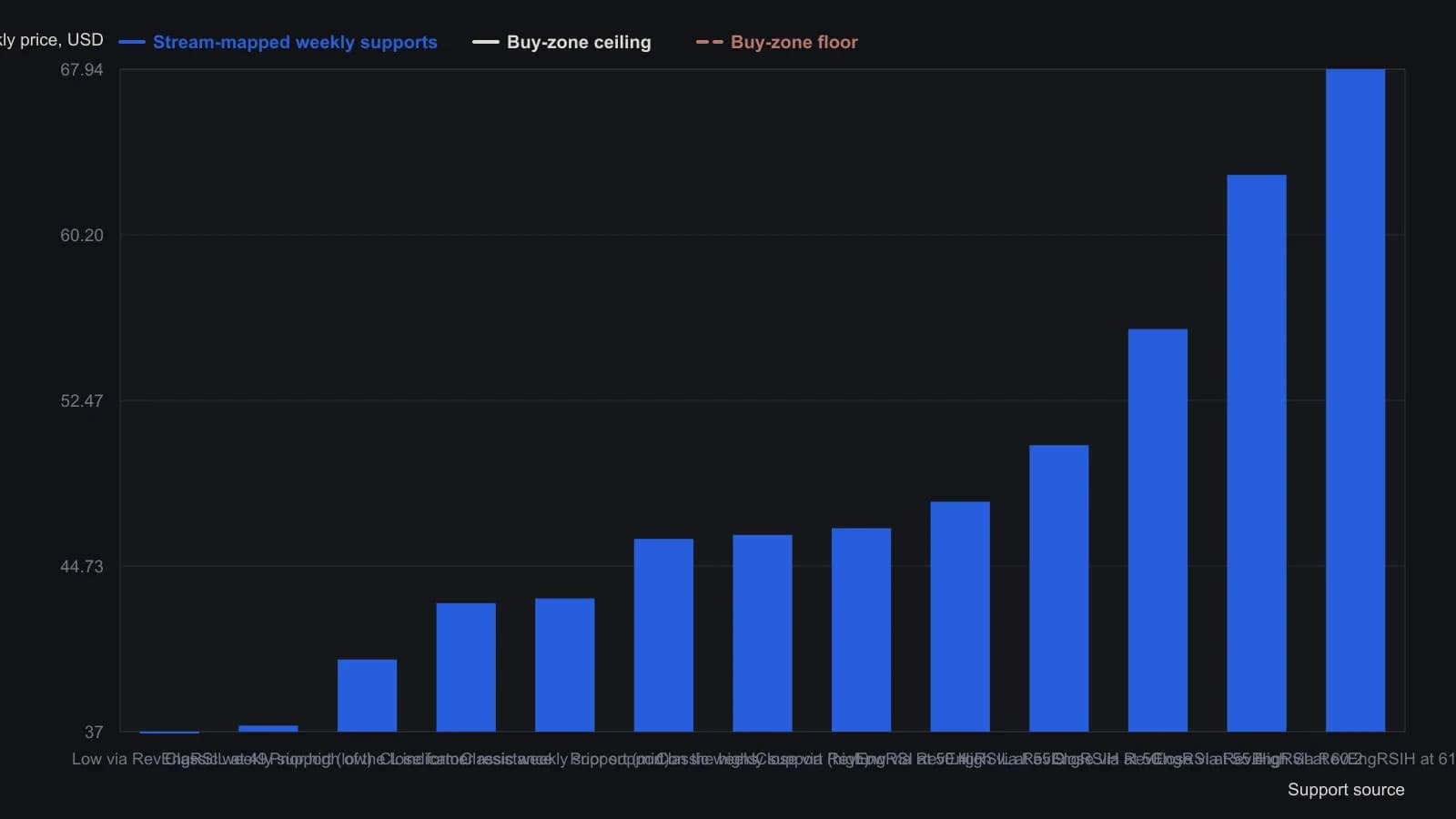
RSI lookback is 14 on weekly bars. The author limits the map to the week of 31 March–7 April 2000.
Editorial reading of the stack
Editorial interpretation by TradersWeek: the archive workflow is read here as a stacking rule. A Relative Strength Index, a Trend filter, and a Stop-loss order are combined only when the high, low, and close streams agree with the whole-price reading. Disagreement is treated as unusable information rather than as a reason to blend the streams.
All readings on this track · 33 readings
- 1988Opening-range brackets, a two-bar trend filter, and bounded stops
- 1990Bezier-curve price trend filter
- 1992Constructing a damping-index trend filter
- 1992Building a random walk index trend filter
- 1992Phase diagrams for moving-average trend filters
- 1993Volume-weighted change smoothing and trend ranking
- 1993Concurrent highest-low filter with a largest-low-fall trigger
- 1994Unit-invariant trend filters and the c-test
- 1995Constructing cup and cap entries with a three-bar net line
- 1997Why a daily timing evaluation depends on interval, lookbacks, and the fitting objective
- 2001A volume budget clock for trend-segment construction
- 2001Keep three jobs separate when you test a composite score
- 2002Evaluating the weekly four-percent close filter as a market-state procedure
- 2003Constructing a confirmed zigzag trend filter
- 2004Decompose high, low, and close into separate forecast streams
- 2005Three-state moving-average breakout bar coloring
- 2005Constructing a volume and move-adjusted trend filter
- 2005A fifty-day average breakout as a trend permission filter
- 2005Current-bar inclusion can mute a stochastic channel break
- 2006A stochastic oscillator gated by a long-term exponential average
- 2010A construction test for a modified volume-price trend filter
- 2011Constructing a Spearman rank trend filter
- 2013Constructing a repeated-median slope as a resistant trend filter
- 2014Combining a relative-strength index and trend filters for oversold setups
- 2014Price-rooted lookbacks for a relative strength index, a moving average, and a trend filter
- 2015Evaluating next-session intermarket range forecasts
- 2018Read the intermarket weight matrix first, then the predicted moving-average filter
- 2018Constructing the stiffness trend filter from moving-average holds
- 2018The averaging kernel and the lagged trend gate are separate specifications
- 2019A trend filter is not ready to compare until portfolio constraints are written down
- 2019Lookback, threshold, and position-capacity for a stiffness trend-filter
- 2020Combining a trend filter with a moving average and a stochastic oscillator
- 2020Constructing a relative-strength oscillator with a rank-agreement trend filter