2014issue C0350-55
Two-leg stochastic stress oscillator as a rebuild drill
Archive reconstructions assemble a stress series from two raw Stochastic oscillator legs, then range-normalize the gap. The workflow keeps lookbacks, zero-range guards, a second market series, and a long-side test specification open to audit.
- Each leg is a raw Stochastic oscillator: the close minus that series lookback low, divided by the same lookback high-low range.
- The stress series range-normalizes the difference between those two raw readings and scales the result by 100 when the difference range is nonzero.
- When a lookback range is zero, reconstructions skip the update, hold a neutral reading of 50, carry the prior stress value, or emit 0.
- Reconstructions attach a second market series, expose lookback and guide-level inputs, and can encode a long-side test specification.
Two raw legs, then a stress series
The archive workflow starts with a Stochastic oscillator on each of two market series. Those raw readings are subtracted, and the difference is range-normalized into a stress series.
A raw Stochastic oscillator on each leg is the close minus that series lookback low, divided by the same lookback high-low range. The stress series is the lookback range-normalization of the difference between those two raw readings, scaled by 100 when the difference range is nonzero.
Daily Hess: two raw stochastic legs and the range-normalized stress gap
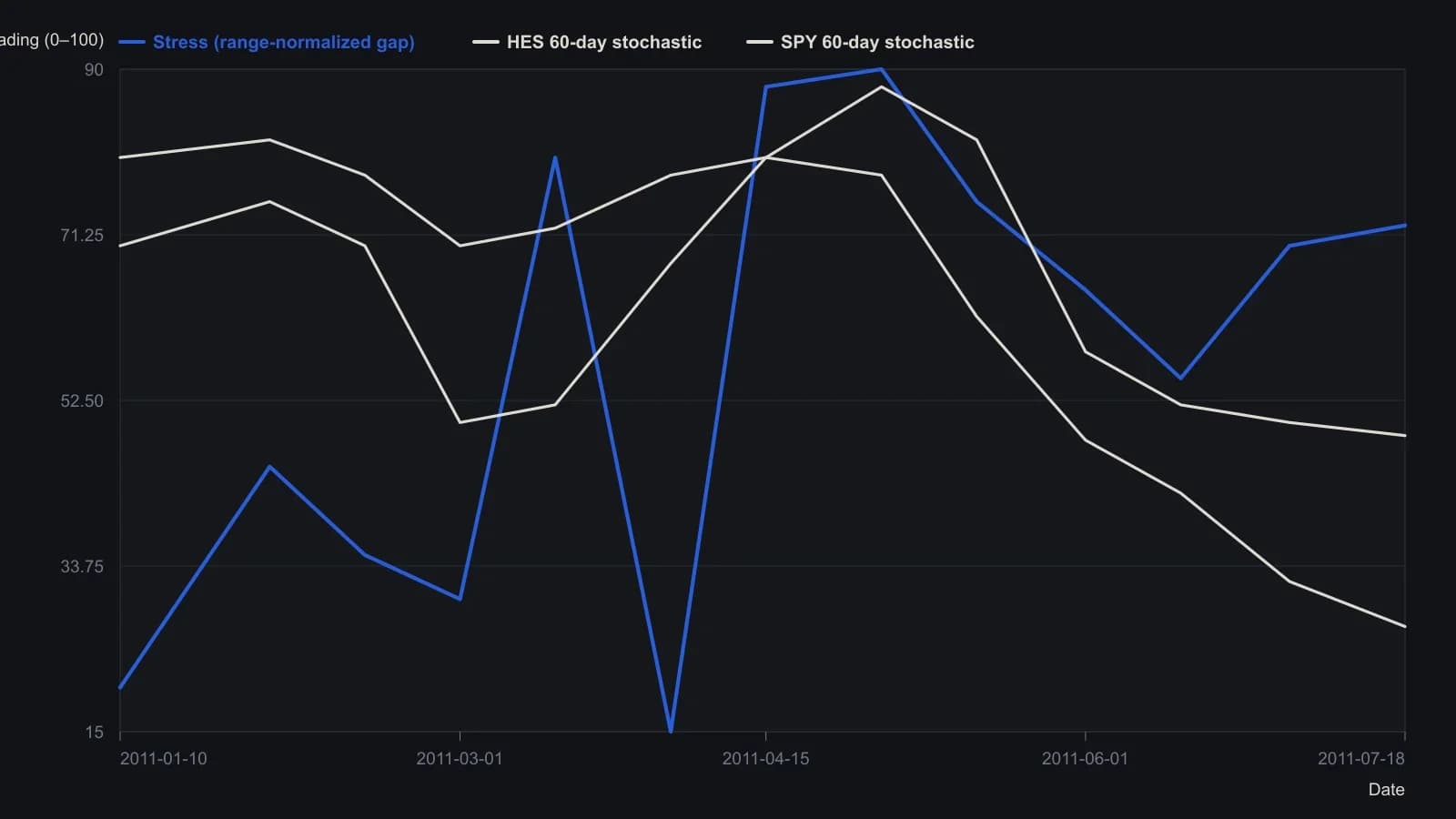
Both raw legs and the stress gap use a 60-session lookback, as in the AmiBroker reconstruction. Last readings are on-chart labels; earlier points are approximate because the raster does not carry tick-level precision.
Zero-range guards
When a lookback range is zero, reconstructions skip the update, hold a neutral reading of 50, carry the prior stress value, or emit 0. Those branches stay part of the rebuild so a finished plot is not treated as the only record of the rule.
What reconstructions expose
One reconstruction exposes period, overbought, oversold, and midline inputs defaulting to 60, 90, 10, and 50, and plots the stress series beside both scaled Stochastic oscillator readings and those guide levels. Another reconstruction lets the Stochastic oscillator lookback be chosen from 1 to 100 with a default of 10.
Reconstructions attach a second market series, typically an index-tracking fund, so the same oscillator can be charted against both legs and scripted as separate equity-side and hedge-side studies. A wizard-style rebuild writes the stress series as a Stochastic oscillator percent-K of the difference between two 60-bar Stochastic oscillator percent-K readings.
A reconstructed test specification
One reconstructed long-side test specification enters when stress is below 10, exits when stress is above 50, applies a 20 percent trailing stop, and sizes the position at a fixed 5000 dollars. Editorial reading: this is a wiring checklist from the reconstructions, not a result and not a recommendation.
All readings on this track · 42 readings
- 1987Stochastic fast and slow construction as a rebuildable stack
- 1989Building the stochastic oscillator from close location
- 1990Monthly stochastics as a multi-year bond regime filter
- 1990Walk-forward screen for yen indicator rules
- 1990Slow stochastic construction for index pullback entries
- 1991Random Walk Index construction with an adaptive lookback
- 1991Building a two-stage stochastic oscillator from close location
- 1992Constructing fast and slow stochastic oscillator lines
- 1992Constructing nested stochastic lookbacks
- 1994Construct the four-state price-volume rank before filtering it
- 1996Crowded stochastics, false breakouts, and hidden stops
- 1997Fade and follow entries from stochastic extremes
- 1998Oversold confirmation as a staged rule-based-entry case
- 1999Constructing regular and slow stochastic oscillators
- 2001Construct a variable-interval simple moving average from stacked extremes
- 2001Threshold RSI and stochastic setups with next-bar stops
- 2001Two tests of a rate-adjusted earnings-yield gap
- 2002Constructing a two-line stochastic from a range-normalized close
- 2002Inspect mechanical stochastic daytrade rules on one bar
- 2003Constructing an adaptive stochastic RSI
- 2003Four parameters that construct a stochastic oscillator
- 2004Volume breakout as signal, pullback as entry
- 2004A first currency-market checklist with two averages and a slow stochastic
- 2005Shared-scale cycle indexes with companion oscillators
- 2005Current-bar versus prior-bar range construction for the stochastic oscillator
- 2005Two-session moving-average pullback short
- 2006Market condition as a permission layer for moving averages and oscillators
- 2008Lock the stop at support before sizing a stochastic entry
- 2010Construct a center-line volume oscillator and read it with a stochastic oscillator
- 2010Sharpened RSI turns with rainbow averages and a slow stochastic
- 2011Build a Spearman rank oscillator from ordered closes
- 2012Gold as a regime-dependent hedge in the euro-area crisis
- 2012Pairing moving averages with variable-length stochastics
- 2014Two-leg stochastic stress oscillator as a rebuild drill
- 2014Ingress dates as price bases for relative strength, stochastics, and moving averages
- 2017Constructing a dual EMA stochastic from range normalization
- 2018Constructing a two-stage stochastic RSI for comparable price-oscillator divergences
- 2018Combining a weekly stochastic, a long moving average, and two-day resistance
- 2018Weekly and daily stochastic readings with a long moving average and support
- 2018A confirming workflow for rotating from discretionary to staples
- 2019Stochastic scan thresholds, averages, and formula syntax
- 2020Constructing Slow %K as a two-stage helper