2001issue C091-4
Adaptive averages driven by cycle-phase speed
An exponential moving average is made adaptive by tying its smoothing coefficient to the measured bar-to-bar cycle-phase increment instead of to price volatility. A follower that applies half of the same coefficient stays synchronized but moves less, and the two lines change order only after a large shift in market direction.
- An exponential moving average is made adaptive by tying its smoothing coefficient to the measured bar-to-bar cycle-phase increment instead of to price volatility.
- The adaptive coefficient equals a FastLimit of 0.5 divided by the phase rate of change, then is clipped between 0.05 and 0.5.
- Half-cycle wrap forces a ratcheting hold: the average steps toward current price, then trails slowly until the next wrap.
- A half-coefficient follower stays synchronized but moves less, and the two lines change order only after a large shift in market direction.
Phase increment as the adaptive control
An exponential moving average is made adaptive by tying its smoothing coefficient to the measured bar-to-bar cycle-phase increment instead of to price volatility. The adaptive-moving-average is an exponential average whose smoothing coefficient is reset from measured cycle-phase speed instead of from a fixed length or from price volatility.
Cycle phase is the arctangent of the quadrature component divided by the in-phase component, and the phase rate of change is the difference of successive phase values. The phase-rate-of-change is the bar-to-bar increment of cycle phase, floored at 1 and used as the divisor of the FastLimit.
One cycle corresponds to 360 degrees of phase advance, so a 36-bar cycle changes about 10 degrees per bar and a 10-bar cycle changes about 36 degrees per bar. Any computed negative phase increment is reset to 1, both because phase is required to advance with time and because the arctangent wraps from +90 degrees back to -90 degrees every half cycle.
Shorter and longer moving averages on daily bars, July 1995–February 1996
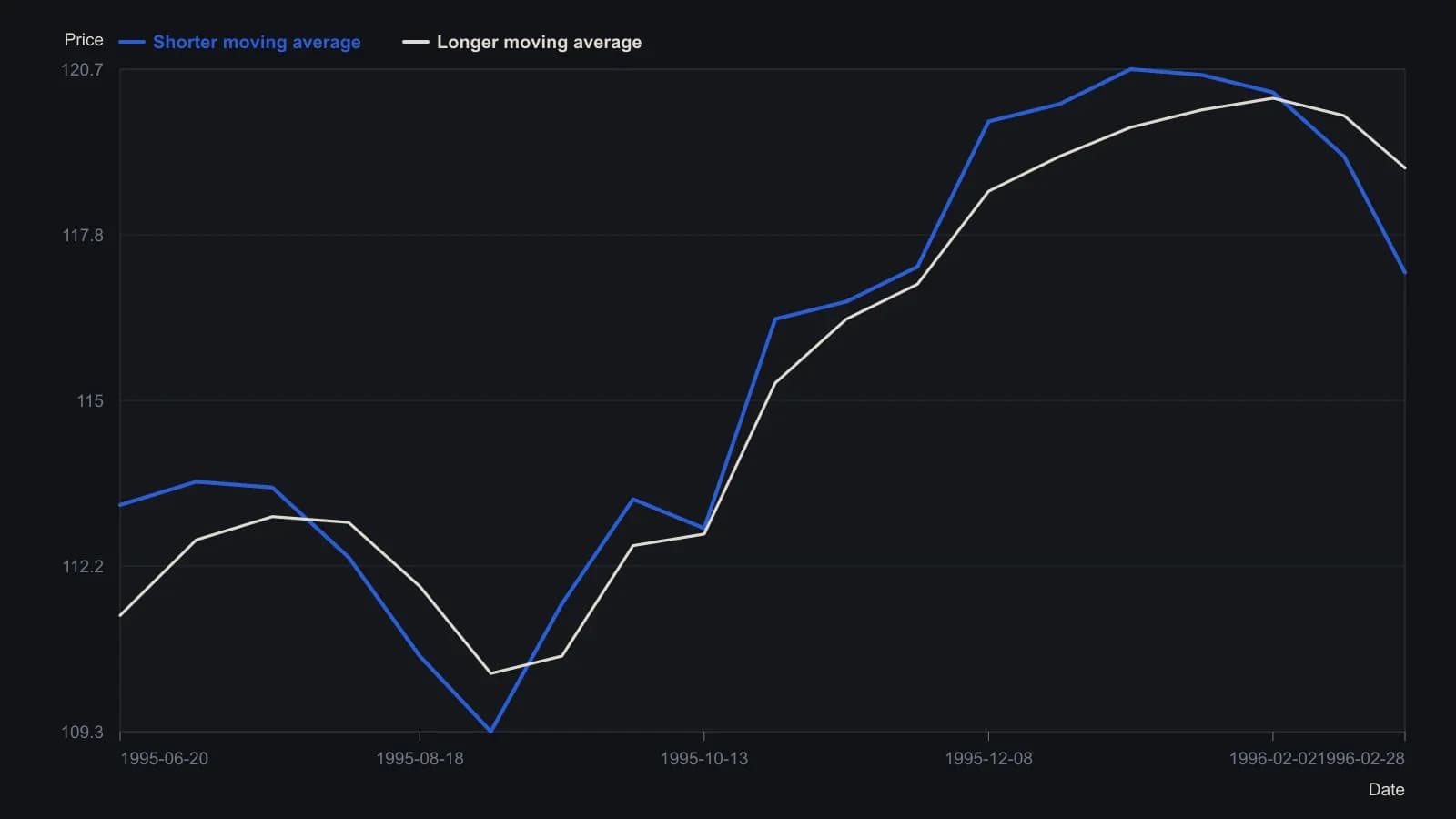
Values were read from the red and blue overlay curves against the printed month ticks and the 2-point price grid. Readings are approximate to about 0.2 price units; intra-month dates are placed from label spacing, not from a table.
FastLimit, clipping, and the ratcheting hold
The adaptive coefficient equals a FastLimit of 0.5 divided by the phase rate of change, then is clipped between 0.05 and 0.5. A coefficient of 0.5 matches a four-bar exponential average.
Half-cycle wrap forces the coefficient to 0.5, so the average steps toward current price and then holds or trails slowly until the next wrap, creating a ratcheting sample-and-hold shape. The ratcheting-hold is a fast step toward current price when the coefficient hits its upper bound, followed by a slow hold until the next half-cycle wrap.
A half-coefficient follower and an order change
A follower average that applies half of the same coefficient to the first adaptive line stays synchronized but moves less, and the two lines change order only after a large shift in market direction. The following-adaptive-average is a second exponential average of the first adaptive line that uses half of that line's coefficient so the pair stays synchronized but the follower travels less.
A moving-average-crossover is a directional hypothesis formed when the phase-adaptive average and its half-coefficient follower change order after a large shift in market direction.
Bounding the measured dominant cycle
The dominant-cycle is the cycle period inferred from successive Hilbert phase readings and from a one-bar homodyne product of the in-phase and quadrature components. Dominant-cycle period from the one-bar homodyne product of the in-phase and quadrature components is bounded between 6 and 50, limited to 1.5 times and 0.67 times its previous value, then smoothed.
When price is in a trend the measured cycle tends to lengthen, so the fast-attack update occurs less often than when a shorter cycle is present.
All readings on this track · 24 readings
- 1991Building variable-length moving averages from partitioned price changes
- 1991Variable-length moving average from change dispersion
- 1992Constructing volatility-adaptive exponential smoothing
- 1995Constructing an adaptive moving average with an efficiency ratio and filter
- 1995Two-gate breakout confirmation with adaptive averages
- 1995Building momentum-scaled adaptive moving averages
- 1995Adaptive length as a construction choice inside exponential smoothing
- 1998Testing price-channel breakouts with a lag-aware adaptive average
- 1998Constructing filters by nesting offsets and variable weights
- 1998Constructing an efficiency ratio adaptive average and entry filter
- 2001Encoding candle structure as a numeric filter
- 2001Adaptive averages driven by cycle-phase speed
- 2005Constructing an adaptive moving average from a fractal-dimension weight
- 2005Range-dimension adaptive exponential filter
- 2010Constructing simple, exponential, and adaptive averages
- 2010How a price-hugging smoother is assembled from ordinary averages
- 2013Evaluating an adaptive moving average against a same-window moving average
- 2016Three-layer confirmation: adaptive average, stochastic relative strength index, and stop-and-reverse
- 2017One-alpha reverse-path exponential smoothing
- 2018Pair two adaptive averages to filter swing turns
- 2018Two Adaptive moving averages as a confirmation pair
- 2018Constructing an adaptive filter for adoption-cycle reversals
- 2018Constructing a deviation-scaled adaptive moving average
- 2020Walk-forward and adaptive averages as two tests of the same trend