2013issue C0938-43
Give the fast band line and the slow stochastic complementary jobs
This archive procedure gives a modified band-position oscillator the job of flagging divergence and a slower rainbow stochastic the job of confirming or vetoing the 50-line. Neither line is used as a standalone forecast.
- The modified band-position oscillator is treated as a fast, often leading line, not as a standalone swing trigger.
- Divergence on one or both oscillators is the chart condition that matters more than either line used alone.
- The slower stochastic confirms continuation when it stays above 50 and later defines the exit or trailing stop when it falls below 50.
- Hidden divergence after a correction is treated as continuation, then joined to 50-line state as the fifth rule of the swing-trading indicator system.
Two jobs in one swing procedure
Swing trading, in this archive usage, is a multi-day to multi-week procedure that combines oscillator divergences, 50-line confirmation, and 50-line exits into one testable entry, hold, and abstention sequence.
The archive pairs a fast modified band-position oscillator with a slower stochastic so that divergence on one or both lines is treated as the more important chart condition. Divergence means a mismatch between successive highs or lows in price and in one or both oscillators, used as a chart condition that can be confirmed or rejected by later oscillator state.
TradersWeek editorial reading: assign the fast line the job of flagging those mismatches, assign the slow line the job of confirming or vetoing the 50-line state, and do not treat either oscillator as a standalone forecast.
How the fast band-position line is built
A band-position oscillator is constructed so that a close at the upper band maps to 100, a close at the lower band maps to 0, and a close outside either band maps beyond those bounds.
The modified oscillator keeps the same band-position formula but first replaces the raw close with a multi-average rainbow series and then applies a zero-lag exponential correction.
In the illustrated construction the modified oscillator uses an 18-day lookback, two standard deviations, and eight-day smoothing, and is treated as a fast, often leading line rather than as a standalone swing trigger.
How the slower stochastic is built
The stochastic is defined as one hundred times the close minus the period low, divided by the period high minus the period low, and is used because momentum is expected to turn before price.
Instead of a raw close, the stochastic input is an average of the rainbow series and typical price, and the resulting line is smoothed again with a simple moving average.
That construction matches the archive meaning of the stochastic oscillator: a lookback oscillator that locates a smoothed rainbow-based close inside a high-low range, then is further averaged so its 50-line crossings can be compared with a faster band oscillator.
Divergence first, then oscillator state
Hidden divergence is described as higher lows in price with lower lows in the oscillators after a correction, and is treated as a continuation condition rather than a reversal condition.
The later oscillator state is what confirms or rejects the chart condition. TradersWeek editorial reading: keep divergence first, then use the slower 50-line as confirmation or veto, rather than reading either oscillator as a complete swing signal.
Hidden divergence in the 2007 uptrend
In the 2007 uptrend example, higher price bottoms with lower oscillator bottoms were treated as hidden divergence, with confirmation when the modified oscillator recrossed above 50 while the stochastic stayed above 50.
Negative divergence at later highs, followed by the stochastic falling below 50 after remaining above 50 through the uptrend, is presented as the exit or trailing-stop condition.
Hidden divergence and the 50-line stop on X, 2007
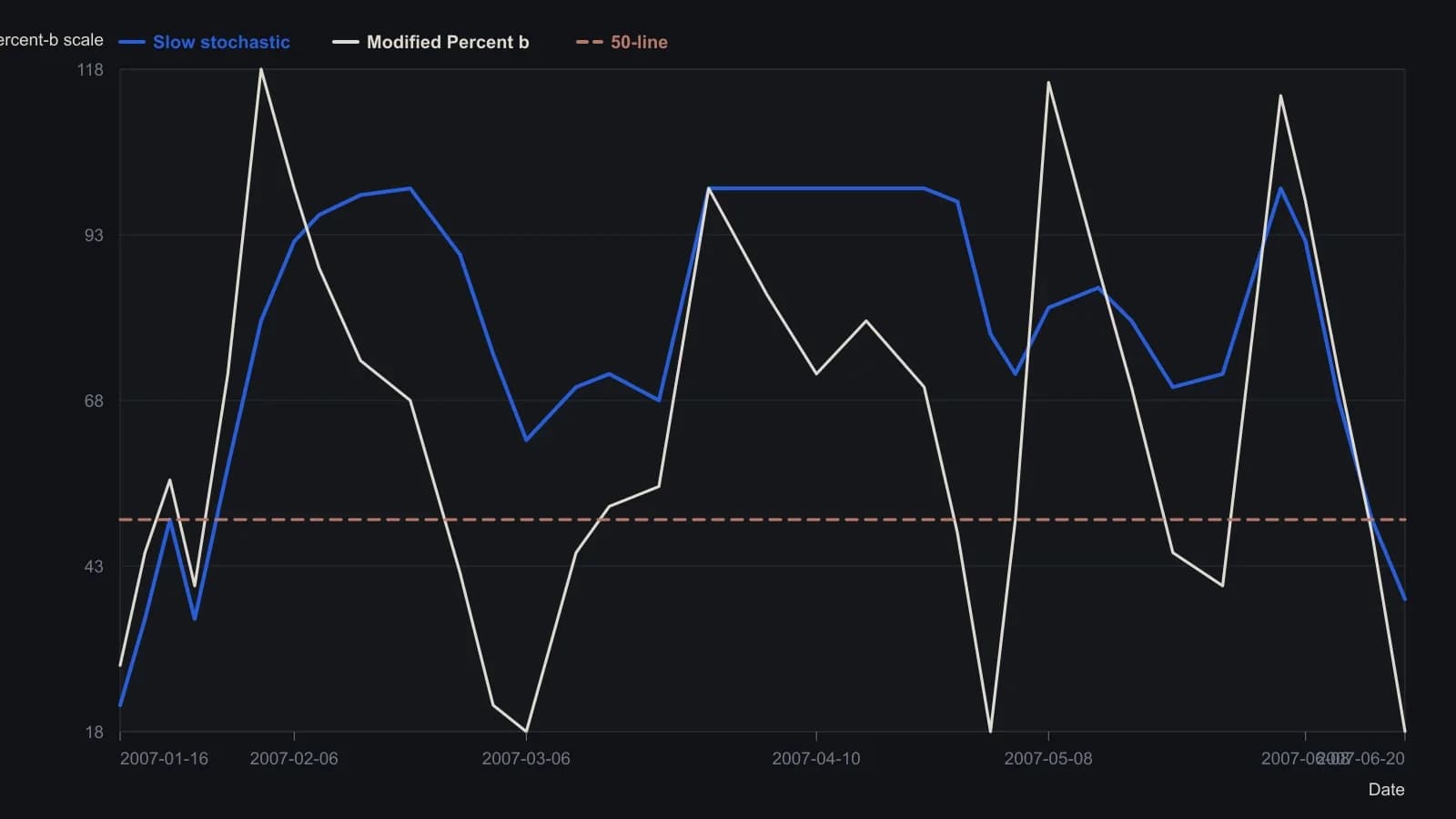
Source pane is labelled SVEZLRBPercB(X Daily, 18, 3, 30, 3): 18-day deviation period, 3-day Percent-b smooth, 30-bar stochastic, 3-bar slowing. Turning-point levels are readable only to the nearest few oscillator points on the printed raster.
The fifth rule sets movement and stop behavior
The combined oscillators are framed as the fifth rule of a swing-trading indicator system, used both to identify expected subsequent price movement and to define stop behavior.
TradersWeek editorial reading: the fifth rule is one sequence that flags divergence on the fast line, accepts or rejects the 50-line on the slow line, and lets a 50-line break after negative divergence define the stop.
All readings on this track · 35 readings
- 2001Swing trading with trailing stops and fixed loss exits
- 2003Linear regression swing alerts and trailing stops
- 2005Range-width gates for swing entries at base edges
- 2006Beyond setups: a six-factor trading process
- 2007Angle of ascent, chart scale, and style-fit
- 2010Stacking a short-horizon oscillator with a moving average and swing hold rules
- 2010A weekly contest long treated as one swing procedure
- 2011Four-color volume-price states for long-only swing actions
- 2012Classify momentum, velocity, or volatility before the swing signal
- 2013Swing rules as a portable entry and exit procedure
- 2013Constructing paired percent-b and stochastic swing oscillators
- 2013Give the fast band line and the slow stochastic complementary jobs
- 2013Smoothed percent-b divergences for numbered swing-wave rules
- 2013Portable swing rules for candle turns and a 1-2-3 wave count
- 2013A three-average swing and breakout case study
- 2013Constructing swing trades with a fifty-day average and a five-bar exponential average
- 2014From aliasing and dilation to a roofed stochastic swing
- 2014Channel width and trend-filter lookback as separate swing-trading choices
- 2016Constructing volume-confirmed multiday breakout swings
- 2017Constructing swing signals from a volume-weighted average cross
- 2017Golden-cross swing entry with a trailing-stop exit
- 2017One swing procedure: group leadership first, then a volume-price leave
- 2017Four-day green-candle breakout entry as one swing procedure
- 2017Swing pivots need a 100-period crossover and a breakout candle
- 2017Supply and demand zones as bounded swing maps
- 2018Three-bar volume-confirmed swing breakout
- 2018Tight stops first on swing breakouts with a range filter
- 2018Constructing trend and swing rules from horizon to crossover
- 2019Decade-level breakouts as one closed swing procedure
- 2019Inverse-pair swing trading with a shared buy-stop
- 2019Week-range next-day breakout on bitcoin pairs
- 2019Ranking strength before confirming a multi-timeframe breakout
- 2019Forty-five-degree multi-week swing breakout as a closed procedure
- 2020A dual pending-stop pair as one bitcoin swing construction
- 2020High-low activator, directional oscillator, and momentum swing agreement