2003issue C111-4
Commodity channel index peak divergence as an exit after twin patterns
This archive note treats one historical tape as two classroom hypotheses: a twin-bottom or twin-peak that is still waiting on a confirmation close, and a 20-period commodity channel index peak that already disagrees with price. A TradersWeek editorial reading is that each rule should be scored on its own so the exit is not smuggled in as part of the pattern call.
- A twin-bottom is identified by two sharp, V-shaped lows of similar price (within about 4%), an intervening advance of at least 10%, and at least three weeks between the lows, but it is not a completed double bottom until a confirmation close above the highest high between those lows.
- Entering that twin-bottom before the confirmation close is described as failing 64% of the time because price never reaches the confirmation level; among 134 such double bottoms, a throwback toward the confirmation price occurred 65% of the time.
- The oscillator panel used a 20-period commodity channel index and a five-period smoothed companion; the exit was divergence with the price trend, not a crossover of those two lines.
- The inverse twin-peak form uses the same identification rules; a pattern score below zero is treated as a forecast that the pattern would do worse than its median, and a confirmed twin-peak had a cited median decline of 12.4% from the confirmation point.
Two classroom hypotheses on one tape
A TradersWeek editorial reading of this archive tape is that it holds two separable tests rather than one combined pattern-and-exit call. The first test is a double top or double bottom that is still waiting on a confirmation close. The second is a 20-period commodity channel index peak that already disagrees with price. Editorial practice is to score each rule on its own so the exit is not treated as part of the pattern call.
How the twin-bottom is identified
A twin-bottom setup is identified here by two sharp, V-shaped lows of similar price (within about 4%), an intervening advance of at least 10%, and at least three weeks between the lows. That twin-bottom is not treated as a completed double bottom until price closes above the highest high printed between the two lows.
What the confirmation close changes
Entering the twin-bottom before that confirmation close is described as failing 64% of the time because price never reaches the confirmation level. Among 134 such double bottoms reviewed, a throwback toward the confirmation price occurred 65% of the time. A throwback here is a return toward the confirmation level after an upward breakout from a twin-bottom.
Southwest Airlines twin bottom versus the 13.90 confirmation close
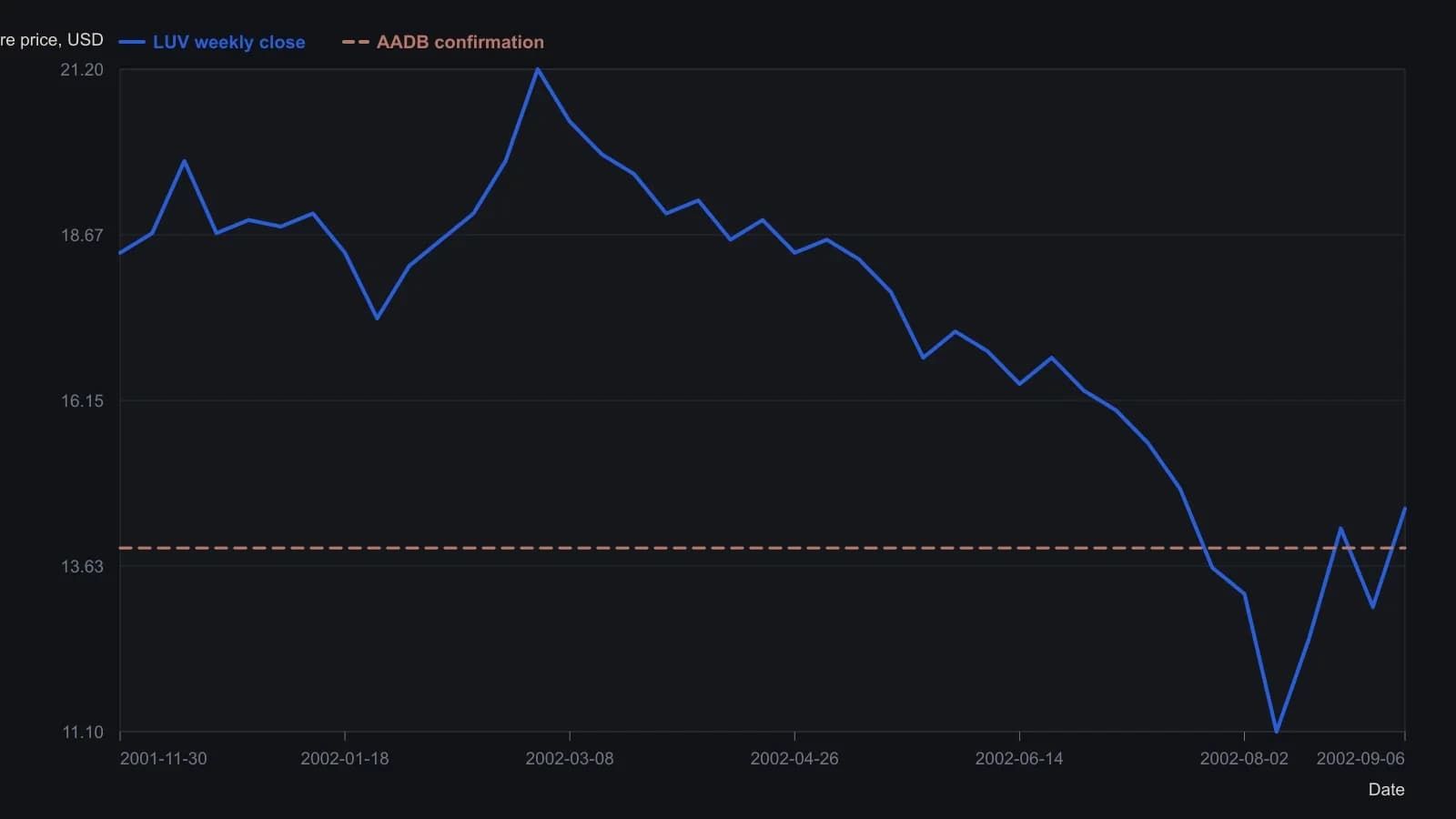
Closes are weekly visual readings from the magazine daily-bar figure, quoted to one decimal because the printed scale is in whole dollars. The confirmation level is the article’s 13.90 figure, not a fitted line. Intraday wicks and volume are not recovered.
An oscillator exit that is not a crossover
The oscillator panel used a 20-period commodity channel index and a five-period smoothed companion. The exit rule was divergence with the price trend, not a crossover of those two lines. Divergence is specified as price making higher highs while the line joining commodity channel index peaks slopes downward, and that split is read as a sell signal of possible trend change. The commodity channel index is used here to forecast a change in trend rather than to time the entry.
The inverse twin-peak and a pattern score
The inverse twin-peak form uses the same identification rules as the twin-bottom. A pattern score below zero is treated as a forecast that the pattern would do worse than its median outcome. If the twin-peak form confirmed with a close below the low between the peaks, the cited median decline from that confirmation point was 12.4%. A separate double-top review found that 65% of the time price never fell to the downward confirmation level before rising above the two peaks.
A second case with wider oscillator peaks
A second case sold on the same oscillator making a lower high against a new price high. The archive notes that the sharper divergence cues appeared when those oscillator peaks were about a month apart.
All readings on this track · 39 readings
- 1982Three gates on a 1982 pork-belly short
- 1982Scale-free Commodity Channel Index construction
- 1986Constructing a commodity channel index and a regression price channel
- 1987Constructing scaled OHLC matrices for study overlays
- 1987Constructing the commodity channel, average directional, and relative strength indexes on a shared cycle scale
- 1992Eleven-bar commodity channel index from typical price and mean deviation
- 1992Evaluating Commodity Channel Index breakout versus range rules
- 1992Evaluating breakout and CCI rules as complete mechanical procedures
- 1993Constructing stochastic, RSI and CCI inputs for forecasts
- 1993Nested centered channels with a commodity channel index confirmation gate
- 1993Listed-option timing as three separable clocks
- 1994Constructing an eleven-period commodity channel index
- 1994Confirming Elliott wave turns with channels and the commodity channel index
- 1995Commodity Channel Index band rules lag zero-line timing
- 1995Building the commodity channel index from typical price
- 1995Staged reversal rules with commodity channel index and average channels
- 1995Commodity channel index construction from typical price to a smoothed zero line
- 2001Reader tests for unfinished lookback oscillators
- 2002Constructing the commodity channel index from typical price
- 2003Breadth-filtered commodity channel index entry and exit rules
- 2003Constructing the Commodity Channel Index from typical price and scaled deviation
- 2003A shallow, poorly participated advance is an unconfirmed trend
- 2003CCI and RSI parameter defaults as scaling conventions
- 2003A cost and capital audit of a Commodity Channel Index trade engine
- 2003Commodity channel index peak divergence as an exit after twin patterns
- 2004Constructing the Commodity Channel Index from typical price
- 2004Constructing the Commodity Channel Index from typical price and mean deviation
- 2006Building custom indicators from the Commodity Channel Index, a least squares moving average and a rule-based entry
- 2012Confirming breakouts and retracements with CCI, ADX, and averages
- 2012Stacking oscillator lookbacks into a heatmap mosaic
- 2013Constructing a consensus and volatility-normalized value oscillator
- 2013Walk-forward system evaluation with a commodity channel index and chandelier exits
- 2014Dual detrended oscillators and dual Bollinger Band channels
- 2014RSI, CCI, and moving-average trend-filter construction
- 2014Dual RSI, a moving average, and CCI as a confirmation stack
- 2017Constructing dual-average cross and channel-index filters
- 2018Treat CAM as a classification layer before confirmation becomes an entry
- 2018Four-state slope labels gated by a moving average and a commodity channel index
- 2018Deviation-Scaled Moving Average construction from a two-bar difference