2017issue C0950-56
One-alpha reverse-path exponential smoothing
This archive article reconstructs a one-parameter smoother of closes that grows reverse-path-stages from a seed-smoother and subtracts an explicit correction to form a zero-line-oscillator. Editorial reading: change only alpha after the stack is built, and the same object flips between a slower trend-context series and a faster cycle-timing series.
- A seed-smoother on closing prices uses a complementary-weight equal to one minus alpha, then eight reverse-path-stages mix each current reverse value with its prior bar at successive powers of two through 128.
- The published zero-line-oscillator equals the forward smoother minus alpha times the eighth reverse-path-stage.
- A dual-horizon-readout runs the same construction at 0.05 and 0.3 and reads signs and zero crossings; recodes usually expose one alpha, often defaulted to 0.1, in a separate oscillator pane.
- The causal-forward-backward-pair uses only current and lagged observations, so the forward pass and reverse-path correction can update on sequential live bars.
Start with a seed-smoother
Editorial framing: treat a single smoothing coefficient as a laboratory switch. Build a conventional seed-smoother on ordered closes first, subtract an explicit reverse-path correction second, and change that one coefficient only after the object is complete.
The construction begins with a one-parameter exponential smoother of closing prices whose complementary-weight equals one minus the chosen alpha. That forward pass is the seed-smoother: the first pass on closes from which the reverse-path stack is grown.
Stack reverse-path-stages
After that forward pass, eight reverse-path-stages are stacked. Each reverse-path-stage mixes the current reverse value with its prior bar using complementary weights raised to successive powers of two through 128.
The published oscillator equals the forward smoother minus alpha times the eighth reverse-path-stage. Written that way, the result is a zero-line-oscillator rather than a price-tracking average.
Read two alphas from one object
An example rule set instantiates the same construction twice, using 0.05 as a trend alpha and 0.3 as a cycle alpha, and defines entries and exits from the signs and zero crossings of those two series. That pairing is the dual-horizon-readout described in the archive workflow.
One demonstration applies a 10-bar simple moving average to the trend reverse-path series and plots both the trend and cycle series against a zero reference.
Reverse EMA oscillator on daily SPY
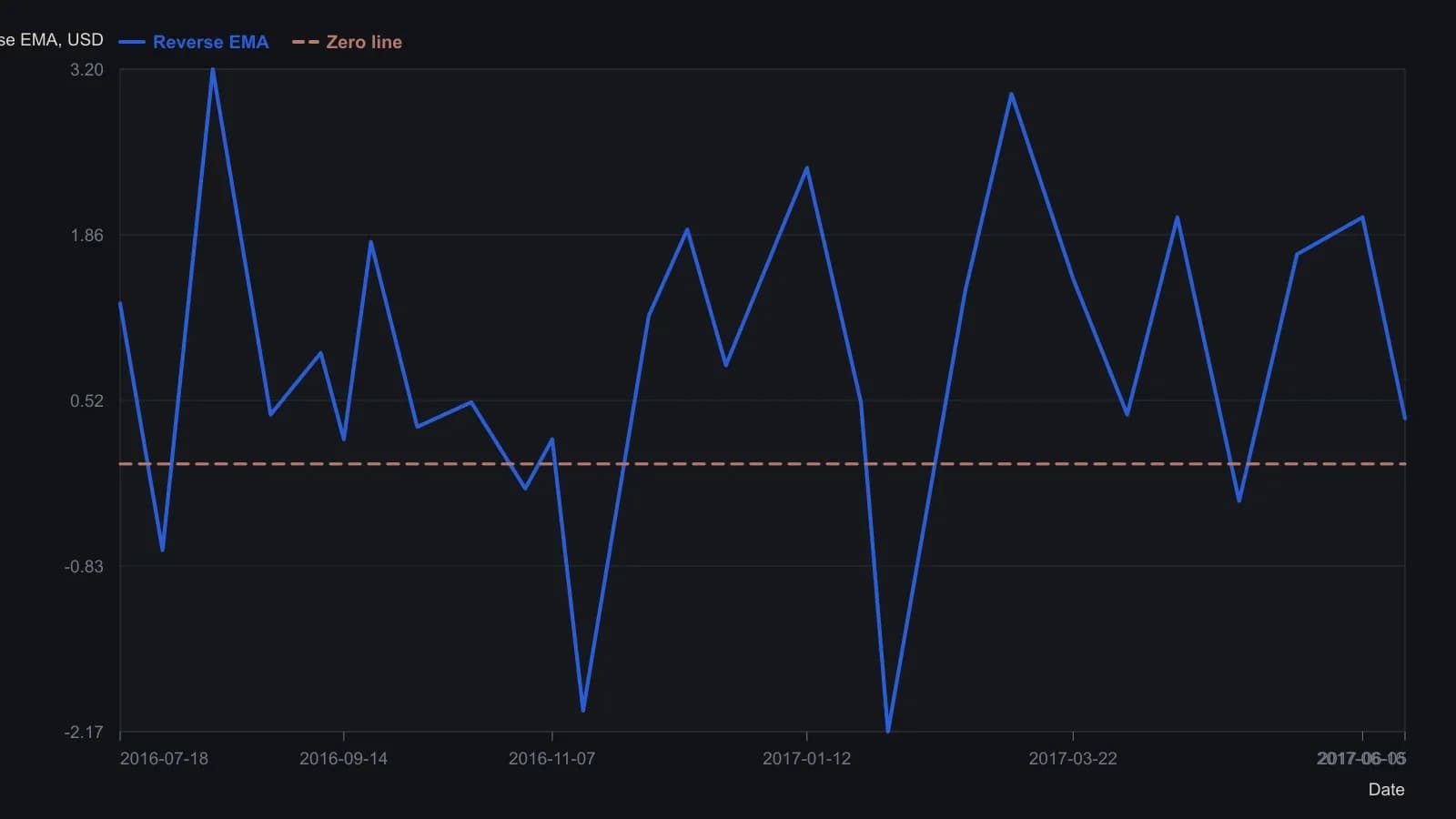
September 2017 Traders’ Tips recodes default the single coefficient to alpha 0.1. Only the two on-chart prints are exact; remaining turning points are approximate raster readings to one decimal place.
Recodes keep a single control
One recode seeds the reverse-path stack from an adaptive moving average of closes that uses the same alpha, then subtracts alpha times the last reverse stage from that seed-smoother. Several independent recodes expose a single alpha control, commonly defaulted to 0.1, and render the result as a separate oscillator pane rather than a price overlay.
One recode withholds output until a warmup of three times ((2 / alpha) - 1) bars has elapsed, then applies seven reverse-path updates that double the complementary-weight exponent on each pass.
Causal comparison on the same closes
The pair is specified as causal, using only current and lagged observations, so the forward smoother and reverse-path correction form a causal-forward-backward-pair that can be evaluated on sequential live bars.
A companion chart places the reverse-path series beside a roofing-filter series computed on the same closes so the two constructions can be compared visually.
All readings on this track · 24 readings
- 1991Building variable-length moving averages from partitioned price changes
- 1991Variable-length moving average from change dispersion
- 1992Constructing volatility-adaptive exponential smoothing
- 1995Constructing an adaptive moving average with an efficiency ratio and filter
- 1995Two-gate breakout confirmation with adaptive averages
- 1995Building momentum-scaled adaptive moving averages
- 1995Adaptive length as a construction choice inside exponential smoothing
- 1998Testing price-channel breakouts with a lag-aware adaptive average
- 1998Constructing filters by nesting offsets and variable weights
- 1998Constructing an efficiency ratio adaptive average and entry filter
- 2001Encoding candle structure as a numeric filter
- 2001Adaptive averages driven by cycle-phase speed
- 2005Constructing an adaptive moving average from a fractal-dimension weight
- 2005Range-dimension adaptive exponential filter
- 2010Constructing simple, exponential, and adaptive averages
- 2010How a price-hugging smoother is assembled from ordinary averages
- 2013Evaluating an adaptive moving average against a same-window moving average
- 2016Three-layer confirmation: adaptive average, stochastic relative strength index, and stop-and-reverse
- 2017One-alpha reverse-path exponential smoothing
- 2018Pair two adaptive averages to filter swing turns
- 2018Two Adaptive moving averages as a confirmation pair
- 2018Constructing an adaptive filter for adoption-cycle reversals
- 2018Constructing a deviation-scaled adaptive moving average
- 2020Walk-forward and adaptive averages as two tests of the same trend