2002issue C071-5
Constructing zero-lag finite-impulse-response and exponential smoothers
A causal smoother cannot output future observations, so delay is inherent. This article treats zero-lag compensation as a construction drill: start from a smoother's known delay, cancel that delay with a matched momentum term, then compare amplitude and group delay for an exponential update and a short finite window so the extra in-band gain is visible before anyone treats the faster line as a signal.
- A causal smoother cannot output future observations, so delay is inherent. Under a short-run assumption of no new disturbances that delay can be driven toward zero, but the same construction does not extend to long lookbacks where the assumption fails.
- In a steady trend, the horizontal delay of an N-bar average matches the vertical span of an N-bar momentum, so adding that momentum to the delayed average recovers the original price path.
- The same delay-compensation step can be applied to finite-impulse-response averages and to exponential infinite-impulse-response averages.
- Feeding a four-bar momentum into an alpha-0.2 exponential update drives zero-frequency lag to zero while raising in-band gain and therefore overshoot at turning points.
Delay is part of a causal smoother
A causal smoother cannot output future observations, so delay is inherent. Under a short-run assumption of no new disturbances that delay can be driven toward zero, but the same construction does not extend to long lookbacks where the assumption fails.
As a TradersWeek editorial reading, treat that limit as the start of a construction drill rather than as a general claim that lag can be removed. The working question is how to cancel a known delay, then how amplitude and group delay change once that term is added.
Match momentum to the known delay
In a steady trend, the horizontal delay of an N-bar average matches the vertical span of an N-bar momentum, so adding that momentum to the delayed average recovers the original price path.
The same delay-compensation step can be applied to finite-impulse-response averages and to exponential infinite-impulse-response averages. A finite-impulse-response filter is a finite-window weighted average of ordered price samples whose response to a single impulse falls to zero after a fixed number of bars. Exponential smoothing is a recursive average that mixes a fraction of the current observation with one minus that fraction of the previous output.
What a sampled series can show
Sampled market series can be analyzed only up to half the sampling frequency. With daily bars that Nyquist frequency is a two-bar cycle, and normalized frequency equals 2 divided by cycle period. Group delay is the frequency-dependent lag of a filter, and it is largest at zero frequency for an uncompensated exponential smoother.
An exponential update with a four-bar correction
An exponential smoother is formed as alpha times current price plus (1-alpha) times the previous output. Those two coefficients must sum to 1 or the output will not converge after a step change.
Exponential-smoother lag equals 1/alpha minus 1, so an alpha of 0.2 implies a four-bar lag and the uncompensated update is 0.2 times price plus 0.8 times the prior output.
Feeding a four-bar momentum into that alpha-0.2 update, written as 0.2 times (twice current price minus price four bars ago) plus 0.8 times the prior output, drives zero-frequency lag to zero while raising in-band gain and therefore overshoot at turning points.
A six-term finite-window lowpass
A lowpass filter attenuates higher-frequency cycle components while passing slower, trend-like movement. A six-term finite-impulse-response lowpass with weights 1, 2, 3, 3, 2, 1 divided by 12 nulls two-, three-, and four-bar cycles, has linear phase, and therefore has the same lag at every frequency, equal to 2.5 bars for a six-element window.
A linear-phase filter is a finite-window smoother whose lag is the same at every frequency and equals (N-1)/2 for an N-element window. Under the same steady-state assumption, a one-bar momentum scaled by 2.5 can be added to those six weights to obtain an equivalent zero-lag finite-impulse-response coefficient set without lengthening the window by another 2.5 bars.
Compare gain before treating the line as faster
As a TradersWeek editorial reading, place the compensated exponential update next to the compensated six-term window and compare amplitude and group delay first. The extra in-band gain is visible in that comparison, and it is the reason the faster line overshoots at turning points. That response should be inspected before anyone treats the compensated output as a signal.
Zero-lag IIR and minimum-lag FIR smoothers, Sep 1995–Feb 1996
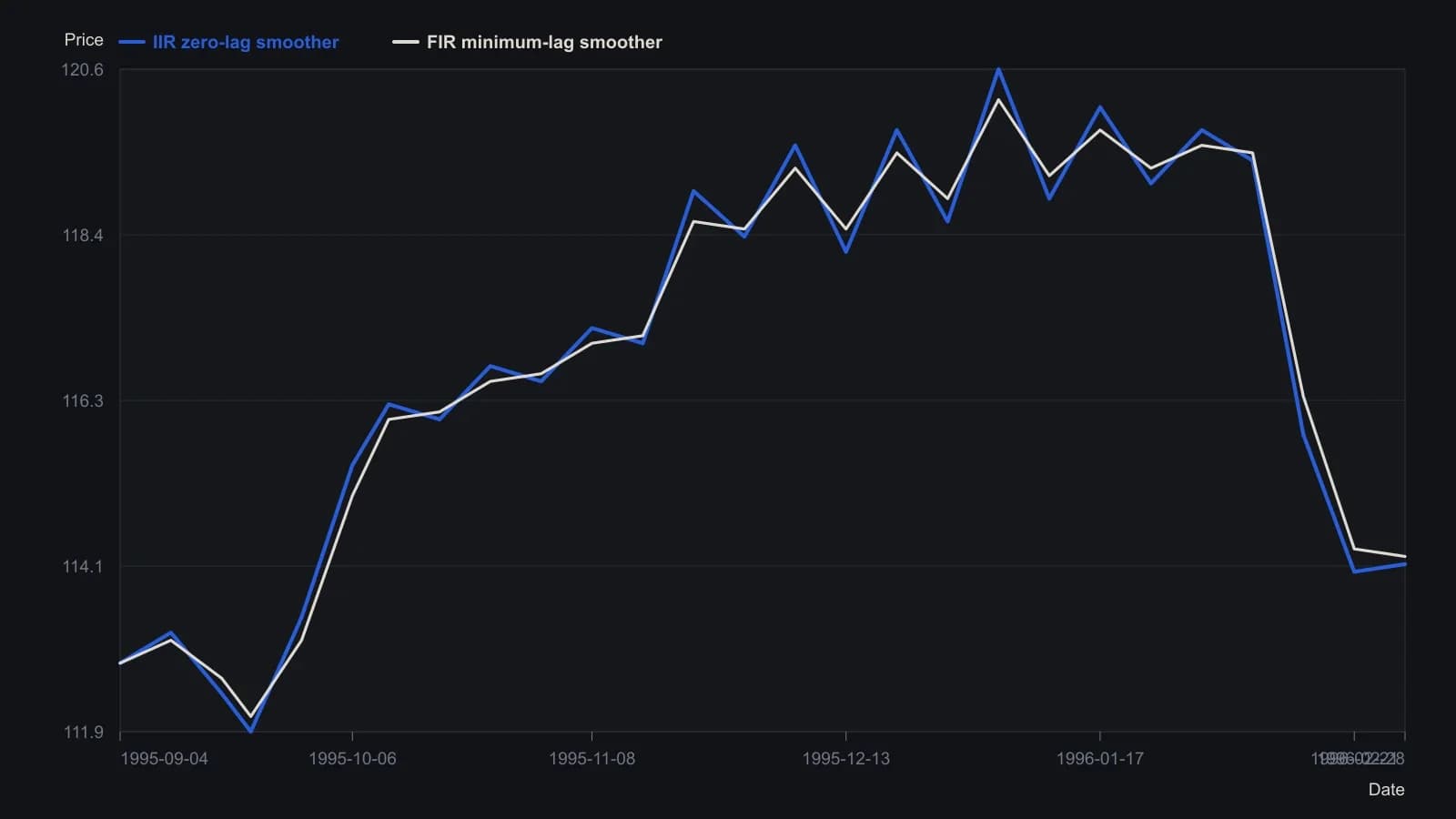
The extracted raster has no tick numerals; those come from the figure’s printed axes. The two traces overlap on the page, so any separation is near the limit of the image and is qualitative.
All readings on this track · 9 readings
- 1991Constructing a coincident moving average as a lowpass filter
- 1994Centering a dual lowpass bandpass on a counted cycle
- 1997Zero-lag cycle filters can fail on a price series
- 2002Constructing zero-lag finite-impulse-response and exponential smoothers
- 2010Constructing cycle versus trend mode filters
- 2010Constructing a trend filter as a low-frequency model
- 2015Whitened lowpass filters for trend and countertrend
- 2016Building Nyquist-safe lowpass trend filters
- 2018Constructing a Finite Impulse Response Filter compared with Exponential smoothing