2014issue C0163-64
Lookback range, a two-lag smoother, and next-bar fills
A stochastic oscillator places the latest filtered observation between lookback extrema on a filtered series, then a two-lag spectrum-style smoother turns that range into a forecast-oriented reading. When the construction uses bar closes, a rule-based entry waits for the next-bar open fill so the signal bar is not treated as a trade.
- The stochastic range comes from the highest and lowest values on a filtered series over a stated lookback length, not from raw unfiltered highs and lows.
- A maximum entropy spectrum style recursion mixes an average of the current and prior stochastic values with the two previous smoothed outputs to form a forecast-oriented reading.
- A close-based rule-based entry cannot logically fill on the signal bar. A conservative convention waits for the next-bar open fill.
- A sample chart can keep the predictive signal distinct from the one-bar delayed trade so the oscillator construction is not confused with the fill.
How lookback sets the range
A stochastic oscillator reading can be built by placing the latest filtered observation between the highest and lowest filtered observations found over a stated lookback.
Those window extrema are identified by comparing every filtered observation in the lookback rather than by using raw unfiltered highs and lows. The filtered series is the intermediate ordered series that defines the range.
Lookback length is the number of filtered observations scanned to find the highest and lowest values used in the scaling. The result is a bounded rescaling of the latest filtered observation inside that window.
How a two-lag smoother forms the reading
The oscillator can then be passed through a maximum entropy spectrum style recursion. That recursion applies coefficients to an average of the current and prior stochastic values and to the two previous smoothed outputs.
The maximum entropy spectrum step is a recursive smoother. It mixes recent stochastic values with two lagged outputs to produce a forecast-oriented reading from an ordered series.
Editorial note: keep this smoother separate from the lookback decision. The lookback only sets the range. The recursion only reshapes that already scaled series.
Why a close-based rule waits for the next open
When the construction uses bar closes, a rule-based entry cannot logically be filled on the same bar that produced the signal. A rule-based entry is a preprogrammed buy or sell condition that replaces discretionary rereading of the same bar and is tested together with its fill assumption.
A conservative simulation convention is to enter or exit on the open of the bar after the signal appears. That next-bar open fill keeps the construction from being assumed to trade the bar that created it.
A sample chart can keep a predictive signal and a one-bar delayed trade distinct so the oscillator construction is not confused with the fill.
Dollar General MESA stochastic with 0.20 / 0.80 signal bands
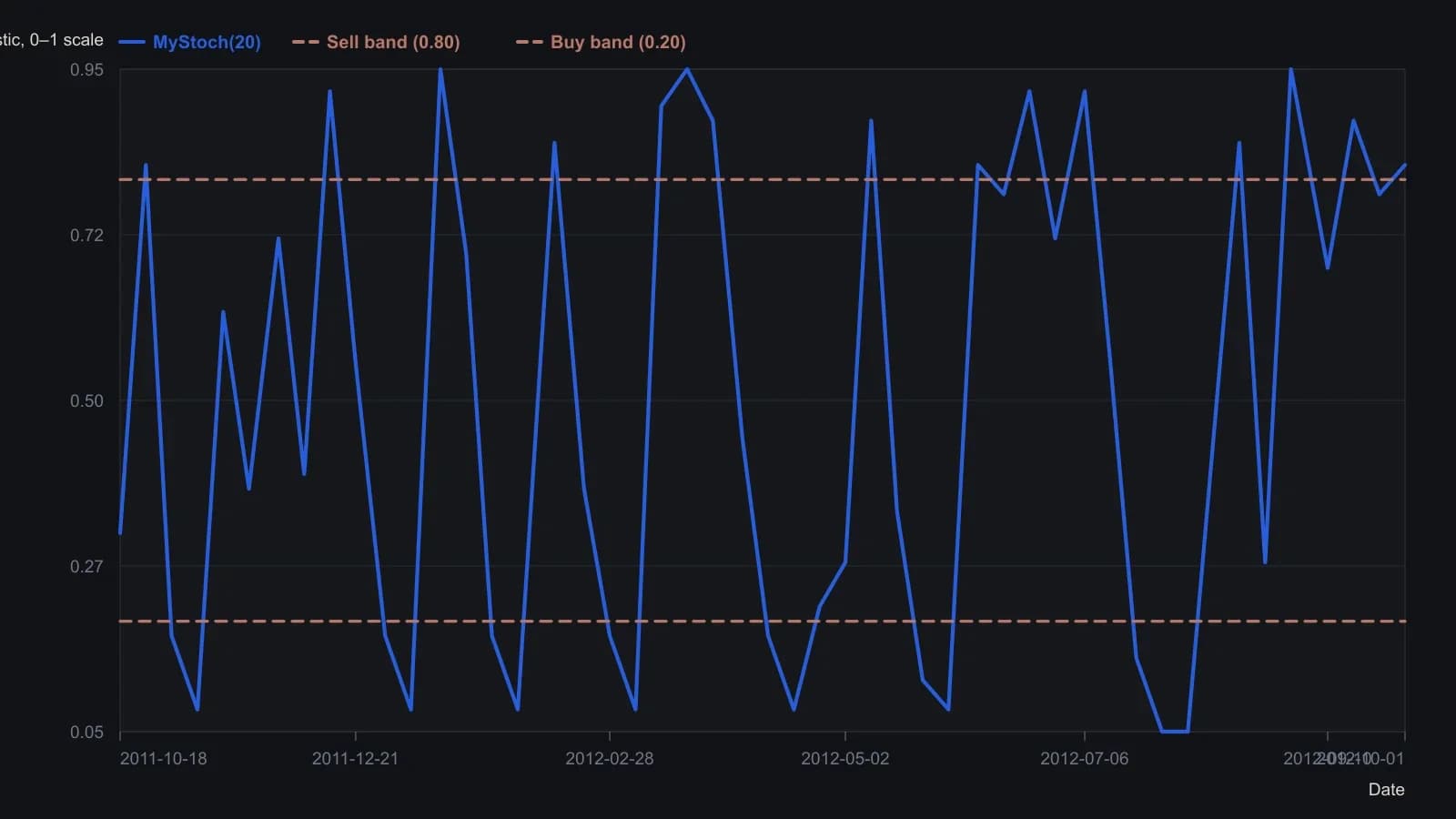
Excel sample uses SuperSmoothBars=10 and StochLen=20; trades fill on the next-bar open because the oscillator is close-based. Digitized from the MyStoch pane of Figure 13; y-values are approximate to about 0.05.
Systems as preprogrammed rules
Trading systems are framed as preprogrammed rules that issue automated buy and sell signals in place of subjective interpretation. They may rest on indicator sets or custom rules.
A public catalog of systems can describe indicators, markets, required applications, and support features without presenting verified track records or editorial rankings.
All readings on this track · 28 readings
- 1984Constructing maximum-entropy spectra for dominant-cycle forecasts
- 1984How to construct a maximum-entropy cycle model
- 1984Constructing a maximum-entropy forecast from a chosen lookback
- 1985Constructing period-locked half-cycle and full-cycle averages
- 1986Why Fourier windows limit dominant-cycle resolution
- 1987Assembling short-lookback maximum-entropy cycle forecasts
- 1988Why a fitted dominant cycle is not a forecast
- 1989Evaluating commodity cycle personalities with spectral histograms
- 1989Evaluating next-session cycle forecasts with stops
- 1989Constructing cycle-aged volatility trailing stops
- 1990A channel signal-to-noise gate for dominant-cycle forecasts
- 1990Year-over-year dominant cycle personality audit
- 1991Cyclic entry from a locked dominant-cycle phase
- 1992Stationarity states on synchronized futures spectral contours
- 1997Hidden horizon assumptions in dominant-cycle readings
- 1997When market cycles are absent more than present
- 1997A spectral estimator that retunes indicators to the measured cycle
- 2000Constructing a Hilbert dominant cycle and a maximum-entropy refinement
- 2000Switch trend and cycle indicators after a half-cycle dwell test
- 2000Constructing a dominant-cycle squelch trend filter
- 2000Phasor displays for dominant-cycle construction
- 2002Low-lag trendline from elliptic and dominant-cycle notches
- 2004Spectral peaks are mode diagnostics, not forecasts
- 2004Compressive last-stage oscillator construction
- 2013Constructing trend failure curves from qualified-trend transitions
- 2014Lookback range, a two-lag smoother, and next-bar fills
- 2014Constructing a MESA stochastic with roofing and SuperSmoother filters
- 2016Constructing spectral heatmaps for dominant market cycles