2007issue C031-5
Constructing a fractal-dimension regime filter
Turn the 1-to-2 fractal dimension reading into an explicit on or off gate in front of an existing entry engine, then rebuild that same gate with Average Directional Index and Vertical Horizontal Filter rules so the constructions can be compared.
- The fractal dimension index is a 1-to-2 score of a price series: below 1.5 is treated as persistent or trending, and above 1.5 as antipersistent or range-bound.
- Place that cut in front of an existing entry engine as an on or off gate, and invert it when the host is written for a range.
- The archive applied the filter to three simple, unoptimized hosts on the 50 most liquid US stocks from January 2000 through December 2005, to isolate the filter rather than establish the engines.
- Rebuild the same permission block with a 28-day Average Directional Index rule and a rising 20-day Vertical Horizontal Filter rule, then compare the constructions.
What this lesson builds
This editorial lesson treats the Fractal indicator as a regime gate, not as a standalone entry. The task is to turn its 1-to-2 fractal dimension reading into an explicit on or off switch in front of an engine you already have, then rebuild that same switch with Average Directional Index and Vertical Horizontal Filter rules.
The archive applied the fractal dimension index as a trade-selection filter on three simple systems. Those tests were framed as isolating the filter rather than establishing the base engines. TradersWeek editorial stance: compare the filter constructions. Do not treat the host engines as a completed trading system.
The 1-to-2 score and the 1.5 cut
The fractal dimension index is specified as a 1-to-2 score of a price series. Readings below 1.5 are treated as persistent or trending. Readings above 1.5 are treated as antipersistent or range-bound.
Editorially, that cut is the entire gate. When the reading is below 1.5, a trend-following host may be allowed to fire. When the reading is above 1.5, that same host stays off. The opposite assignment is used when the host is a range engine.
The same cut read through Hurst
A reading below 1.5 is equated with a Hurst exponent greater than 0.5. Hurst is obtained from rescaled-range analysis by reading the slope of log range-over-deviation versus log sample length, applied to log price returns.
The archive uses that equivalence to justify treating the lower half of the 1-to-2 scale as persistence. TradersWeek editorial note: the Hurst step is a classification aid for the gate. It is not a second entry signal.
Isolate the filter, leave the hosts plain
The index is applied as a trade-selection filter on three simple systems. The sample is described as the 50 most liquid US stocks from January 2000 through December 2005, with system parameters and exits left unoptimized.
That design is the point of the historical workflow. The engines stay simple so a change in the gate can be seen. They are not presented here as engines to optimize.
Host one: dual moving averages
The dual moving-average engine goes long when the close is above both the 20-day and 80-day averages of highs and those averages sit above their values 20 and 80 days earlier. Shorts and exits use the matching averages of lows and highs.
Editorially, the Fractal indicator sits in front of those rules as an on or off gate. A trending classification, a reading below 1.5, is the condition that allows this host to take a trade. The averages still decide direction and exit.
Host two: a 20-day channel
The channel engine enters long when the session high exceeds the prior 20-day high, enters short when the session low breaks the prior 20-day low, and exits only on an opposite entry.
The same trending classification is the editorial on-switch for this breakout host. The channel still supplies the entry and the only exit.
Host three: invert the gate for a range engine
The oscillator engine is short-only. A 14-day RSI of closes enters above 65 and exits below 35, and the fractal filter is inverted so trades are taken only when the series is classified as a range.
That inversion is the construction lesson. The 1.5 cut does not change. Only the on-side of the gate changes, because this host is written for a range, not a trend.
Rebuild the gate with Average Directional Index
The Average Directional Index comparison rule requires a 28-day reading above 20, with plus directional movement above minus directional movement for longs and the reverse for shorts.
Editorially, keep the three hosts unchanged and replace only the fractal on or off test with this rule. The 28-day reading above 20 is the regime permission. The plus and minus directional movement comparison is the direction check that the fractal 1-to-2 score does not supply on its own.
Rebuild the gate with Vertical Horizontal Filter
The Vertical Horizontal Filter comparison rule treats a rising 20-day reading as the trend condition.
Editorially, this gate uses a single trend condition: whether the 20-day reading is rising. Direction and exit still come from the host. Use the same three hosts so the only change is the filter rule.
Compare the three constructions
TradersWeek editorial assignment: write the fractal 1.5 cut, the Average Directional Index rule, and the Vertical Horizontal Filter rule as three interchangeable on or off blocks in front of the same host. Do not retune the 20-day, 80-day, 14-day, or 28-day host settings while you do that.
The historical workflow left parameters and exits unoptimized and used a fixed stock sample so the filter could be isolated. That is the standard to keep when you compare constructions.
IBM fractal dimension versus the 1.5 persistence cut
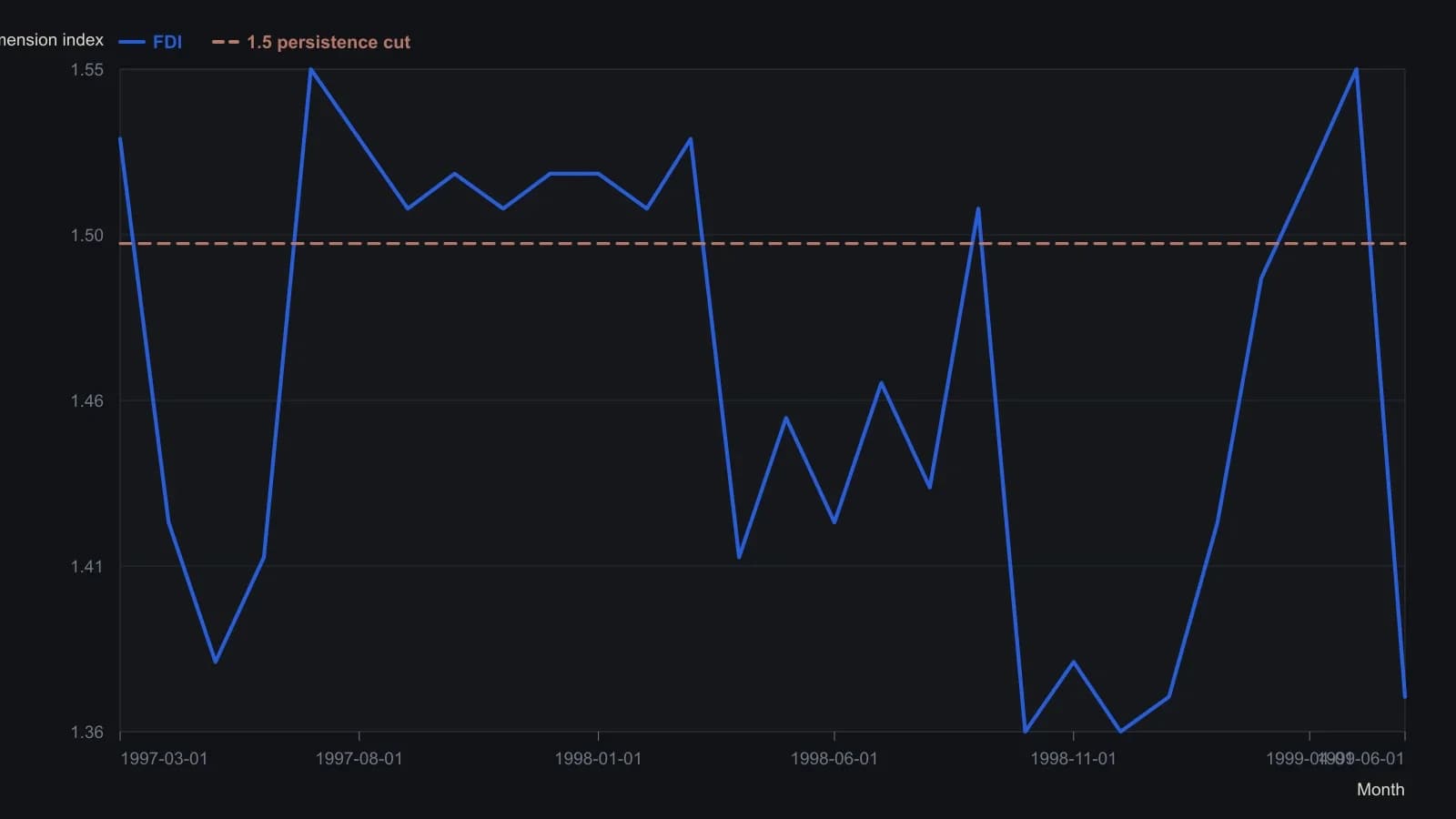
Digitized from the published TradeStation FDI pane. The source does not state the FDI lookback. Values are approximate to about 0.02 and are not tick-exact.
All readings on this track · 7 readings
- 1992Constructing fractal templates from successive index changes
- 1994Constructing polarized fractal efficiency as a path filter
- 2002Long memory, regimes, and the limits of bell-curve models
- 2003Constructing the fractal dimension index
- 2005Constructing a fractal-dimension adaptive moving average
- 2007Constructing a fractal-dimension regime filter
- 2015Constructing fractal swings as support-resistance atoms