2008issue C081-5
Zero-centered stochastic bands and bracket stops
A short-period stochastic can be rewritten so the rebuilt-stochastic sits on a zero-line and occupies a bounded scale from +1 to -1. Two band pairs then drive next-bar-entry rules, and a bracket-exit sets the loss bound before the position is held.
- The rebuilt-stochastic recenters a short-period range-momentum reading on a zero-line and maps it through a bounded transform onto a scale from +1 to -1.
- Double-exponential-smoothing after recentering is used so the oscillator responds to turns more evenly than the unsmoothed short-period version.
- An extreme-band pair and a near-zero-band pair define separate entry modes, with buys and shorts filled on the next bar after a qualifying cross.
- A bracket-exit places a contract-level protective stop with a target at least twice as large, so the loss bound is fixed before the position is held.
What the rebuilt-stochastic measures
A short-period stochastic can be rewritten so its neutral reading sits at zero and the series moves above or below that zero-line as price fluctuates. The input stochastic still measures momentum by locating the latest close inside the high-low range of a stated lookback in bars. It does not run a random process.
Construction around a zero-line
Construction uses an 8-bar %K, recenters it around 50, and scales that reading. After recentering, double-exponential-smoothing applies two successive exponential averages. The smoothing length equals the square root of a longer period input, so the oscillator's response to turns is more even than in the unsmoothed short-period version. The rebuilt series is then mapped through a bounded exponential transform so values occupy a symmetric scale from +1 to -1.
Extreme-band and near-zero-band entries
A countertrend procedure can treat two symmetric bands as separate long and short entry modes when the oscillator crosses those levels. The extreme-band pair is set at 0.90 and at its negative counterpart, and it is used when the oscillator leaves a stretched reading and crosses back through that band. The near-zero-band pair is set at 0.20 and at its negative counterpart, and it is a second, more frequent entry mode on pullbacks toward the center.
The coded procedure buys the next bar at market when the oscillator crosses down through either positive band. It sells short the next bar when the oscillator crosses up through either negative band. That next-bar-entry rule keeps the signal and the fill as separate steps.
Why the crosses stay anticipatory
Even with a short lookback and double-exponential-smoothing, the oscillator remains a function of past prices and therefore still lags. Threshold crosses are treated as anticipatory signals rather than confirmed turns.
A bracket-exit that fixes the loss bound
Exits can be specified as a bracket-exit: a contract-level protective stop and a profit target placed together. The target is sized at least twice the stop, so the loss bound is set before the position is held.
Bracket-strategy dollar results on daily emini Russell 2000
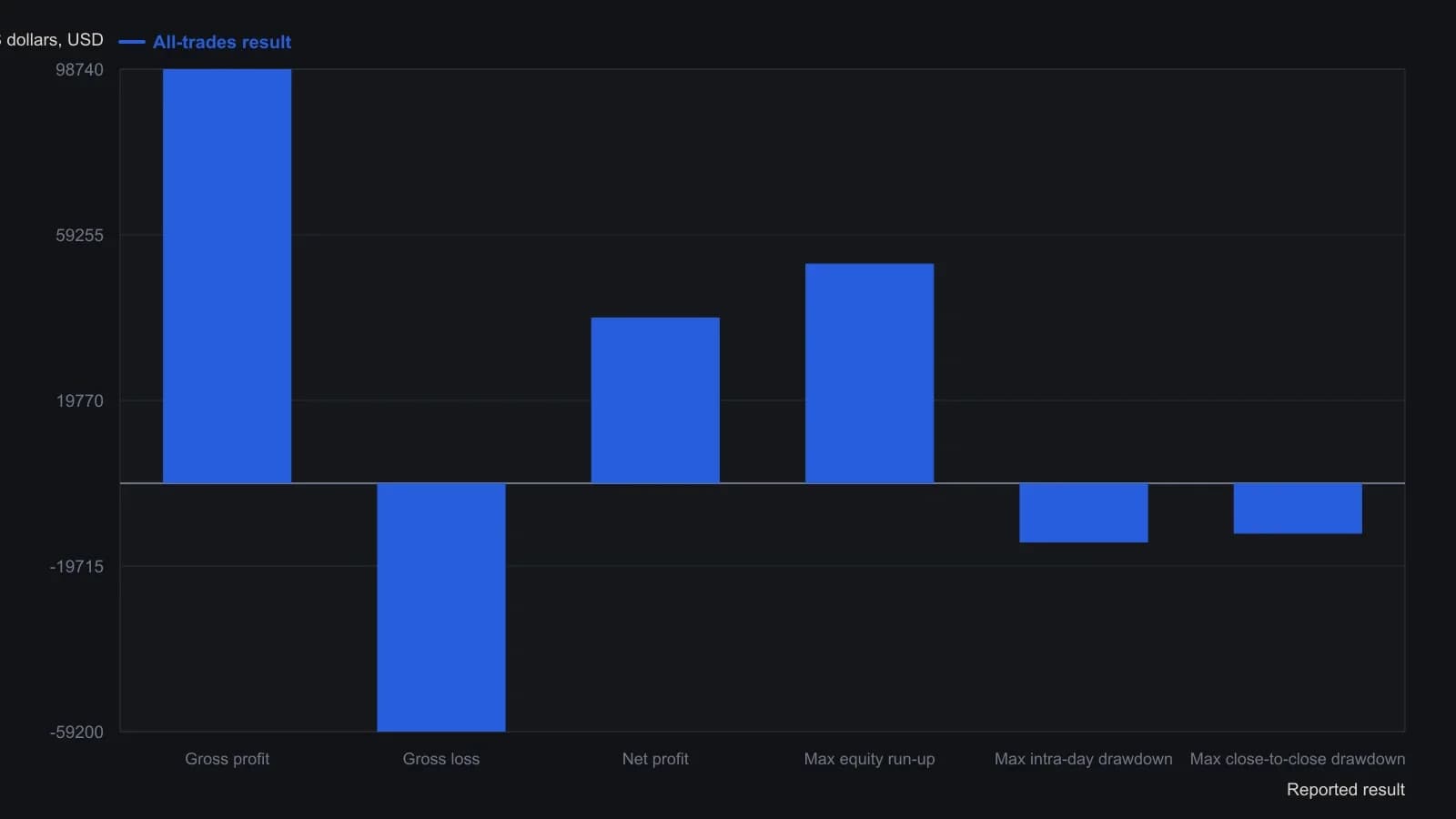
The source fixed a one-contract bracket of $800 stop-loss and $1,600 profit target, found by a 2-to-1 optimization. Commission and slippage were reported as zero over a 4-year, 9-month, 21-day run.
All readings on this track · 51 readings
- 1984Half-cycle differencing for momentum signals
- 1987Relative strength evaluation under competing optimization criteria
- 1988Weekly MACD as a two-clock momentum confirmation stack
- 1989Equal-weight zero-cross from smoothed spreads
- 1989Testing relative-strength-index reversal rules against trend continuation
- 1989Smoothed three-day futures filter for index option bounces
- 1989Cycle-length windows for momentum, Relative Strength Index, and stochastic construction
- 1991Filtered rally magnitude as a bull-regime breakout
- 1992Constructing true strength from double-smoothed momentum
- 1992Constructing a double-smoothed true strength index
- 1993When momentum structure and breadth break together
- 1993Constructing double-smoothed range and momentum oscillators
- 1993Constructing a two-parameter relative momentum index
- 1993Building a bounded momentum oscillator with RSI smoothing
- 1993Two-speed oscillators with divergence and trendline gates
- 1993Constructing a relative momentum index from the relative strength index
- 1994Constructing daily advance-decline breadth tools
- 1994Building a composite regime score from monetary climate and weekly trend
- 1994Averaging Relative Strength Index and the stochastic oscillator into one reversal oscillator
- 1995Dividend-yield regression as a hold versus momentum gate
- 1996Jump and hold filters for long-term Treasury yield direction
- 1997Constructing extendedness from a 10 percent swing filter
- 1997A range-expansion oscillator that can refuse its own stretch
- 1997RSI trend permission and Fibonacci pullback rules
- 1998Nested midpoint construction for a range-normalized oscillator
- 1999Evaluating Relative Strength Index momentum with zero-line and threshold rules
- 1999Treat RSI and momentum as three mechanical procedures
- 2000Thrust strength figure from moving-average swings
- 2001Constructing a non-range-bound balance of market power score
- 2004Cleaned breadth oscillator and new-high divergence: a swing-market case file
- 2004Evaluating advance-issues-momentum on a fixed-symbol-basket
- 2004Constructing a trend filter from two adjacent high-low windows
- 2006A dollar-versus-commodity extreme as a regime case
- 2008Zero-centered stochastic bands and bracket stops
- 2012Evaluating engulfing momentum across hold windows
- 2012Staged stops as one mechanical entry and exit procedure
- 2012Stacking a relative-strength-index forecast, a trend filter, and long-only momentum
- 2013Constructing fair-value filters from averages and momentum
- 2014Constructing a multi-window slope divergence entry
- 2015Bandedge trend filter construction with inverse crossover rules
- 2017Opposite rules for index price and volatility momentum
- 2018A three-state overlay that colors a trend only after the line clears the bar
- 2018Half-cycle relative-strength index with a Fisher map for cyclic reversals
- 2018Emotion as a rule input when momentum breaks
- 2018Two-bar body expansion as a momentum breakout construction
- 2019Pair a two-day high breakout with a volume-weighted exit on the same chart
- 2020Building reflex and trendflex cross and extreme entry rules
- 2020Construct a dual-series price momentum oscillator overlay
- 2020A multi-timeframe stochastic as a panel of weekly voters
- 2020Centerline crossovers that compare index momentums
- 2020Multi-timeframe stochastic voting as one mechanical rule