2004issue C101-4
Why on-balance volume and the accumulation-distribution line disagree
A gap-and-recovery session can send on-balance volume and the accumulation-distribution line to opposite extremes. Editorial reading: name the attribution rule behind each print before a system is allowed to treat either series as volume confirmation.
- Volume-price indicators fall into three construction classes: activity-only volume change, interday attribution of the session’s volume to the close-to-close price change, and intraday attribution from the close’s place in that day’s range.
- On-balance volume uses interday attribution, so a down close versus the prior session assigns that day’s full volume as distribution. The accumulation-distribution line uses intraday attribution and weights volume by close-in-range.
- After a gap-down session that recovered to finish near the open and in the top 10% of the day’s range, interday readings weakened while intraday readings strengthened, even as volume rose by almost 11 times.
- A wider panel can split to opposite extremes on the same bar because of those construction rules. A breakout-style filter that only sees the interday drop can treat the bar as confirmation of weakness, while an accumulation-distribution reading of the close-in-range can treat the same bar as a caution against that confirmation.
A gap-and-recovery session as a construction lab
On-balance volume is a cumulative volume-price series that adds or subtracts a session’s full volume from the sign of the interday close change. The accumulation-distribution line is a cumulative volume-price series that weights session volume by where the close sits between that day’s high and low.
Volume-price analysis is the practice of assigning volume to bullish or bearish control with a price-location rule, because completed buys and sells always match. When the two series print opposite extremes on the same bar, the construction question is which attribution rule produced each reading.
Three construction classes
Volume-price indicators fall into three construction classes: activity-only volume change, interday attribution of the session’s volume to the close-to-close price change, and intraday attribution from the close’s place in that day’s range.
Interday attribution is a construction choice that signs a day’s volume from the change between one session’s close and the next. On-balance volume uses that rule, so a down close versus the prior session assigns that day’s full volume as distribution.
Intraday attribution is a construction choice that signs a day’s volume from the close’s position inside the same session’s high-low range. The accumulation-distribution line uses that rule, weighting volume by how close the finish sits to the session high versus the session low. Close-in-range is that location of the close between the session high and low.
Activity-only volume reports turnover change without assigning that turnover to a price direction. Activity-only tools such as a volume oscillator can rise on a turnover surge without taking a directional side.
What the reviewed sessions showed
After a gap-down session that recovered to finish near the open and in the top 10% of the day’s range, interday volume-price readings weakened while intraday readings strengthened.
In the reviewed pair of sessions, volume rose by almost 11 times while the close finished about 20% below the prior close and almost unchanged from the same day’s open.
A wider panel of volume-price indicators can split to opposite extremes on the same bar because of those construction rules, not because one formula is miscoded.
Micromuse 10-day money flow index, December 2003 to July 2004
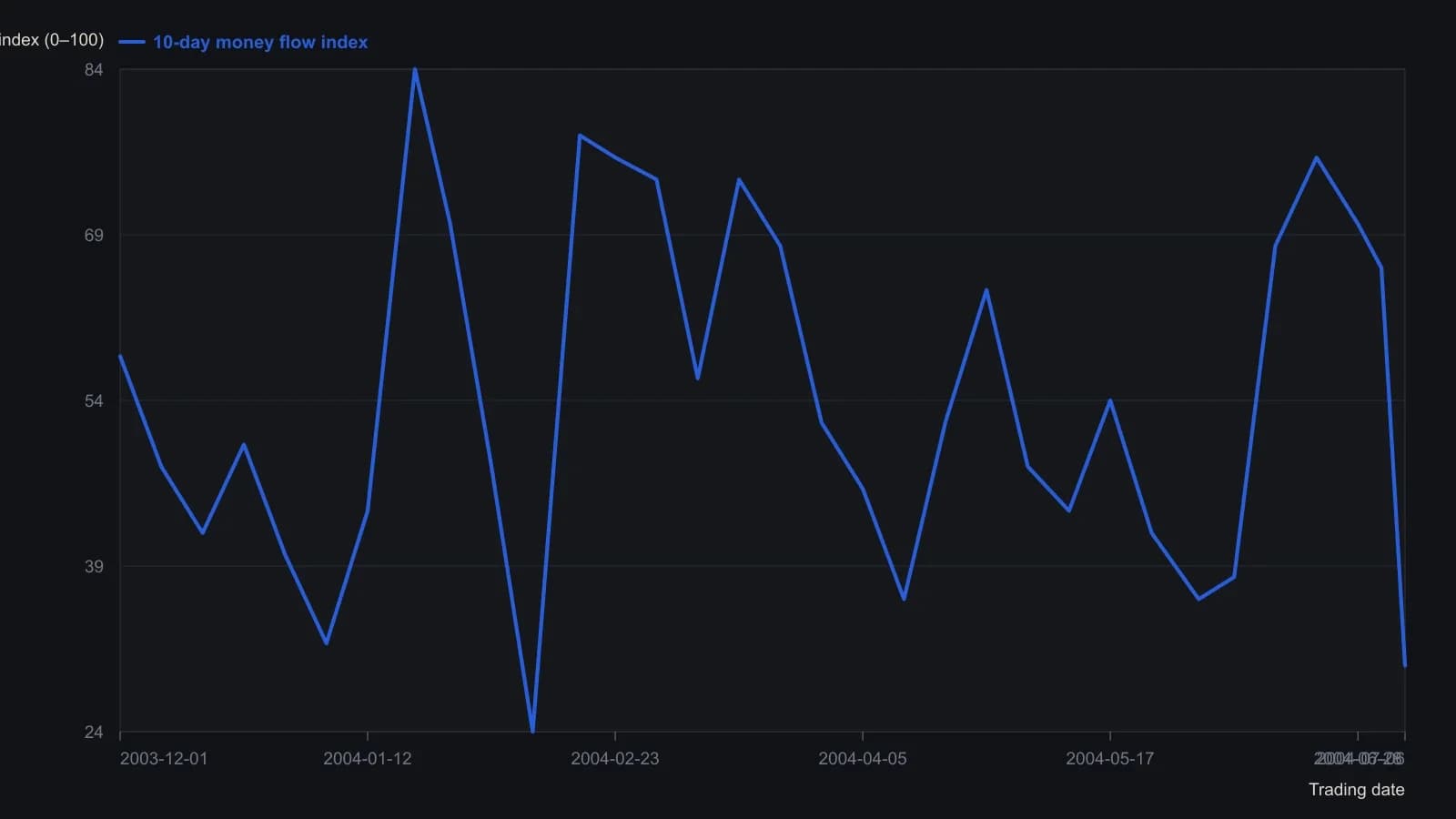
Tomlinson used a 10-day MFI rather than the 14-day default. Points are weekly samples from the daily pane plus the July 2 and July 6 sessions. The attached pane has no printed y ticks, so levels other than the stated 66 and 30 are approximate.
Signed volume is an attribution choice
Volume-price analysis cannot subtract sell volume from buy volume, because each completed trade is both. Any signed indicator must assign volume with an imperfect price-location rule.
Editorial reading: the archive describes that historical workflow. The instruction to name the attribution rule before treating either print as confirmation is a TradersWeek interpretation, not a finding of the source material.
All readings on this track · 8 readings
- 1995Constructing an accumulative swing index from open-high-low-close comparisons
- 2001Confirming a price-box break with on-balance volume and the accumulation-distribution line
- 2004Why on-balance volume and the accumulation-distribution line disagree
- 2006Lagged commercial nets and a weekly accumulation trigger
- 2007Constructing dominant cycles from participant accumulation
- 2011Linear regression overlays on volume-flow primaries
- 2014Lookalike money flow is not on-balance volume
- 2015Volume-free accumulation and a next-session bias overlay