2007issue C041-4
Rebuilding rate of change as a path-weighted oscillator
Ordinary rate of change uses only the current price and a lagged price, so the interior path never enters the reading. This article rebuilds the oscillator from every one-step percentage change, exponential smoothing over the original span, and a matching scale, then uses the series for the same chart tasks, including divergence.
- Ordinary rate of change uses only the current bar and the bar from T periods earlier, so observations between those dates never enter the reading.
- A single isolated price change moves the ordinary series twice: once when it enters the lookback and again when it drops out.
- The adjusted series applies exponential smoothing to every one-step percentage change over the original span, then multiplies by that span so the scale stays comparable.
- The rebuilt reading is used for the same chart tasks, including price-indicator divergence, without fixed overbought or oversold bands.
Ordinary rate of change
Ordinary rate of change is defined as current price minus the price from T periods earlier, divided by that lagged price and scaled by 100. Other common two-price ratios of the same pair are treated as algebraically equivalent.
The result is a momentum reading formed from the relative change between the current price and a price lagged a stated number of periods. The familiar percentage-change scale is kept. What changes is whether the window is allowed to ignore everything between its two endpoints.
The two-point problem
Ordinary rate of change uses only the current bar and the bar T periods earlier, so observations between those two dates do not enter the reading. Separate price paths that begin and end at the same two prices therefore receive the same ordinary rate-of-change value even when the intervening trajectories differ.
The construction has no inherent smoothing, unlike constructions that average or sum many observations, so isolated noise in the two endpoint prices passes straight into the oscillator. A single isolated price change also moves the ordinary series twice: once when the change enters the lookback and again T bars later when that same change drops out.
Adjusted rate of change
The adjusted rate of change computes every one-step rate of change between the original endpoints, applies exponential smoothing with a lookback equal to that span, and multiplies the smoothed series by the same span so the result stays on a comparable scale.
Exponential smoothing is a recursively weighted average over a defined lookback that gives more influence to recent observations than to older ones. Because those weights favor recent one-step changes, the delayed second peak or trough that appears T bars after a one-bar jump is removed from the adjusted series.
When three paths share one ordinary reading
In a three-path example that shared one ordinary reading, the adjusted values at the final bar were 0.62 on the lowest path, 0.27 on the middle path, and -0.09 on the uppermost path. Those prints match the intended ranking that the lowest path should score highest.
ROCadj ranks three price paths that share one ordinary ROC
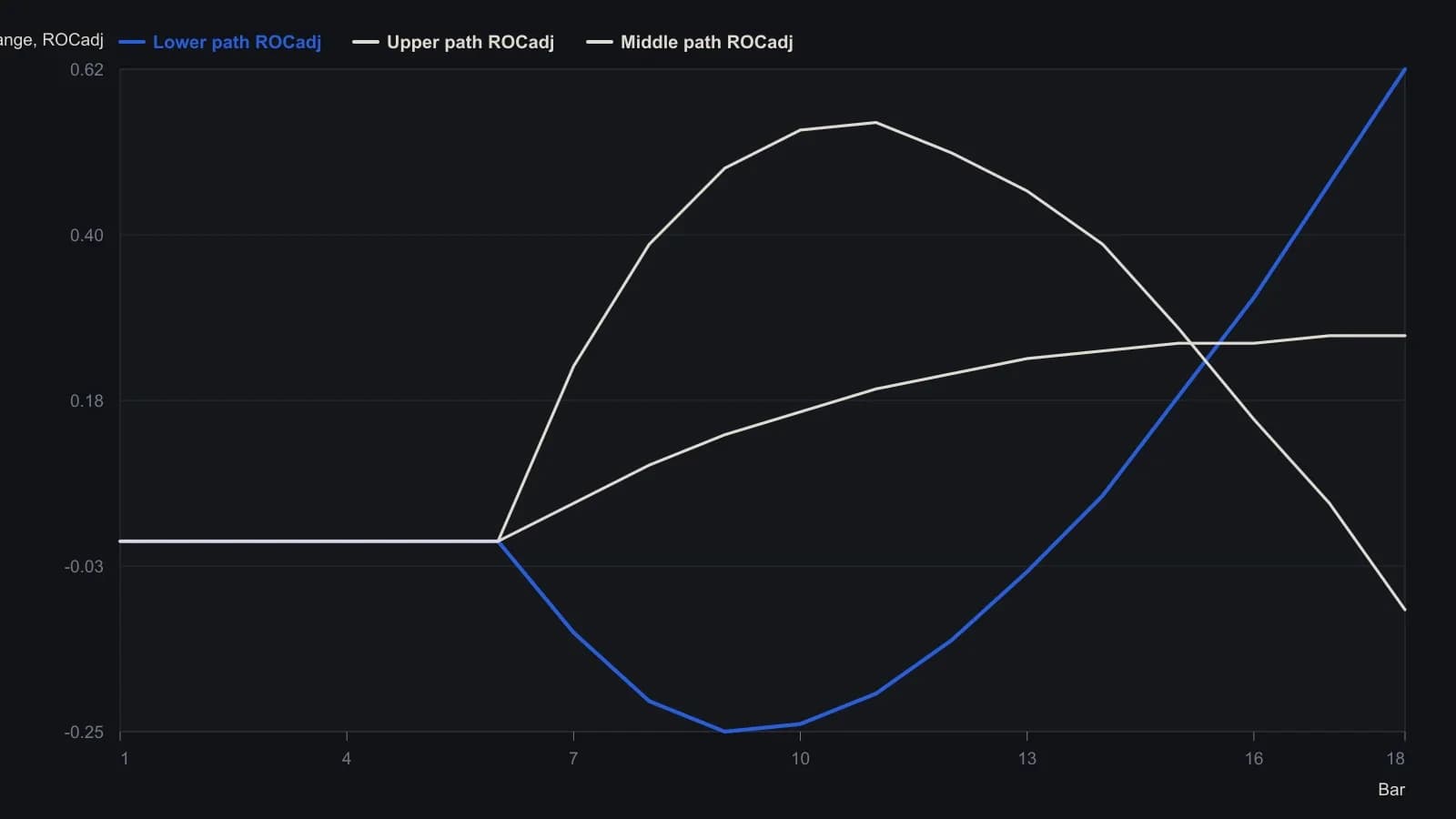
Markers sit on integer bars 1–18; values between grid lines are read to the nearest 0.01–0.02. Endings 0.62, 0.27 and -0.09 are the figures the article states in prose. The MetaStock sidebar omits the length-multiply step described in the text, and the plotted scale matches the unmultiplied one-step percent EMA.
Divergence and historically extreme prints
The adjusted series is applied to the same chart tasks as ordinary rate of change, including price-indicator divergence and comparison of trend breaks. Divergence is a chart condition in which price and a momentum series fail to confirm each other, used as a candidate reversal hypothesis rather than a completed forecast.
A worked chart used a 21-period adjusted series to mark a divergence that the unadjusted series did not show. Neither the ordinary nor the adjusted form is given fixed overbought or oversold bands. Historically extreme prints are treated only as a cue to inspect for a possible turn.
All readings on this track · 46 readings
- 1985Constructing excess and momentum difference-curve oscillators
- 1988Five reading rules for smoothed indicator charts
- 1989Momentum overlays that speed moving-average oscillators
- 1990A laboratory template that constructs Rate of Change as a pane module
- 1991Volume-scaled rate of change as a momentum construction
- 1991Three-indicator market overview from tape, sentiment and rates
- 1991Three-component trend model with rate-of-change filters
- 1992A KST oscillator from a weighted rate-of-change stack
- 1992Four-window weighted rate-of-change composite
- 1992Constructing multi-span smoothed rate-of-change filters
- 1992Constructing a four-horizon summed rate of change
- 1992Constructing KST from four weighted smoothed rates of change
- 1992Constructing a composite from weighted smoothed rates of change
- 1992Three-horizon KST maturity alignment
- 1992Construct a bond-led dividend-to-bond-yield regime first
- 1992Constructing relative-strength KST from weighted rate-of-change
- 1993Constructing a volume oscillator from average ratios and smoothed rate of change
- 1994Gold as a cycle clock for commodities and yields
- 1994Constructing a composite from weighted, smoothed rate-of-change windows
- 1994Constructing gold-mining rate-of-change tripwires for Treasury bonds
- 1994A capacity-stress checklist across commodities, bonds, and breadth
- 1994Rate of change parameters for testable entries
- 1994Constructing rate-of-change midpoints, lookbacks and divergence
- 1994Lead oscillator breaks need price trendline confirmation
- 1994Nested averages for an annual momentum curve
- 1994Evaluating a Coppock-style rate of change as a bottom-regime filter
- 1995A weighted eleven-month Dow rate of change as one testable timing procedure
- 1996Named lookbacks, thresholds, and streaks for entry rules
- 1997A midpoint rate-of-change test for bond trend follow-through
- 1997Constructing a short-rate-adjusted equity momentum filter
- 1998Daily momentum rank-churn as a portfolio-construction problem
- 1999Constructing a lagged rate of change cycle system
- 2000A triple delay line then a one-bar elliptic oscillator
- 2001Confirming rate of change divergences with price
- 2001Momentum trendline breaks need price confirmation
- 2001Market breadth, On-balance volume, and Rate of Change as a combined timing framework
- 2001Know Sure Thing with stacked horizons and trendline confirmation
- 2003Constructing a mechanical system from a rate of change condition
- 2003Constructing momentum from two closes and spotting divergence
- 2003Formula choice tilts which momentum mismatches count as divergences
- 2004RSI and momentum agreement as an asymmetric filter
- 2005Constructing price-normalized moving-slope hybrids
- 2005Unsigned speed gates on a fixed average-cross pair
- 2007Rebuilding rate of change as a path-weighted oscillator
- 2008Construct Special K so short-horizon signals stay inside the primary trend
- 2013Restore volume balance before adding another price-time indicator