2010issue C1270-83
Constructing a Hull smoother and a Hull-based oscillator gate
A Hull series of length N nests weighted averages of the half lookback, the full lookback, and the integer square root of the lookback. This archive article then applies a relative-strength index to that series, not to raw price, and uses the reading as the oversold and overbought gate in a long-only rule.
- A Hull series of length N is built from twice the weighted average of the last N/2 observations, minus the weighted average of the last N observations, then a weighted average of that residual over the integer square root of N.
- The construction prefers a perfect-square-length such as 4, 9, 16, 25, 49, or 81 so the square-root step does not truncate the inner average.
- The companion oscillator is a nine-bar relative-strength index of a nine-bar Hull series, not of raw price, and that reading gates the long-only entry and exit.
- An open long closes if the close falls more than 5 percent from the entry close, rises more than 15 percent from the entry close, or if the same nine-bar oscillator exceeds 90.
A Hull moving average is a nested weighted-average smoother that combines a half-length series, a full-length series, and a square-root-length series to reduce lag while keeping a long lookback. Length-n is the lookback in bars used for the outer Hull calculation. Half-N and square-root-N are derived from it.
How the nested averages are built
A Hull series of length N is built by taking twice the weighted average of the last N/2 observations, subtracting the weighted average of the last N observations, then taking a weighted average of that residual over the integer square root of N. A length check rejects N of 1 or less before any nested weighted average is computed.
Perfect-square lookbacks
Because the square-root step truncates non-integers, the construction prefers lookbacks that are perfect squares such as 4, 9, 16, 25, 49, or 81. A perfect-square-length is a lookback chosen so the square-root step is an integer, avoiding truncation of the inner average length.
A short overlay against a simple average
One demonstration overlay uses a four-bar Hull on daily SPY closes against a 50-bar simple average of the close.
Nine-bar Hull average versus nine-bar simple average on SPY
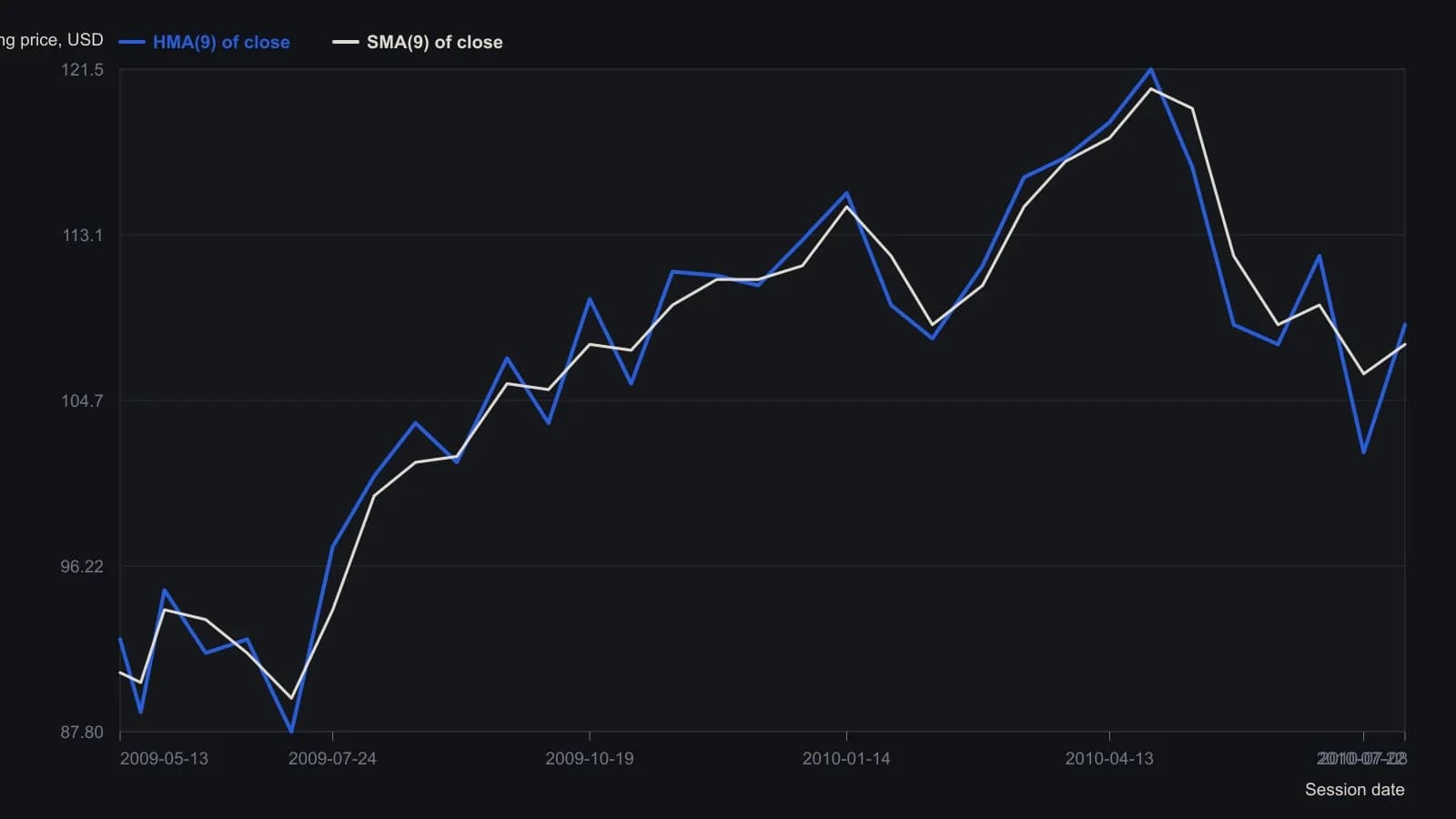
Both smoothers use a nine-bar window on the close. Coordinates are approximate readings from the raster, not a published table.
Oscillator of the smoother
The companion oscillator is a nine-bar relative-strength index computed on a nine-bar Hull series, not on raw price. The relative-strength index is used here as an overbought or oversold gate on the Hull series rather than on raw closes.
Long-only entry and exit
The rule-based entry is a long-only timing procedure that enters when the Hull-based oscillator is oversold and exits on a percentage move or an overbought oscillator reading. A long is opened when that Hull-based oscillator is below 30 and no position is already open. An open long is closed if the close falls more than 5 percent from the entry close, rises more than 15 percent from the entry close, or if the same nine-bar oscillator exceeds 90. The exit-percent is a fixed percentage gain from the entry close that closes the position without waiting for an oscillator signal.
Packaged strategy inputs
The packaged strategy inputs expose a nine-bar oscillator length, a nine-bar Hull length, close as the Hull price series, and a 15 percent profit exit, with orders generated only on bar close.
All readings on this track · 6 readings
- 2010Constructing a Hull smoother and a Hull-based oscillator gate
- 2015Evaluating moving-average lag in cycle filters
- 2017Rebuild a Hull moving average with linear-regression intercepts
- 2017A Hull moving-average forecast in a credit-spread trend procedure
- 2019Constructing nested regression projections as smoothers
- 2020Evaluating countertrend ETF rules against a buy-and-hold control