1993issue C111-3
Concurrent highest-low filter with a largest-low-fall trigger
A concurrent-highest-low test first confirms an uptrend on ordered lows. Only then may a largest-low-to-low-fall trigger print a sell. Coding the gate as 1 and the trigger as 2 puts both conditions on one series.
- The concurrent-highest-low filter is a binary uptrend gate. It is true only when the highest low of the last 5 periods is also the highest low of the last 19 periods.
- The largest-low-to-low-fall trigger is evaluated only while that filter is true. It fires when the change from the prior session low to the current session low is the most negative change over the last 17 periods.
- Dual-state-encoding records a true filter as 1, a true trigger as 2, and both-false as 0, so the gate and the sell can be read on one plot.
- The sell is an exit from a long that may have been opened by another procedure. Repeated sells can print on successive sessions, but a false filter blocks every sell even if a long remains open.
Two gates on ordered lows
This construction uses two gates in sequence. A trend-filter first asks whether recent lows still define an uptrend. Only after that gate is true may a downside trigger print a sell on the same session.
The first gate is a concurrent-highest-low test on ordered lows. The second gate is a largest-low-to-low-fall test on one-period changes in those lows.
The concurrent-highest-low filter
The concurrent-highest-low filter is a binary test. It is true only when the highest low of the last 5 periods is also the highest low of the last 19 periods.
A true concurrent-highest-low reading is treated as an uptrend state. The trend-filter must stay true before any downside trigger is allowed to print.
The largest-low-to-low-fall trigger
The one-period input to the trigger is the change from the prior session low to the current session low.
The largest-low-to-low-fall trigger is evaluated only when the concurrent-highest-low filter is true. If the filter is false, the trigger remains false.
When the filter is true, the trigger fires if the current one-period low change is the most negative change over the last 17 periods.
Sell, stay, or abstain
Editorial interpretation: the pairing is a rule-based-entry procedure. It maps filter state, one-period low changes, and a lookback minimum into a sell, a stay-in-state reading, or abstention.
The sell reading is specified as an exit from a long position that may have been opened by a different procedure. Repeated sell readings can print on successive sessions. If the trend-filter turns false, no sell reading can print even while a long position remains open.
Read both states on one plot
The two states can be plotted together by coding a true filter as 1 and a true trigger as 2, with 0 meaning both conditions are false.
Dual-state-encoding is a plotting and spreadsheet convention that keeps both conditions on one series. Editorial reading: a 2 is the sell, a 1 is the uptrend gate without a trigger, and a 0 is abstention because the filter is off.
December T-bond OHLC with CHL/LLF histogram, May–September 1993
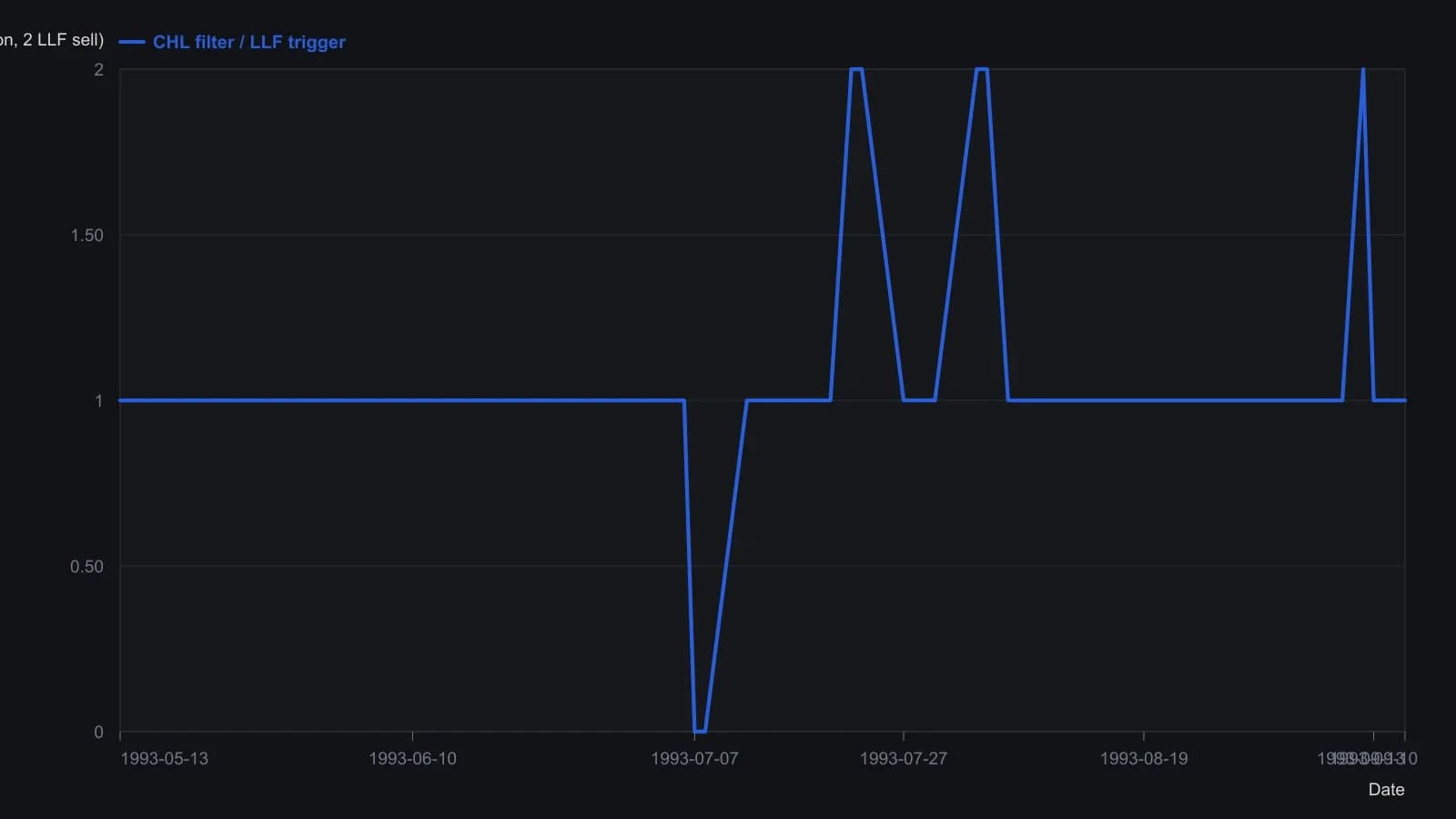
CHL is encoded as 1 and LLF as 2 so both gates share one histogram. The source notes sells on 22–23 July and the filter going dark on 7–8 July, when a long could not exit. Daily closes and histogram states are approximate readings from the raster, not spreadsheet cells.
All readings on this track · 33 readings
- 1988Opening-range brackets, a two-bar trend filter, and bounded stops
- 1990Bezier-curve price trend filter
- 1992Constructing a damping-index trend filter
- 1992Building a random walk index trend filter
- 1992Phase diagrams for moving-average trend filters
- 1993Volume-weighted change smoothing and trend ranking
- 1993Concurrent highest-low filter with a largest-low-fall trigger
- 1994Unit-invariant trend filters and the c-test
- 1995Constructing cup and cap entries with a three-bar net line
- 1997Why a daily timing evaluation depends on interval, lookbacks, and the fitting objective
- 2001A volume budget clock for trend-segment construction
- 2001Keep three jobs separate when you test a composite score
- 2002Evaluating the weekly four-percent close filter as a market-state procedure
- 2003Constructing a confirmed zigzag trend filter
- 2004Decompose high, low, and close into separate forecast streams
- 2005Three-state moving-average breakout bar coloring
- 2005Constructing a volume and move-adjusted trend filter
- 2005A fifty-day average breakout as a trend permission filter
- 2005Current-bar inclusion can mute a stochastic channel break
- 2006A stochastic oscillator gated by a long-term exponential average
- 2010A construction test for a modified volume-price trend filter
- 2011Constructing a Spearman rank trend filter
- 2013Constructing a repeated-median slope as a resistant trend filter
- 2014Combining a relative-strength index and trend filters for oversold setups
- 2014Price-rooted lookbacks for a relative strength index, a moving average, and a trend filter
- 2015Evaluating next-session intermarket range forecasts
- 2018Read the intermarket weight matrix first, then the predicted moving-average filter
- 2018Constructing the stiffness trend filter from moving-average holds
- 2018The averaging kernel and the lagged trend gate are separate specifications
- 2019A trend filter is not ready to compare until portfolio constraints are written down
- 2019Lookback, threshold, and position-capacity for a stiffness trend-filter
- 2020Combining a trend filter with a moving average and a stochastic oscillator
- 2020Constructing a relative-strength oscillator with a rank-agreement trend filter