2014issue C0726-30
Walk-forward velocity filters on noisy intraday trends
This is the second part of a two-part treatment of a velocity-based system applied to eurodollar futures on one-minute bars. Walk-forward analysis applies a performance-metric filter to each in-sample optimization and tests only the selected inputs on the immediately following out-of-sample section.
- A single combinatorial search over the whole series is treated as curve-fitting both repeatable patterns and non-repeating spurious moves, so the best in-sample inputs are not accepted without out-of-sample checks repeated many times.
- The performance-metric filter first requires fewer than 60 in-sample trades, then ranks remaining rows by a median runup-minus-final-profit metric and an equity-smoothness term so that one in-sample row remains for each window.
- Selected lookback, velocity thresholds, and polynomial degree jump from window to window: noisier in-sample data is assigned slower first- or second-order fading-memory velocity, while cleaner data is assigned faster third- or fourth-order velocity.
- The filter is applied across 310 in-sample sections, producing 310 paired out-of-sample weeks whose average and dispersion describe expected weekly results rather than one lucky window.
The second part of a velocity-based eurodollar study
This article is the second part of a two-part treatment of a velocity-based system applied to eurodollar futures on one-minute bars.
Walk-forward analysis splits the series into many successive in-sample and out-of-sample sections, applies a performance-metric filter to each in-sample optimization, and then tests only those selected inputs on the immediately following out-of-sample section.
Why a full-sample combinatorial search is not enough
A single combinatorial search over the whole series is treated as curve-fitting both repeatable patterns and non-repeating spurious moves, so the best in-sample inputs are not accepted without out-of-sample checks repeated many times.
Walk-forward analysis is a repeated in-sample search and immediately following out-of-sample test that averages many independent windows so chance-fitted noise is not treated as a durable rule.
How the performance-metric filter keeps one row
The walk-forward metric filter used here first requires fewer than 60 in-sample trades so the selected inputs tend to follow the main intraday trend rather than generate more than about three trades a day.
After the trade-count gate, the filter ranks remaining rows by a median runup-minus-final-profit metric and an equity-smoothness term so that one in-sample row, and its inputs, is left for each window.
A performance-metric filter is that rule applied to the in-sample optimization table. It keeps one input row by jointly constraining trade count, runup-to-profit closeness, and equity-path smoothness.
Paired out-of-sample weeks across many windows
That filter is applied across 310 in-sample sections, producing 310 paired out-of-sample weeks whose average and dispersion are used to describe expected weekly results rather than one lucky window.
Under a normal-distribution assumption on weekly results, the reported breakeven horizon for this filter is 33 weeks for a 98 percent chance that cumulative out-of-sample equity is above zero, and the longest stretch without a new equity high is 17 weeks.
Fading-memory velocity that changes with noise
A least squares moving average is a polynomial fit to recent prices whose slope is treated as fading-memory velocity. The polynomial degree can change with how noisy the in-sample window is.
Selected lookback, velocity thresholds, and polynomial degree jump from window to window. Noisier in-sample data is assigned slower first- or second-order velocity, while cleaner data is assigned faster third- or fourth-order velocity.
The trend filter is a gate that lets the velocity-based system trade only when estimated trend strength exceeds an explicit threshold, so noisy one-minute moves do not generate entries.
What the 310-week out-of-sample run reported
After a stated 30-dollar round-trip cost, the 310-week out-of-sample run on one eurodollar contract reports 49421 dollars net equity, a largest losing week of 3550 dollars, a largest drawdown of 4400 dollars, an average of 2.2 trades per week, activity in 188 of 310 weeks, and 60 percent of trades profitable, with no overnight positions.
Walk-forward out-of-sample equity on eurodollar one-minute bars
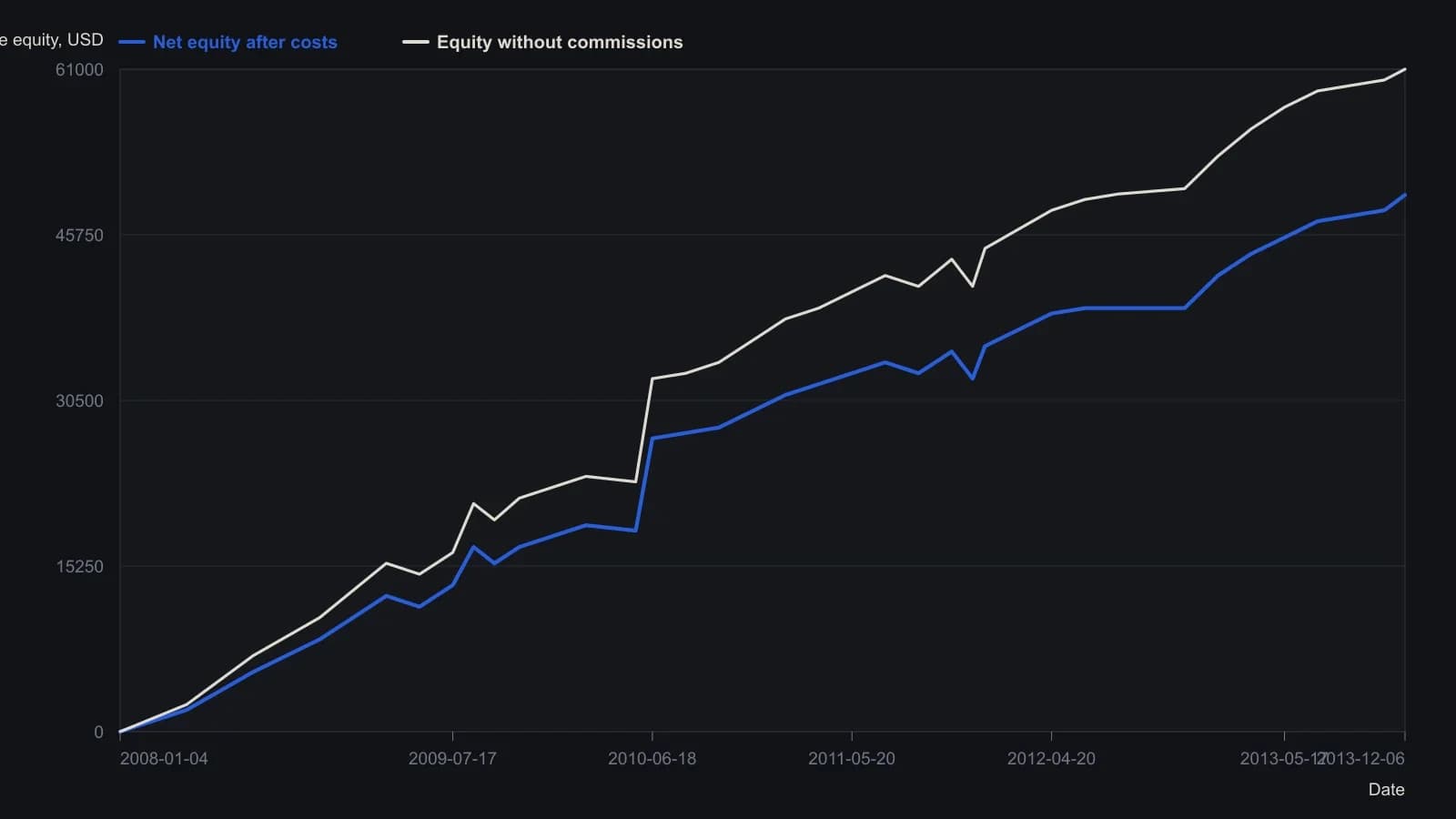
Filter b10m(ru-p)<60-mDev on 310 weekly in-sample/out-of-sample windows. Positions were not held overnight. Intermediate points are approximate raster readings rounded to $500; only the $49,421 ending net equity is a stated total.
All readings on this track · 50 readings
- 1990Three-window walk-forward system evaluation
- 1990Building the construction layer of a mechanical trading system
- 1991Constructing walk-forward neural trading rules
- 1991Constructing neural trading systems from facts to walk-forward
- 1992Walk-forward evaluation of stop overlays on average crossovers
- 1992Audit mechanical system tests for fills and regimes
- 1993Walk-forward evaluation of monthly yield and real-rate forecasts
- 1993Constructing walk-forward forecasts with linear and moving-average baselines
- 1993Walk-forward hybrid rules for intermarket forecast stacks
- 1994Neural-net construction as a mechanical trading-system problem
- 1995Constructing an intermarket neural net trading system
- 1996Weekly market breadth as one procedure on an unused window
- 1996Walk-forward evaluation of gold-index bond-fund rules
- 1996Evaluating weekday-in-month filters for index day trades
- 1996Require both a trend filter and a cycle oscillator before entry
- 1997Walk-forward windows as a diagnostic of parameter instability
- 1997Walk-forward validation of a market-breadth timing rule
- 1997Sunspot spikes and walk-forward evaluation of an adaptive cycle rule
- 1997A walk-forward check for bond-breadth timing
- 1998Walk-forward audit of regression trend forecasts
- 1998Evaluating a cubic least-squares currency trend with walk-forward segments
- 1998Walk-forward evaluation of recursive yen trend signals
- 1999Personal system design under crowd psychology
- 1999Walk-forward evaluation of a polynomial price forecast
- 2000Walk-forward optimization of regression-slope-angle rules
- 2001Construct a winter seasonal window as one procedure
- 2001Inspectable rules when system write-ups dry up
- 2002Evaluating mechanical systems before position sizing
- 2003Walk-forward construction of rule-based market-position systems
- 2007Evaluating metal seasonal windows across regimes
- 2007Evaluating mechanical timing systems against hold baselines
- 2011Walk-forward reoptimization as a system design gate
- 2011Evaluate generated systems on holdouts, then add stops
- 2012Walk-forward analysis and out-of-sample tests for a mechanical trading system
- 2012Personality-first trading system design
- 2012Scorecard-first mechanical system construction
- 2012Constructing an advancer-decliner moving average for market breadth
- 2012Formula search as mechanical system construction
- 2013Identity-first system construction
- 2013Construct a swing system from bias rules to walk-forward
- 2014Evaluate mechanical stock systems with stops and walk-forward
- 2014Walk-forward velocity filters on noisy intraday trends
- 2015Event-predictability versus position-constrained rules
- 2015Constructing mechanical systems for walk-forward tests
- 2016When a tested system must be retired
- 2016Walk-forward metric filters and chance-level checks for selected inputs
- 2018Evaluate mechanical trading systems without catalog rankings
- 2019Phased stop construction from entry risk to trailing exit
- 2020Stockpiling simple ideas for mechanical system construction
- 2020A pretty first draft is not a walk-forward waiver