1995issue C051-8
A weighted eleven-month Dow rate of change as one testable timing procedure
This lesson builds DJROC from monthly MROC readings, then pairs a buy-confirmation, a 12-month duplicate-lockout, and a first-decline-or-calendar holding-window. The stack is meant to be tested as one procedure, not as a hunt for exact market turns.
- The construction does not try to call exact tops or bottoms. It asks whether current conditions raise the chance of a later advance.
- MROC is the eleven-month percentage change of a monthly close. DJROC is the ten-period weighted average of successive MROC readings, using weights 10 down to 1 and divisor 55.
- A buy-confirmation is defined only after DJROC has fallen to -1.0 or below and then rises for one month.
- One evaluation design ignores a duplicate-lockout buy inside 12 months and uses a holding-window of at most 12 months, exiting earlier on the first monthly DJROC decline.
Start from conditions, not turning points
The construction treats exact top and bottom calls as neither necessary nor assumed possible. It instead asks whether current conditions raise the chance of a later advance.
That question sits inside long-horizon-momentum: a multi-month price swing is treated as tending to persist until a defined outside force, here an upturn in the weighted rate-of-change, is treated as counteracting it.
Build MROC from two monthly closes
The raw monthly input is MROC, the eleven-month percentage change of a monthly close. Take the latest monthly close, divide by the close 11 months earlier, subtract one, and multiply by 100.
Using a December 1994 monthly close of 3834.44 against a January 1994 close of 3978.36 produces an MROC of -3.62.
Turn successive MROC readings into DJROC
DJROC is the ten-period weighted average of successive MROC values applied to Dow industrials monthly closes. Multiply the newest reading by 10, the next by 9, and so on down to the reading nine months earlier by 1. Sum those products and divide by 55.
That weighted-average step produces a DJROC value of 2.76 for December 1994.
Define the buy-confirmation
A buy is defined only after DJROC has fallen to -1.0 or below and then rises for one month. That rule is the buy-confirmation.
Such alerts are described as typically arriving only once every couple of years after a long decline has lost downside force.
Close the procedure with lockout and exit
One evaluation design treats any new buy that arrives within 12 months of an earlier buy as a duplicate-lockout and ignores it.
One paired exit holds after a buy for 12 months or until DJROC records a monthly decline, whichever comes first. The holding-window is therefore at least one month and at most 12 months.
Keep the evaluation attached to the same rule
The procedure is documented with a long-horizon price chart, DJROC plotted beneath it, and side-by-side three-, six-, and 12-month outcome tables for buys from 1915. The tables are shown with duplicates, without duplicates, and with the optional early-exit rule.
Editorial: keep confirmation, lockout, and exit in the same test. Rebuild the archive workflow as one procedure rather than as a search for the precise month of a turn.
12-month DJIA return after unique DJROC buy signals
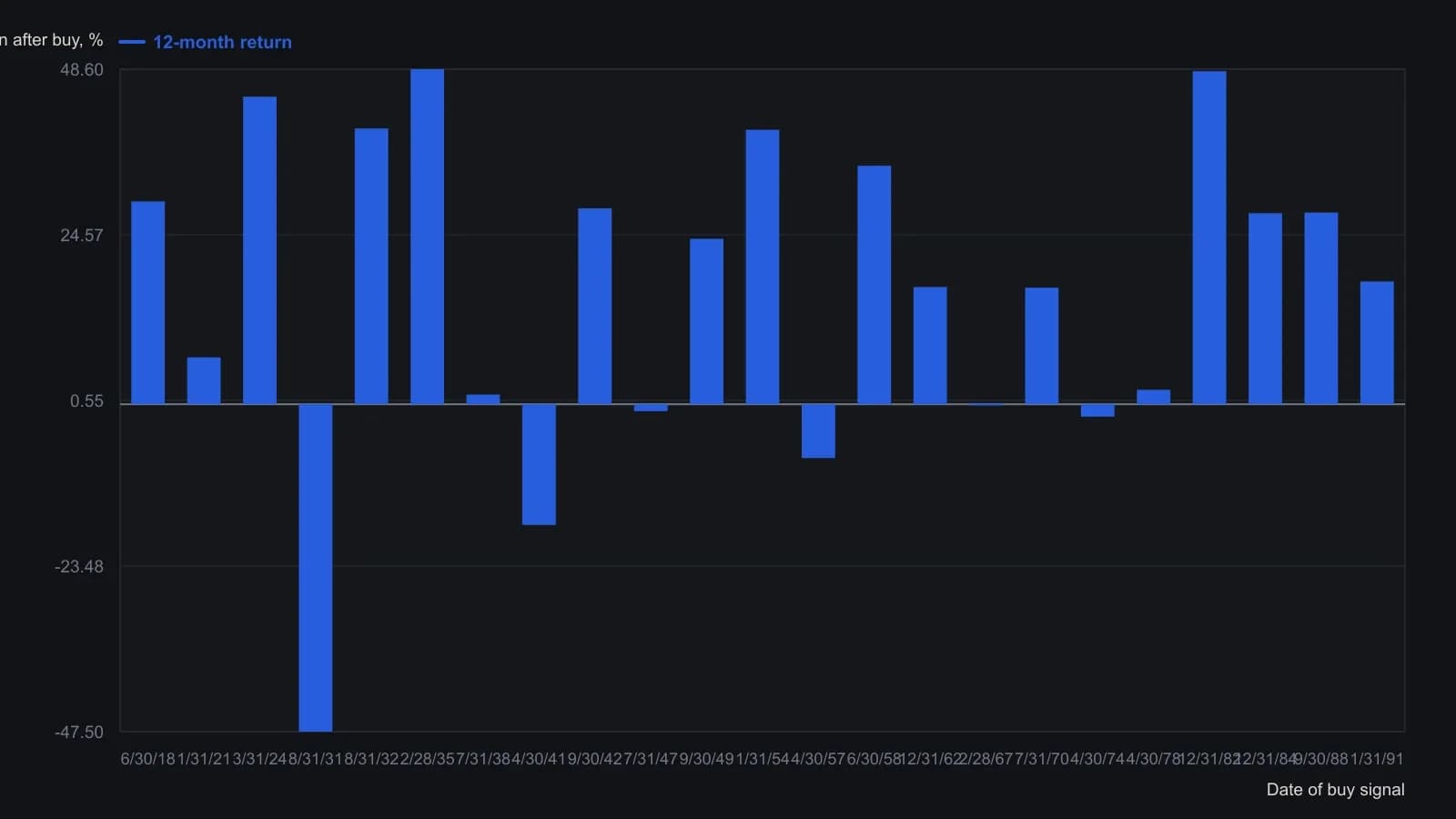
Source drops any later buy that falls inside 12 months of a prior signal. Holding-window table (sell on first decline or at 12 months) is a separate sample and is not mixed in here.
All readings on this track · 46 readings
- 1985Constructing excess and momentum difference-curve oscillators
- 1988Five reading rules for smoothed indicator charts
- 1989Momentum overlays that speed moving-average oscillators
- 1990A laboratory template that constructs Rate of Change as a pane module
- 1991Volume-scaled rate of change as a momentum construction
- 1991Three-indicator market overview from tape, sentiment and rates
- 1991Three-component trend model with rate-of-change filters
- 1992A KST oscillator from a weighted rate-of-change stack
- 1992Four-window weighted rate-of-change composite
- 1992Constructing multi-span smoothed rate-of-change filters
- 1992Constructing a four-horizon summed rate of change
- 1992Constructing KST from four weighted smoothed rates of change
- 1992Constructing a composite from weighted smoothed rates of change
- 1992Three-horizon KST maturity alignment
- 1992Construct a bond-led dividend-to-bond-yield regime first
- 1992Constructing relative-strength KST from weighted rate-of-change
- 1993Constructing a volume oscillator from average ratios and smoothed rate of change
- 1994Gold as a cycle clock for commodities and yields
- 1994Constructing a composite from weighted, smoothed rate-of-change windows
- 1994Constructing gold-mining rate-of-change tripwires for Treasury bonds
- 1994A capacity-stress checklist across commodities, bonds, and breadth
- 1994Rate of change parameters for testable entries
- 1994Constructing rate-of-change midpoints, lookbacks and divergence
- 1994Lead oscillator breaks need price trendline confirmation
- 1994Nested averages for an annual momentum curve
- 1994Evaluating a Coppock-style rate of change as a bottom-regime filter
- 1995A weighted eleven-month Dow rate of change as one testable timing procedure
- 1996Named lookbacks, thresholds, and streaks for entry rules
- 1997A midpoint rate-of-change test for bond trend follow-through
- 1997Constructing a short-rate-adjusted equity momentum filter
- 1998Daily momentum rank-churn as a portfolio-construction problem
- 1999Constructing a lagged rate of change cycle system
- 2000A triple delay line then a one-bar elliptic oscillator
- 2001Confirming rate of change divergences with price
- 2001Momentum trendline breaks need price confirmation
- 2001Market breadth, On-balance volume, and Rate of Change as a combined timing framework
- 2001Know Sure Thing with stacked horizons and trendline confirmation
- 2003Constructing a mechanical system from a rate of change condition
- 2003Constructing momentum from two closes and spotting divergence
- 2003Formula choice tilts which momentum mismatches count as divergences
- 2004RSI and momentum agreement as an asymmetric filter
- 2005Constructing price-normalized moving-slope hybrids
- 2005Unsigned speed gates on a fixed average-cross pair
- 2007Rebuilding rate of change as a path-weighted oscillator
- 2008Construct Special K so short-horizon signals stay inside the primary trend
- 2013Restore volume balance before adding another price-time indicator