1993issue C021-11
Force on-balance volume to agree with itself at slower horizons
A daily on-balance-volume flip against a two-week exponential average only starts the construction. Later rule sets require that same series to line up at two slower sampling intervals so the extra averages act as a trend filter. Editorial reading: intersecting linear-regression channels belong beside that stack because the lookbacks are different strata, not interchangeable smoothers.
- On-balance volume is a running sum of volume that adds the session after an up close and subtracts it after a down close.
- The first rule set only compared daily on-balance volume with its two-week exponential average. Later rule sets used slower averages of the same series as a trend filter.
- The stacked rule set required the two-week, 20-week, and 50-week averages to agree before entry and closed the position if either slower horizon disagreed.
- Intersecting short-horizon and long-horizon linear-regression channels on British pound prices were presented to mark later high-volatility episodes months ahead of the event.
The short flip leaves slower horizons free
On-balance volume is a running sum of volume that adds the session's volume after an up close and subtracts it after a down close. Each bar updates both direction and participation.
The first rule set bought when daily on-balance volume was above its two-week exponential average and sold when it was below that average. Trades were filled on the next session's close. The market in that first pass was the Deutschemark.
Slower averages become the trend filter
A second rule set used the two-week on-balance-volume average relative to a 20-week average as the trend filter. The same conventions were then applied to the yen, treated as correlated with the Deutschemark, and to Treasury bonds, treated as correlated as well.
A third rule set required the two-week, 20-week, and 50-week on-balance-volume averages to stack in the same direction before entry. Mixed AND/OR logic meant disagreement at either slower horizon closed the position.
That multi-horizon stack samples the same on-balance-volume series at nested lookbacks so the short, intermediate, and long traces can confirm or veto one another. The slower confirmation rule is a longer exponential average, or the required stack of averages, that must agree with the shorter-horizon signal before a long or short is opened or held.
Deutschemark on-balance volume at three horizons, May–June 1992
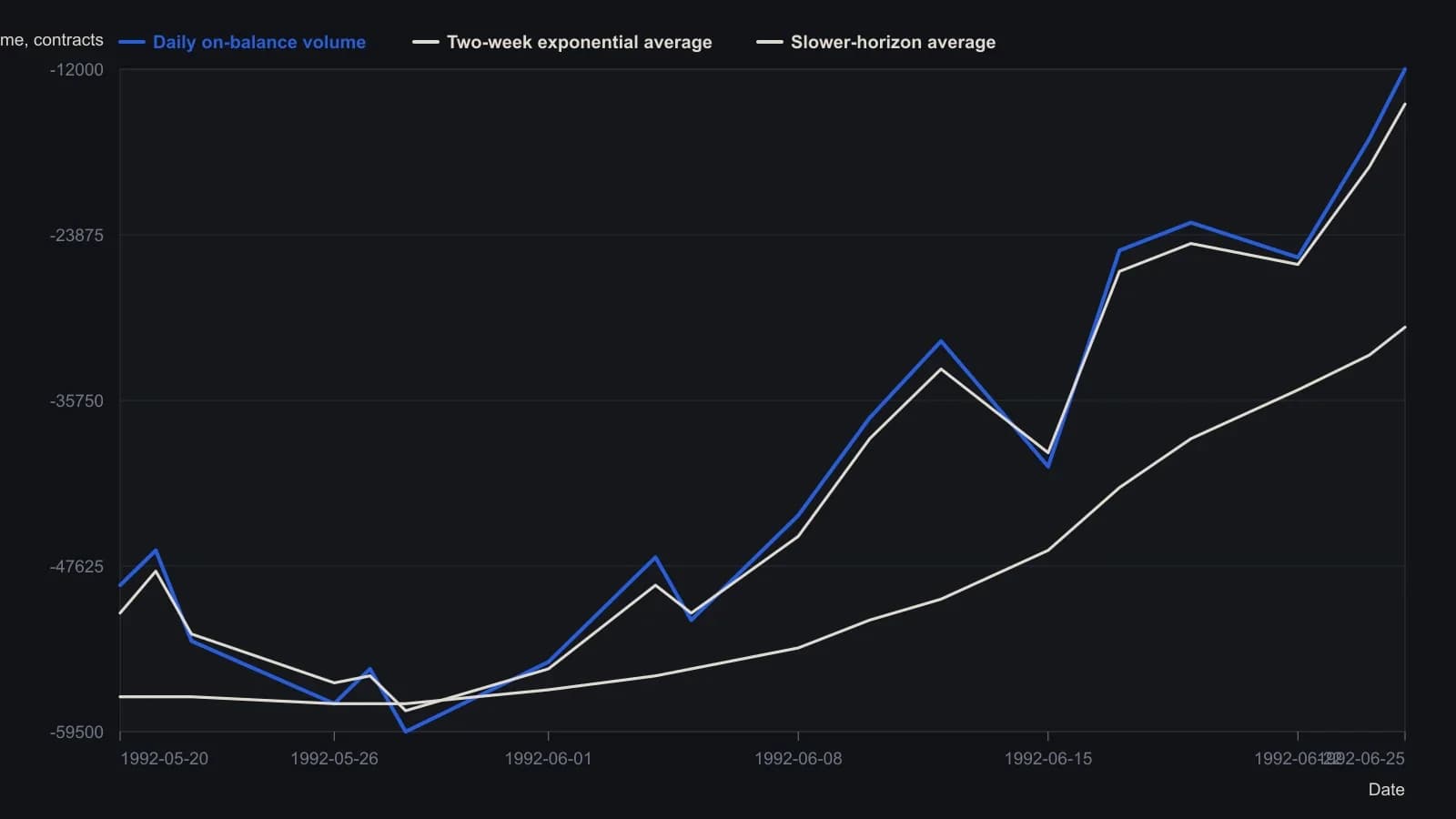
Y values are approximate visual readings from the 5,000-unit grid on the raster. Dates follow the printed '92 / 23 / 8 / 15 / 22 marks as mid-May through 25 June 1992 daily sessions. Interior wiggles smaller than one grid step were not invented.
The particular months are not required
The stacked design was motivated by a momentum construction that sampled three discrete horizons of 6, 12, and 24 months. Other intervals, including 50 weeks, were then used deliberately to show that those particular months are not required.
A two-scale schematic was drawn as a bimodal distribution, with one peak for moves better matched to the shorter component and one peak for moves better matched to the longer component.
Linear-regression channels sit beside the stack
Intersecting short-horizon and long-horizon linear-regression channels on British pound prices were presented as a way to mark later high-volatility episodes months ahead of the event.
A linear-regression channel here is a fitted price band. When a short-horizon channel crosses a long-horizon channel, the overlay marks multi-scale tension. It does not replace the on-balance-volume entry.
All readings on this track · 61 readings
- 1988Cumulative volume trend and 200-session polarity
- 1988Three clocks when cumulative volume led price
- 1988Payoff index checkpoints for open interest and divergence
- 1988Relative strength, stochastics, and on-balance volume as a turning-point stack
- 1988Signing volume by open interest change
- 1988Case study: weekly on-balance volume with trendlines and a 21-period average
- 1988Combining weekly and daily MACD divergences with on-balance volume
- 1988Restoring the original tests for market breadth, on-balance volume, and trendlines
- 1989Evaluating volume-weighted breadth extremes
- 1989Demand oscillator construction with a momentum overlay
- 1989Constructing a volume percentage ratio from advance-decline flow
- 1990Constructing net positive volume as On-balance volume
- 1990Buying-share scale with on-balance volume
- 1990Friday-filtered on-balance confirmation lines
- 1991Constructing rate-market volume breadth from on-balance volume
- 1991Building a breadth composite from on-balance volume breakouts
- 1992Constructing a rate-complex volume-breadth index
- 1992Constructing a breadth index from on-balance volume
- 1992Constructing signed market thrust from issue volume
- 1992Constructing indicator phase across averages, volume and bands
- 1993Force on-balance volume to agree with itself at slower horizons
- 1993Three transforms of market thrust from breadth and volume
- 1994Constructing a tick-line momentum oscillator
- 1994Constructing a smoothed on-balance tick momentum oscillator
- 1994Histogram confirmation and a second-series veto for MACD-family alerts
- 1994Constructing a 40-period envelope on on-balance volume
- 1996Constructing a matched percent-B volume disparity
- 1997Constructing calendar regime overlays and volume-weighted rules
- 1997Constructing market thrust from breadth and volume
- 1997Constructing on-balance volume as a signed running total
- 1997A three-layer construction for a signed volume-force oscillator
- 1997Constructing a range-sum volume-force oscillator
- 1999On-balance volume confirmation, price-indicator divergence, and bounded exits
- 2000A daily long-only confirmation stack on the tether line
- 2000A three-filter tether and volume trend system
- 2003Constructing finite volume elements as a finite-period money-flow filter
- 2003Constructing on-balance volume from signed session volume
- 2003On-balance volume as a market-breadth participation ledger
- 2003Construct a volatility-adjusted on-balance volume filter before confirming a breakout
- 2004Opening and midday ranges as an on-balance-volume breakout case
- 2004Constructing a volatility-gated volume-flow measure
- 2004Constructing a volume-flow series from on-balance volume
- 2004Volume-flow indicator construction from on-balance volume
- 2004Volume-flow slope divergence, then separate on-balance-volume and crossover rules
- 2004Volume flow and band construction as one inspectable problem
- 2004Auditing advance-decline confirmation for scale, horizon, and composition
- 2005Bounded market breadth from the Arms index to BRIN
- 2006Overnight-hold entry and exit construction
- 2007Evaluating Volume-price confirmation versus On-balance volume and MACD
- 2009Volume confirmation versus a price advance
- 2010Typeahead retrieval of a moving average, on-balance volume, and a stochastic oscillator
- 2010Modified volume-price trend and log-price scale alignment
- 2010Constructing liquidity accelerometers from advance-decline averages
- 2012Failed short cycles as breadth and volume tests
- 2016Earnings straddles, implied volatility, and money-flow filters
- 2017A volume residual filter and a price projection matrix
- 2019Volume-volatility parabola and signed-volume momentum
- 2019Separating on-balance volume into breadth and volume
- 2020Constructing the obvm signal line
- 2020Constructing smoothed on-balance volume with a signal line
- 2020Keep neutrality as a first-class input in three-state market data