2018issue C0448-54
Two Adaptive moving averages as a confirmation pair
The April 2018 implementations pair a close-location Adaptive moving average with a Kaufman Adaptive moving average and use their cross as the working signal. Sideways markets still produce failed signals, so a Trend filter or a sustained bar-count confirmation remains part of the design.
- Pair a close-location Adaptive moving average with a Kaufman Adaptive moving average and treat their Moving-average crossover as the working signal, not as a single smoother.
- The close-location line scales its smoothing constant from where the close sits inside the lookback high-low range. The Kaufman line reacts to close-to-close change.
- Adding the second Adaptive moving average is described as reducing but not eliminating whipsaws. Sideways markets remain a main source of failed signals.
- A market or Trend filter, or a chosen number of bars of confirmation, can be required before a cross is treated as official.
Pair two Adaptive moving averages
The April 2018 Traders' Tips implementations pair a close-location Adaptive moving average with a Kaufman Adaptive moving average. Their Moving-average crossover is the working signal.
The close-location Adaptive moving average updates Kaufman's construction by scaling the smoothing constant from how far the close sits inside the lookback high-low range, rather than from close-to-close change alone.
How the close-location line updates
The supplied Adaptive moving average function first maps close location inside the high-low range onto a smoothing constant between the fast and slow constants, squares that constant, and then updates the prior average toward the current close.
Supplied lookback and cross rules
A supplied EasyLanguage indicator and strategy use a 10-period lookback with fast and slow average lengths of 2 and 30. They buy or sell short the next bar when the Adaptive moving average crosses the Kaufman Adaptive moving average.
Platform notes present the same pairing as a way to mark turning points and to filter price movement. Those notes include rule-block rebuilds and overlaid daily plots of both averages.
AMA and KAMA on daily ES March 2018
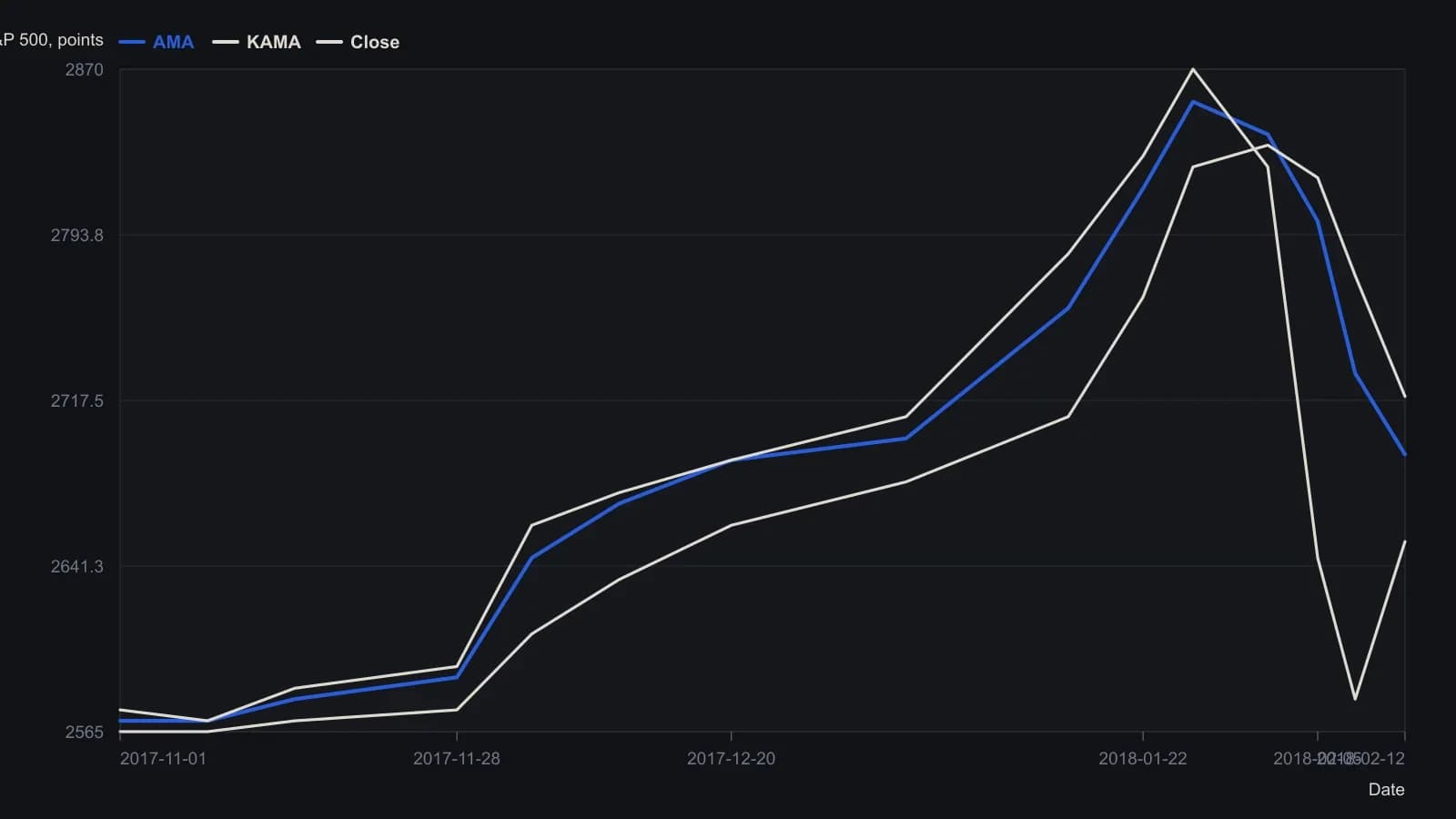
Study settings printed on the chart are fast 2, period 10, slow 30. Interior levels are approximate to the 20-point price grid; only the three right-scale tags are exact.
Sideways markets and an extra Trend filter
Commentary on the crossover system states that sideways markets remain a main source of failed signals. An additional market or Trend filter can be used to reduce further whipsaws.
Relative to a simple price-versus-Kaufman-average cross, adding the second Adaptive moving average is described as reducing but not eliminating whipsaws.
Hold the cross for a chosen number of bars
A further bar-count confirmation is proposed. Treat an Adaptive moving average versus Kaufman Adaptive moving average cross as official only after it has been sustained for a chosen number of bars.
On one illustrated chart, a one-bar or two-bar delay was not enough to ignore brief interruptions of the prevailing trend. A three-to-five-bar delay was noted as potentially costly if a true reversal held.
All readings on this track · 24 readings
- 1991Building variable-length moving averages from partitioned price changes
- 1991Variable-length moving average from change dispersion
- 1992Constructing volatility-adaptive exponential smoothing
- 1995Constructing an adaptive moving average with an efficiency ratio and filter
- 1995Two-gate breakout confirmation with adaptive averages
- 1995Building momentum-scaled adaptive moving averages
- 1995Adaptive length as a construction choice inside exponential smoothing
- 1998Testing price-channel breakouts with a lag-aware adaptive average
- 1998Constructing filters by nesting offsets and variable weights
- 1998Constructing an efficiency ratio adaptive average and entry filter
- 2001Encoding candle structure as a numeric filter
- 2001Adaptive averages driven by cycle-phase speed
- 2005Constructing an adaptive moving average from a fractal-dimension weight
- 2005Range-dimension adaptive exponential filter
- 2010Constructing simple, exponential, and adaptive averages
- 2010How a price-hugging smoother is assembled from ordinary averages
- 2013Evaluating an adaptive moving average against a same-window moving average
- 2016Three-layer confirmation: adaptive average, stochastic relative strength index, and stop-and-reverse
- 2017One-alpha reverse-path exponential smoothing
- 2018Pair two adaptive averages to filter swing turns
- 2018Two Adaptive moving averages as a confirmation pair
- 2018Constructing an adaptive filter for adoption-cycle reversals
- 2018Constructing a deviation-scaled adaptive moving average
- 2020Walk-forward and adaptive averages as two tests of the same trend