1995issue C101-2
Adaptive length as a construction choice inside exponential smoothing
A variable-length moving average can be built as an exponential smoother whose gain is scaled by a volatility measure from up-day and down-day closing increments. Only the closing-price series enters the worked adaptive-average calculation, which is seeded from an earlier close and may be shown with fixed 1 percent bands.
- A variable-length moving average can be built as an exponential smoother whose gain is scaled by a volatility measure from up-day and down-day closing increments.
- The relative-strength-index form uses the up-sum over the total of the up-sum and the down-sum. A companion oscillator uses the same sums with their difference in the numerator, and the absolute value of that ratio is the volatility scaler.
- The unscaled exponential constant is 2 divided by one plus the chosen base length, then multiplied by the absolute oscillator before the current close is blended with the previous adaptive value.
- The recursion is seeded with an earlier closing price, only the close enters the worked sheet, and fixed 1 percent bands are formed by multiplying the adaptive average by 1.01 and by 0.99.
The same blend, a variable gain
A variable-length moving average can be built as an exponential smoother whose gain is scaled by a volatility measure taken from up-day and down-day closing increments.
An adaptive moving average is a recursive average whose effective length shortens or lengthens when a volatility scaler raises or lowers the smoothing gain. Exponential smoothing is a one-step blend of the latest observation with the prior smoothed value, using a base constant of two divided by one plus a chosen length.
Advances, declines, and running sums
Period-to-period advances are stored as positive close-to-close differences and otherwise zero. Declines are stored as the absolute value of negative close-to-close differences.
The up-sum is the lookback total of period-to-period closing advances. The down-sum is the lookback total of the absolute values of period-to-period closing declines.
The worked construction used a 9-period window for the running up and down sums and a 12-period base length for the adaptive average. Other windows may be substituted if those formulas are changed to match.
Two readings from the same sums
The relative strength index is a bounded oscillator formed from the ratio of summed up increments to the total of summed up and down increments. In the worked form, that reading is one hundred times the up-sum divided by the total of the up-sum and the down-sum.
The companion oscillator uses the same two sums but places their difference in the numerator. The absolute value of that signed up-minus-down ratio is the volatility scaler, used to multiply the exponential gain.
From base constant to scaled blend
The unscaled exponential constant equals 2 divided by one plus the chosen base length. That constant is then multiplied by the absolute oscillator before blending the current close with the previous adaptive value.
Seeding and the close-only input
The recursion is seeded with an earlier closing price rather than being copied from the first row of the sheet.
Only the closing-price series enters the adaptive-average calculation in the worked sheet. The other listed price fields are unused.
Percentage envelopes around the average
Fixed 1 percent bands around the adaptive average can be formed by multiplying that average by 1.01 and by 0.99. A percentage envelope is a pair of fixed fractional offsets drawn above and below the adaptive average.
VIDYA adaptive average with 1 percent envelopes
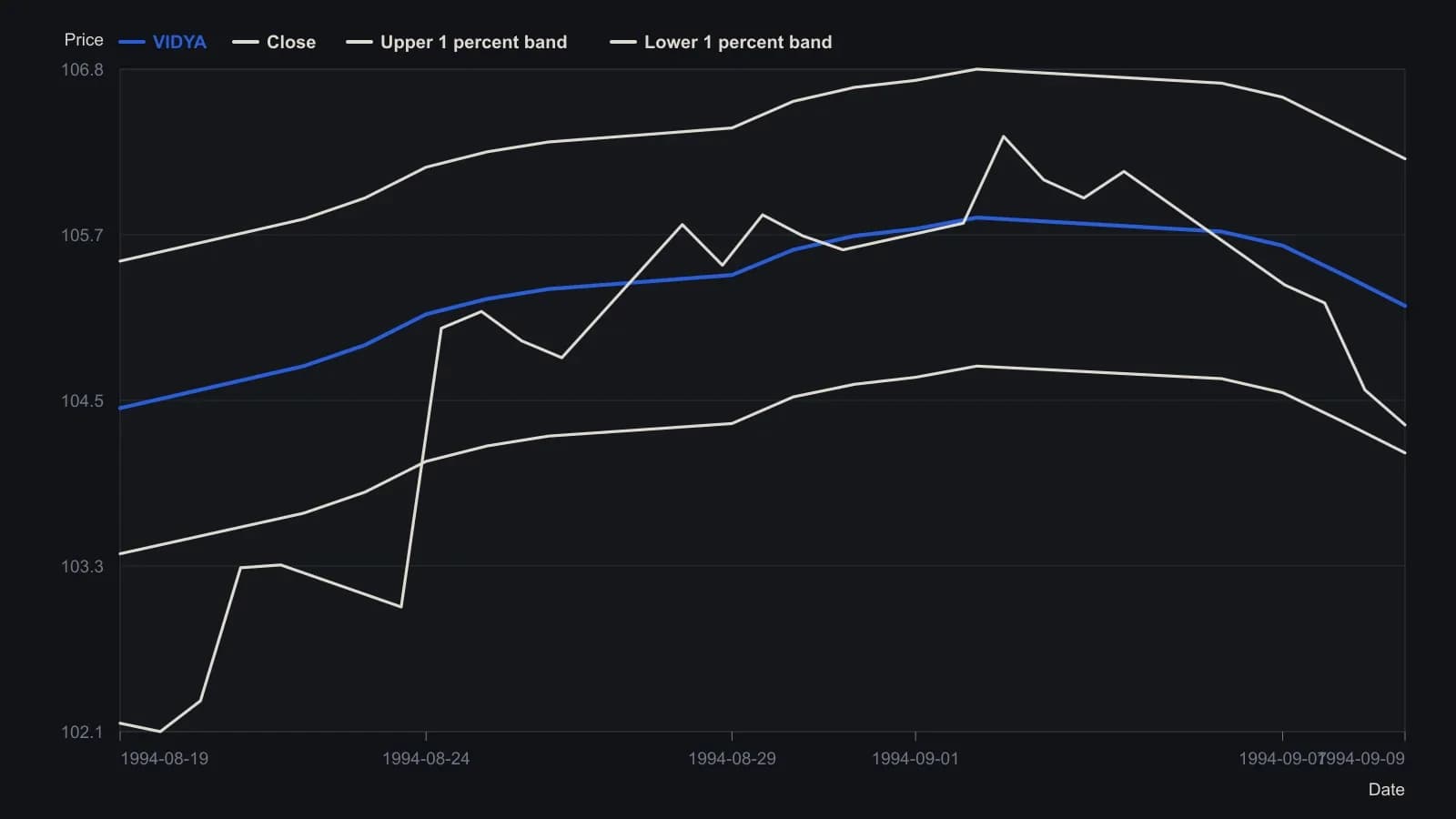
The sheet holds a 12-period base gain of 0.15 and starts printing VIDYA only once the nine-day CMO window is filled; the bands are a display overlay, not a second model.
All readings on this track · 24 readings
- 1991Building variable-length moving averages from partitioned price changes
- 1991Variable-length moving average from change dispersion
- 1992Constructing volatility-adaptive exponential smoothing
- 1995Constructing an adaptive moving average with an efficiency ratio and filter
- 1995Two-gate breakout confirmation with adaptive averages
- 1995Building momentum-scaled adaptive moving averages
- 1995Adaptive length as a construction choice inside exponential smoothing
- 1998Testing price-channel breakouts with a lag-aware adaptive average
- 1998Constructing filters by nesting offsets and variable weights
- 1998Constructing an efficiency ratio adaptive average and entry filter
- 2001Encoding candle structure as a numeric filter
- 2001Adaptive averages driven by cycle-phase speed
- 2005Constructing an adaptive moving average from a fractal-dimension weight
- 2005Range-dimension adaptive exponential filter
- 2010Constructing simple, exponential, and adaptive averages
- 2010How a price-hugging smoother is assembled from ordinary averages
- 2013Evaluating an adaptive moving average against a same-window moving average
- 2016Three-layer confirmation: adaptive average, stochastic relative strength index, and stop-and-reverse
- 2017One-alpha reverse-path exponential smoothing
- 2018Pair two adaptive averages to filter swing turns
- 2018Two Adaptive moving averages as a confirmation pair
- 2018Constructing an adaptive filter for adoption-cycle reversals
- 2018Constructing a deviation-scaled adaptive moving average
- 2020Walk-forward and adaptive averages as two tests of the same trend