2010issue C0956-63
A consensus filter for objective RSI and smoothing construction
This archive article teaches a construction that binds a Relative Strength Index forecast and an exponential-smoothing forecast to one consensus filter, so only candidate setups that match shared pattern-quality rules are retained.
- Relative Strength Index is treated as a formula-driven forecast on ordered price observations, not as visual pattern identification.
- Exponential smoothing is a mathematical indicator construction that can be scanned systematically across series.
- A consensus filter first casts a wide net of candidates, then keeps only setups that match shared expert-rule elements such as symmetry, volume, and spacing.
- Chart-pattern rules remain subjective even after automation, so they are combined with formula-based indicators rather than used as standalone signals.
Formula-driven forecasts, not isolated chart shapes
The featured construction treats Relative Strength Index as a formula-driven forecast on ordered price observations. That treatment is distinct from visual pattern identification. In this workflow, Relative Strength Index is a bounded momentum forecast built from ordered price observations over a defined lookback.
Exponential smoothing is included as a mathematical indicator construction that can be scanned systematically across series. It is a recursive forecast that weights recent observations more heavily than older ones.
ABT daily price, November 2009 to 2 July 2010
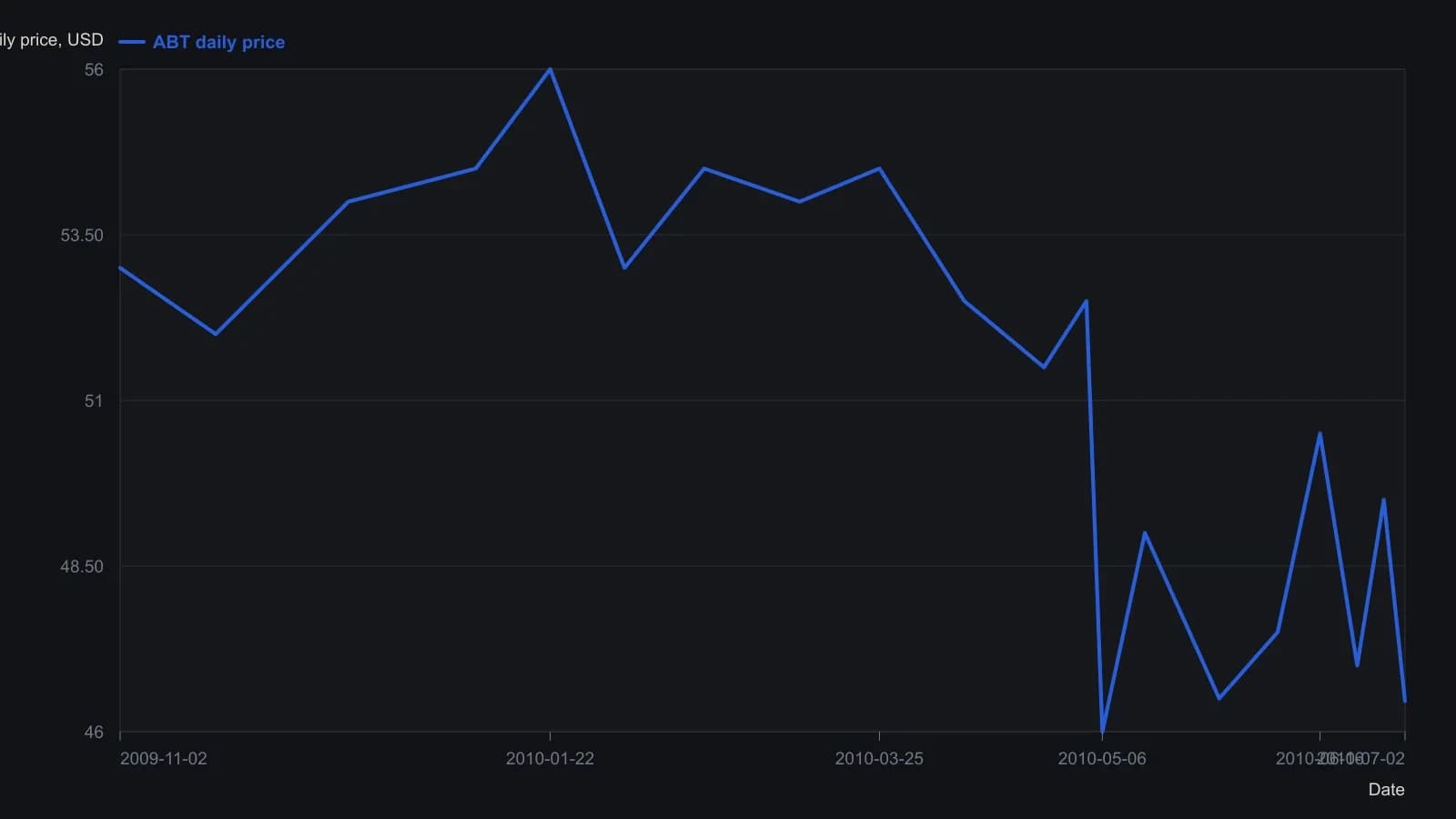
Eight months of daily bars sit in a small pane, so intermediate prices are only good to about half a dollar. Last-bar overlay prints at 50.71 and 47.58, and the lower-pane 38.05 reading the review ties to MA(RSI(15),15), are single-session annotations and were not traced as series.
Build the consensus filter from shared expert rules
A consensus filter is a construction step that retains only candidate setups matching shared expert-rule commonality. The filter first casts a wide net of candidate setups, then keeps only those matching shared expert-rule elements such as symmetry, volume, and spacing.
Different identification rules can label different patterns in the same price region, so an explicit rule set is required for repeatable construction. The construction pairs both formula-based forecasts with that shared rule set rather than treating isolated chart shapes as standalone signals.
Judge the later forecast on a defined breakout horizon
A breakout horizon is the sampling interval after a setup forms during which a later forecast is evaluated. A historical-database study concluded that setups can have trading value, with a higher chance of reaching targets if evaluation waits longer than the formation period. The study described waiting as long as three times the formation length before judging whether a setup reached its target.
Identifying a candidate before the breakout is presented as a way to enter earlier than the later price jump.
Editorial reading of the construction
Editorial interpretation, not an archive claim: the construction is more objective when both forecasts pass through the same consensus filter, because chart-pattern rules remain subjective even after automation. The archive describes the historical workflow. This reading does not add a performance claim.
All readings on this track · 41 readings
- 1984Matching average age across price filters
- 1984Residual-impact construction of exponential smoothers
- 1988Constructing simple and exponential moving averages as specified filters
- 1989Evaluating smoothed free reserves and funds-discount spreads
- 1990Integer construction of moving averages and exponential smoothing
- 1990Constructing incremental moving average filters
- 1991Constructing a double-smoothed stochastic oscillator
- 1991Constructing an exponential average from a smoothing weight
- 1991Constructing a double-smoothed momentum oscillator family
- 1991Competing certainty rules from exponential-average conditions
- 1991Hybrid construction of a mechanical timing system from smoothed signals
- 1991Constructing an exponential smoother from a moving-average length
- 1991Equivalent relative-strength-index constructions from a ratio and from smoothed momentum
- 1991Constructing the true strength index from double-smoothed momentum
- 1991True strength index from signed, double-smoothed momentum
- 1992Constructing exponential averages from simple lookbacks
- 1992Constructing exponential averages by the smoothing constant, startup length and lag
- 1992Nested range smoothing and windowed high-low damping
- 1992A weekly equity stance from the discount-bill spread
- 1993Double-smoothed stochastics momentum index construction
- 1993Constructing the true strength index with double exponential smoothing
- 1994Polarized fractal efficiency with a shared exponential smoother
- 1994Five-interval exponential smoothing of ten-interval signed path-efficiency
- 1994Hand-ranked price-volume series with stacked smoothing and stochastic
- 1995Range expansion filter on multi-horizon averages
- 1995The exponential smoothing constant from averaging lag
- 1997Construct a nested-average rainbow band and oscillator
- 1998Filter stacks that combine a moving average with exponential smoothing
- 2002Smoothed relative-strength construction from wilder-averaging and a price prefilter
- 2003Reverse-engineered RSI price targets
- 2004Piecewise trend quality from moving-average reversals
- 2004Nested smoothing recipes versus unaudited oscillator experiments
- 2008Weight construction beyond the N-day label
- 2010A consensus filter for objective RSI and smoothing construction
- 2012Sentiment-zone oscillator from signed closes
- 2012Classic RSI one-over-N smoothing versus the standard exponential average
- 2013Why exponential smoothing uses two over n plus one
- 2015Constructing ratio indicators with moving-average and exponential-smoothing weights
- 2015Slow relative-strength index from an exponentially smoothed price
- 2017Rebuilding the relative strength index as open-scale buy-sell pressure
- 2017Comparing Wilder and exponential smoothing inside a relative-strength index