1996issue C071-4
The Alpha coefficient as a signed Trend filter for treasury bonds
This archive article teaches a two-market Linear regression intercept as a signed bond-versus-cyclical-proxy bias, then follows the historical check that the sign of that intercept split later bond returns before the reading is treated as a Trend filter.
- The Alpha coefficient is the intercept of a Linear regression of one return series on another, reused here as a bond-versus-cyclical-proxy bias reading.
- Two daily price series are converted to log returns, a rolling nine-observation intercept is estimated, and that intercept is smoothed with a twelve-period simple average.
- The sign of the smoothed intercept is used as a two-state Trend filter: above zero for a long or buy bias, and below zero for a short or sell bias.
- Editorial reading: require that the sign of the intercept actually split later returns before treating the reading as a Trend filter.
The intercept as a bias reading
A stock-style Alpha coefficient is the intercept of a Linear regression of one return series on another. That intercept is reused here as a bond-versus-cyclical-proxy bias reading.
The fitted relation is bond return equals alpha plus beta times a cyclical chemical-sector proxy return, so a positive intercept is read as an upward bond bias if the proxy is unchanged.
How the reading is built
The construction converts two daily price series to log returns, estimates a rolling nine-observation regression intercept, then smooths that intercept with a twelve-period simple average.
A two-state sign rule
The sign of the smoothed intercept is used as a two-state Trend filter. A reading above zero is treated as a long or buy bias and a reading below zero as a short or sell bias.
Daily alpha intercept of T-bonds versus FSCHX
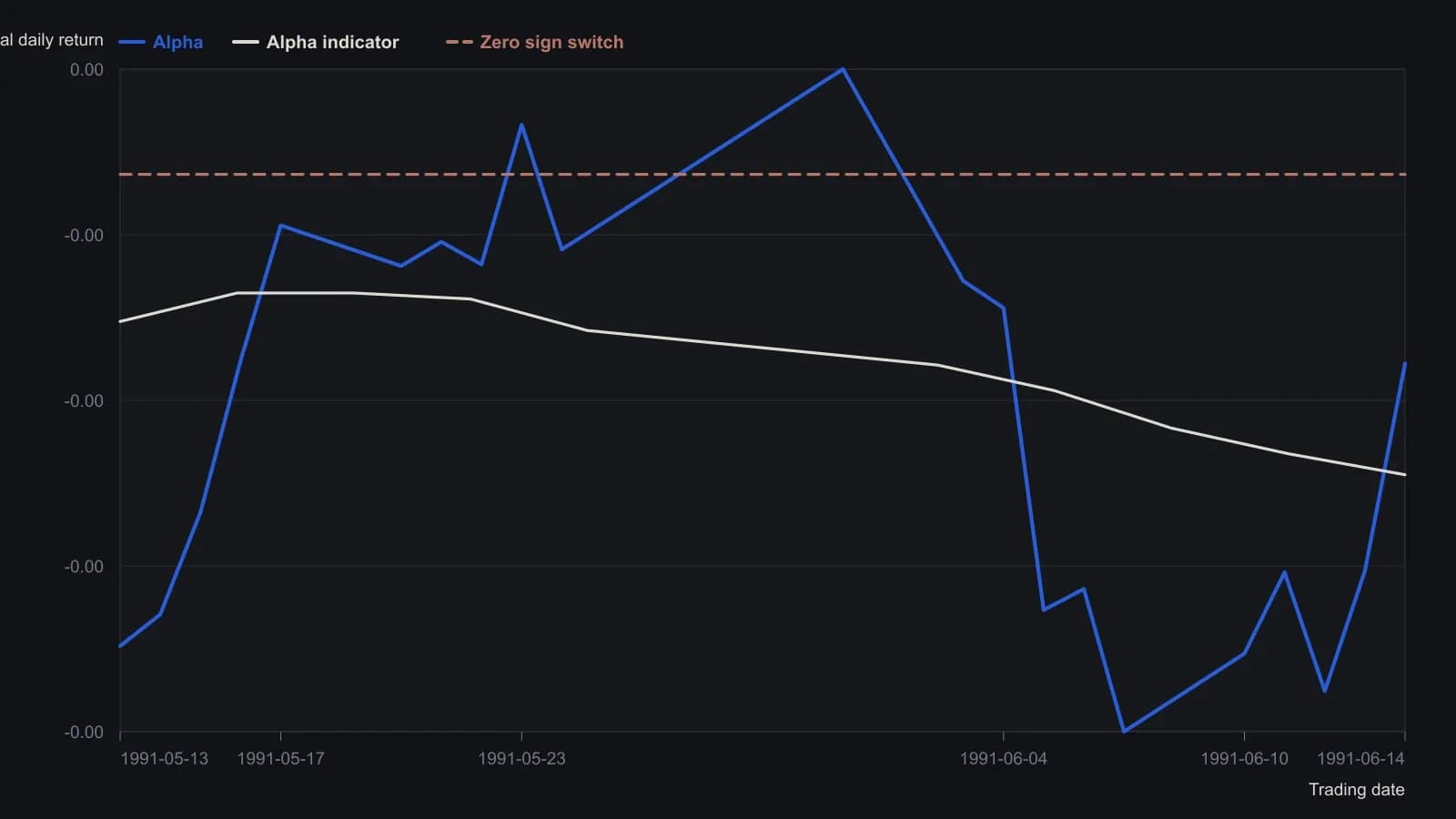
Alpha first appears on 13 May 1991, after enough daily-return pairs exist for the two-market regression. The alpha-indicator column begins only on 3 June 1991, after a further smoothing lag. The zero line is the sign switch the article uses as the buy/sell rule.
A historical sign split of later returns
A five-day-ahead bond-return series from January 3, 1991 to April 3, 1996 was split by the sign of the Alpha coefficient reading into two groups of 600 observations each, for 1,200 observations in total.
In that split the mean five-day return was 0.002945 after positive readings and -0.0016 after negative readings, versus 0.000701 for the full series. A two-sample t-test on those group means produced a t-statistic of 6.63, treated in the historical test as evidence that the sign split separated later five-day returns.
The same sign rule was also run as a one-contract long-when-positive, short-when-negative overlay from January 1991 to April 1996, with commissions and slippage omitted.
Where the construction is meant to travel
The intercept method is presented as reusable beyond monthly equity work when the two series are fundamentally related, and as either a standalone signal or a confirming Trend filter.