2005issue C031
Constructing a volume and change weighted moving average
This archive article walks through a moving-average construction that adds change magnitude and bar volume as extra inputs, then blends the two weighted series into one line.
- A simple moving average is presented as a noise filter that reports where an ordered series has already been.
- The change-weighted average turns each absolute preceding change into a percentage weight inside the lookback window, then sums the weighted observations.
- The volume-weighted average turns each observation's volume into a percentage weight inside the same window, then sums the weighted observations.
- The blended volume-change average is the arithmetic mean of those two contemporaneous series, and the same procedure is specified for a 10-period window and a 20-period window.
What a simple average reports
A simple moving average is presented as a noise filter that reports where an ordered series has already been. The construction adds two extra inputs to that average: the magnitude of successive datapoint changes and the volume attached to each datapoint.
How the change-weighted average is built
The change-weighted average assigns each lookback observation a weight equal to the absolute preceding change divided by the sum of all absolute changes in the window, then sums the weighted observations. Those multipliers are percentage weights, each observation's share of the window total before the weighted values are added.
A four-period change-weighted window first sums four successive absolute differences between adjacent datapoints, then converts those differences into percentage weights.
How the volume-weighted average is built
The volume-weighted average assigns each lookback observation a weight equal to that observation's volume divided by the sum of volumes in the same window, then sums the weighted observations. The lookback window is the fixed count of successive ordered observations used to compute both weight sets.
How the two series are blended
The blended volume-change average is the arithmetic mean of the contemporaneous change-weighted and volume-weighted averages. The same weighting procedure is specified for both a 10-period window and a 20-period window.
Four-period VOMOMA against MOMA, VOMA and close
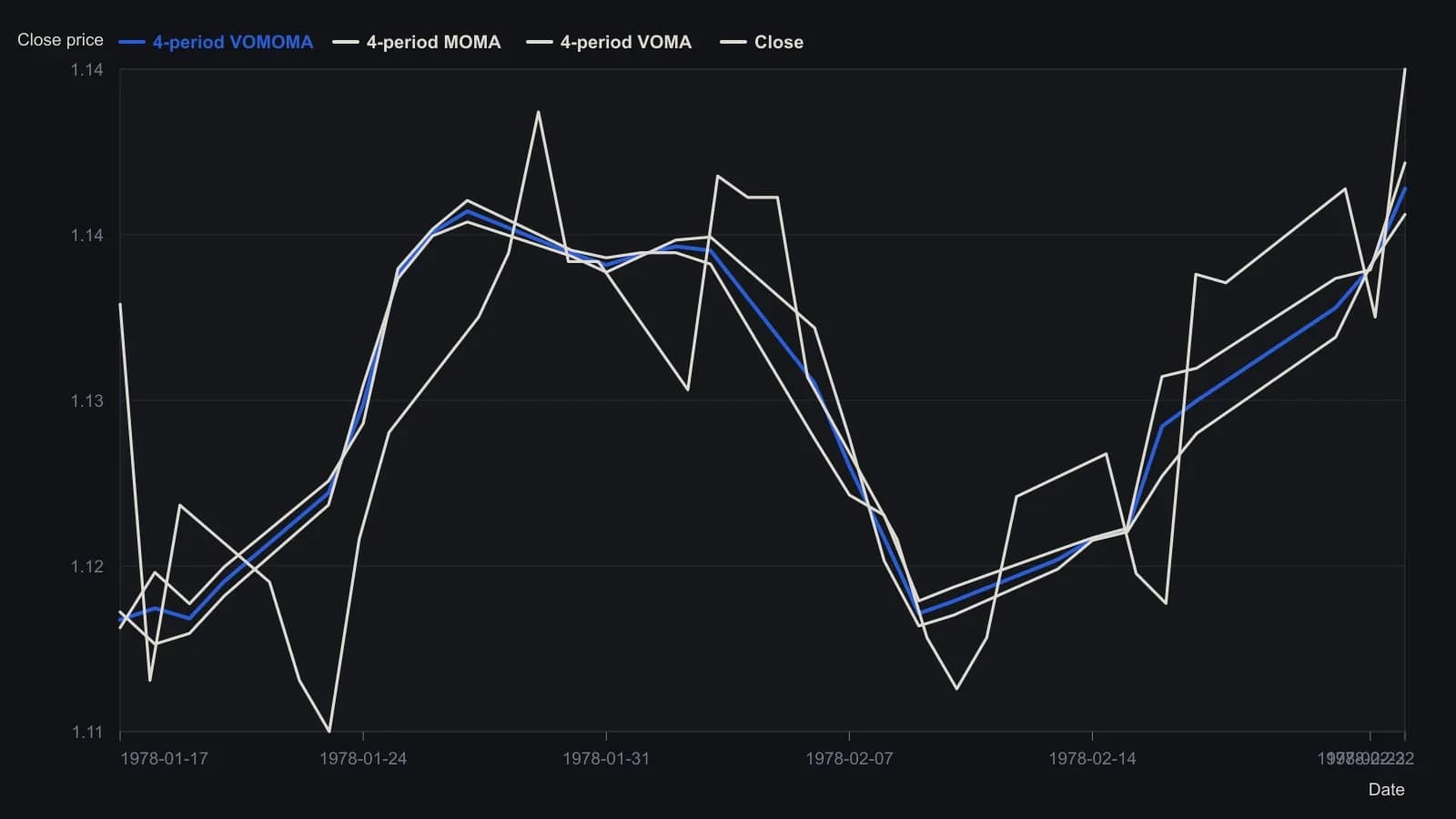
Lookback is four bars. Each MOMA weight is that bar’s absolute close-to-close change divided by the sum of those four changes; each VOMA weight is that bar’s volume divided by window volume. VOMOMA is the arithmetic mean of the two.
All readings on this track · 19 readings
- 1989T-bond volume-price boxes and a withheld rectangle top
- 1990Constructing ease of movement from volume-scaled boxes
- 1990Weekly four-stage mapping with average, range, and volume
- 1996Constructing volume-confirmed average-cross entries
- 1996Constructing four MFI bar states from range and volume
- 2001Building in-gear volume-price overlays
- 2004Constructing index volume for price-volume signals
- 2004Auditing volume-on-retest rules for prior highs and lows
- 2004Wait-rule collapse in a mistaken sale cascade
- 2005Constructing a volume and change weighted moving average
- 2005Daily average support and Friday volume holds
- 2007Match a volume-price oscillator to a range, not to a policy rebound
- 2008Volume confirms chart pattern breakouts
- 2011Color-coded volume bars for rule-based swing entries
- 2012Go or no-go checklist at repeated resistance
- 2012Pocket-pivot volume rules before a later breakout
- 2014Constructing defended price lines from volume spikes
- 2016Closing score from range location as a volume-checked sentiment filter
- 2019Volume follows price as auction state