2008issue C111-30
Constructing stacked moving-average filters
A stacked moving-average is specified by applying the same averaging method to one input series at several fixed lookbacks, so each length is an explicit filter rather than a decorative overlay.
- A stacked construction applies the same averaging method to one input series at several fixed lookbacks.
- The short-term-group uses lookbacks of 3, 5, 8, 10, 12, and 15 sampling intervals.
- The long-term-group uses lookbacks of 30, 35, 40, 45, 50, and 60 sampling intervals.
- Both groups sit on the same input series and the same averaging method.
What a stacked construction specifies
A moving-average is a lookback smoother applied to an ordered price series at a defined sampling interval. It is used here as a quantitative baseline rather than a trading signal.
A stacked moving-average construction can be specified by applying the same averaging method to one input series at several fixed lookbacks.
The short-term-group
The short-term-group is the faster members of a stacked moving-average set, typically built from short lookbacks on the same input series.
Short-horizon members of that stack can be defined with lookbacks of 3, 5, 8, 10, 12, and 15 sampling intervals.
The long-term-group
The long-term-group is the slower members of a stacked moving-average set, typically built from longer lookbacks on the same input series.
Long-horizon members of that stack can be defined with lookbacks of 30, 35, 40, 45, 50, and 60 sampling intervals.
Daily Apple with a three-anchor MIDAS stack
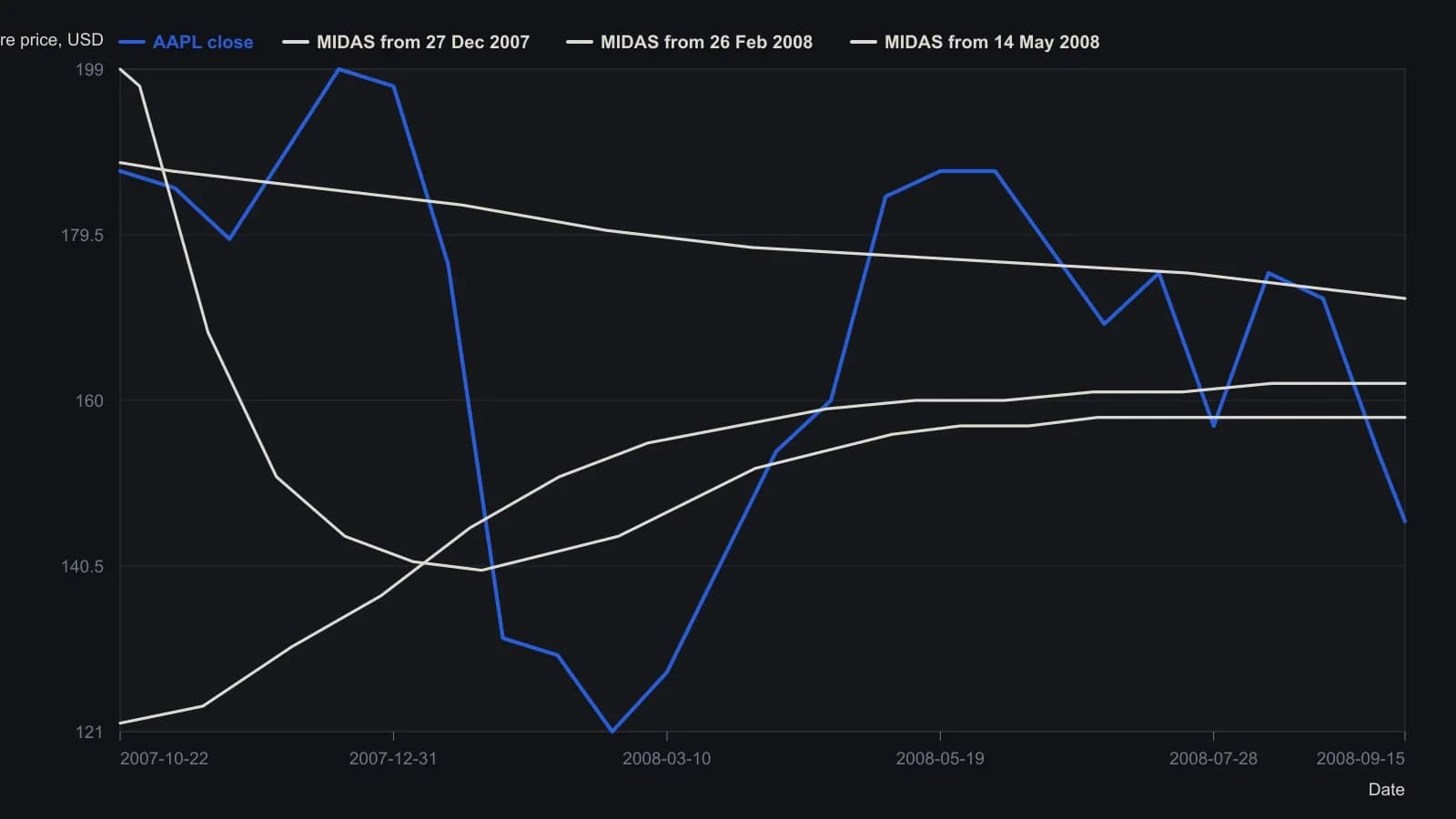
Y values are approximate readings from the labeled dollar axis except the final 145.76, which is printed on the scale. MIDAS anchors come from the chart legend. Raster resolution supports about one-dollar precision.
How to assemble the stack
Apply the same averaging method to the chosen input series at every lookback in the short-term-group and the long-term-group.
Editorial reading: once those lookbacks are fixed, the stack is a set of comparable moving-average filters on one series, not a mix of unrelated overlays.
All readings on this track · 15 readings
- 1990Building a percent-difference moving-average oscillator
- 1991Ease of movement oscillator construction
- 1993A twelve-month moving-average filter for inflation direction
- 1993Constructing two-endpoint JSA moving averages
- 1999Centered moving averages for trend construction
- 2000Constructing a slope-corrected moving average
- 2000Lookback length as a construction check for the modified moving average
- 2001Smoothing balance of market power with a moving average
- 2005Three-state moving-average directional breakout construction
- 2005Constructing a move-adjusted moving average
- 2005Moving-average construction: windows, weights and stops
- 2008Constructing stacked moving-average filters
- 2011Constructing percentage-offset moving-average bands
- 2015Linearity, commutation, and ratio smoothing in moving averages
- 2019Constructing a 50-200 sma-channel for swing entries and exits