1992issue C021-12
A KST oscillator from a weighted rate-of-change stack
Four smoothed rate-of-change series, weighted in proportion to their time spans, form a KST composite. A short moving average of that composite supplies a crossover signal, while longer averages and majority-vote barometers are used for confirmation.
- A rate-of-change oscillator divides the current-period price by the price n periods earlier, so a 10-day series compares today's price with the price 10 days ago.
- Four smoothed rate-of-change series, weighted 1, 2, 3, and 4 and then divided by 10, form a KST composite that is not limited to one cycle length.
- The same recipe scales from a 10- to 30-day stack to 10- to 20-week and 9- to 24-month versions.
- A 15-day average of the short-horizon oscillator is an example moving-average-crossover rule, while a 12-month average and a six-of-ten consensus barometer are used for confirmation rather than an exact historical fit.
A rate-of-change oscillator is constructed by dividing the current-period price by the price n periods earlier. A 10-day example uses today's price over the price 10 days ago.
Why a single rate-of-change can mislead
A single rate-of-change series reflects only one cycle length. It can mislead when another cycle dominates or when a strong trend is in force. Wide trading ranges are the setting where that single series is described as more useful.
Four smoothed series become one KST
One construction that addresses that single-cycle fragility is to combine four smoothed rate-of-change oscillators into one composite, weighting each series in rough proportion to its time span.
A short-horizon composite can be built from 10-, 15-, 20-, and 30-day rates of change. Each series is smoothed with a 10-day simple moving-average, except the 30-day series, which uses a 15-day simple moving-average. Those four smoothed series are then weighted 1, 2, 3, and 4 respectively, summed, and divided by 10, the sum of the weights.
That weighted sum is the KST: four separately smoothed rate-of-change oscillators, with heavier weight on the longest lookback, then scaled by the sum of the weights.
The same recipe at longer horizons
The same recipe scales to other horizons. An intermediate version can use 10-, 13-, 15-, and 20-week rates of change. A long-term version can use 9-, 12-, 18-, and 24-month rates of change.
A short average turns the composite into a signal
The composite is often paired with a short moving-average of itself as a moving-average-crossover rule. A 15-day simple average of the short-horizon oscillator is given as an example, with a cross below that average from a high reading treated as a sell signal.
A 12-month moving-average is described as the most reliable long-term average across most markets in this construction discussion, while still failing from time to time.
Confirmation by majority, not a fitted turning point
Business-cycle stage is framed as a confirmation problem. A stock-price peak is treated as more consistent when a bond index is below its 12-month moving-average and a commodity index is above its 12-month moving-average.
A consensus barometer tallies many imperfect indicators with a majority threshold, six of ten, rather than fitting historical peaks and troughs exactly. The design is intended to reflect the future environment instead of an overfitted past.
Gold with its 26-week average, 1982–1989
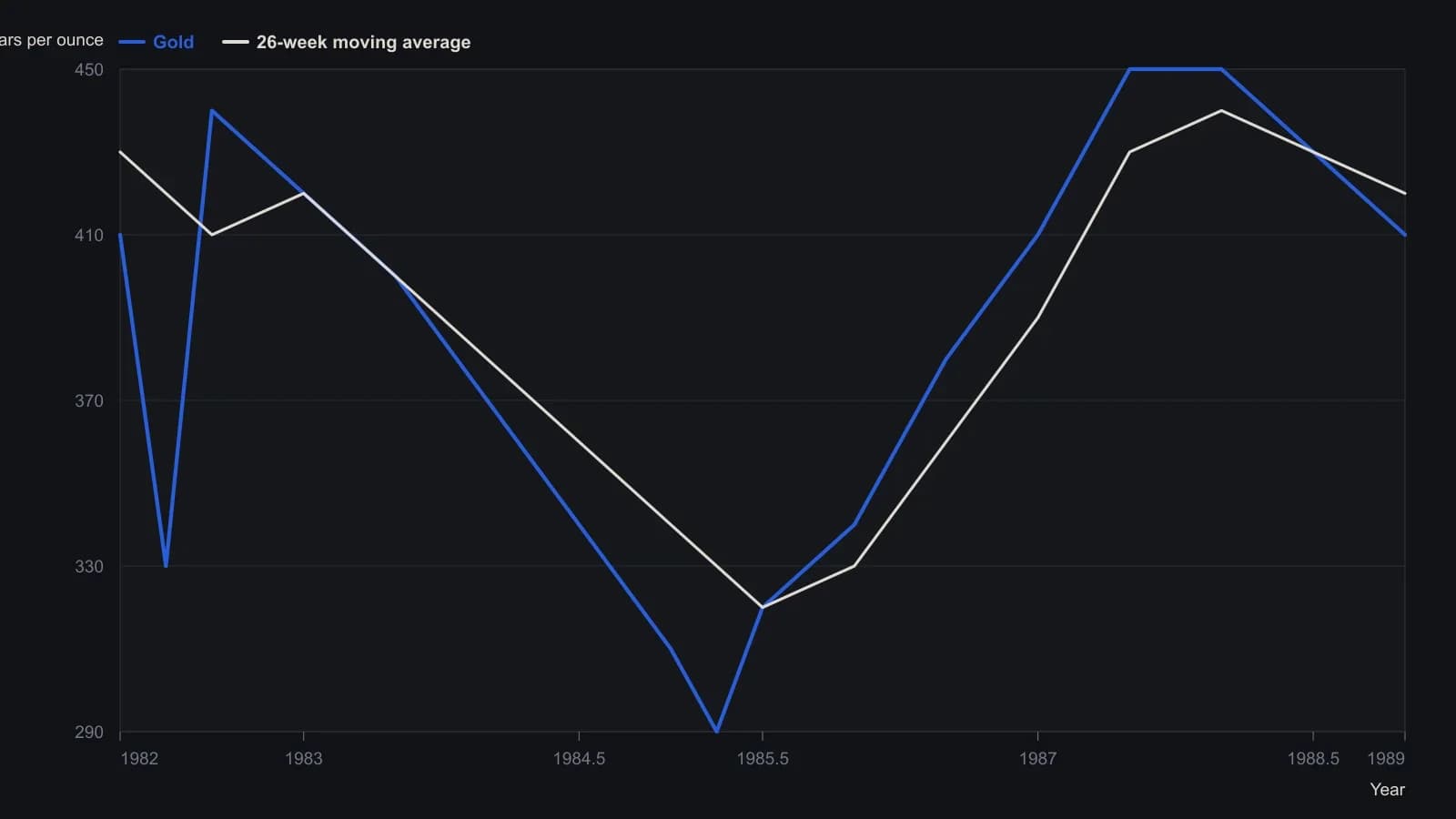
Digitized from a rotated magazine scan; prices rounded to the nearest $10 against the printed 250–550 scale. Calendar time follows the printed 1982–1989 year marks.
All readings on this track · 46 readings
- 1985Constructing excess and momentum difference-curve oscillators
- 1988Five reading rules for smoothed indicator charts
- 1989Momentum overlays that speed moving-average oscillators
- 1990A laboratory template that constructs Rate of Change as a pane module
- 1991Volume-scaled rate of change as a momentum construction
- 1991Three-indicator market overview from tape, sentiment and rates
- 1991Three-component trend model with rate-of-change filters
- 1992A KST oscillator from a weighted rate-of-change stack
- 1992Four-window weighted rate-of-change composite
- 1992Constructing multi-span smoothed rate-of-change filters
- 1992Constructing a four-horizon summed rate of change
- 1992Constructing KST from four weighted smoothed rates of change
- 1992Constructing a composite from weighted smoothed rates of change
- 1992Three-horizon KST maturity alignment
- 1992Construct a bond-led dividend-to-bond-yield regime first
- 1992Constructing relative-strength KST from weighted rate-of-change
- 1993Constructing a volume oscillator from average ratios and smoothed rate of change
- 1994Gold as a cycle clock for commodities and yields
- 1994Constructing a composite from weighted, smoothed rate-of-change windows
- 1994Constructing gold-mining rate-of-change tripwires for Treasury bonds
- 1994A capacity-stress checklist across commodities, bonds, and breadth
- 1994Rate of change parameters for testable entries
- 1994Constructing rate-of-change midpoints, lookbacks and divergence
- 1994Lead oscillator breaks need price trendline confirmation
- 1994Nested averages for an annual momentum curve
- 1994Evaluating a Coppock-style rate of change as a bottom-regime filter
- 1995A weighted eleven-month Dow rate of change as one testable timing procedure
- 1996Named lookbacks, thresholds, and streaks for entry rules
- 1997A midpoint rate-of-change test for bond trend follow-through
- 1997Constructing a short-rate-adjusted equity momentum filter
- 1998Daily momentum rank-churn as a portfolio-construction problem
- 1999Constructing a lagged rate of change cycle system
- 2000A triple delay line then a one-bar elliptic oscillator
- 2001Confirming rate of change divergences with price
- 2001Momentum trendline breaks need price confirmation
- 2001Market breadth, On-balance volume, and Rate of Change as a combined timing framework
- 2001Know Sure Thing with stacked horizons and trendline confirmation
- 2003Constructing a mechanical system from a rate of change condition
- 2003Constructing momentum from two closes and spotting divergence
- 2003Formula choice tilts which momentum mismatches count as divergences
- 2004RSI and momentum agreement as an asymmetric filter
- 2005Constructing price-normalized moving-slope hybrids
- 2005Unsigned speed gates on a fixed average-cross pair
- 2007Rebuilding rate of change as a path-weighted oscillator
- 2008Construct Special K so short-horizon signals stay inside the primary trend
- 2013Restore volume balance before adding another price-time indicator