2012issue C0278-81
MACD window tuning as hold-time control
The usual MACD series is the gap between a 12-period exponential average of the close and a 26-period exponential average of the close, with a 9-period signal-line for crosses. An editorial reading treats that published lookback-pair as a starting point: once exponential-smoothing is explicit, the same cross logic is hold-time control rewritten to a chosen horizon.
- The usual MACD series is the gap between a 12-period exponential average of the close and a 26-period exponential average of the close, compared with a 9-period signal-line.
- The lookback-pair sets how quickly the oscillator tracks a chosen hold horizon, and a longer-horizon variant uses a 25-period exponential average minus a 120-period exponential average.
- A zero-line-cross is presented as one way to stretch the decision horizon relative to the conventional signal-line cross.
- Knowing how exponential-smoothing and the seeding moving-average are built is framed as a way to avoid multicollinearity from stacked rules that repeat the same smoothed-price information.
The usual MACD series
MACD is a price oscillator formed by subtracting a longer exponential average of the close from a shorter one, then comparing that difference with a signal average or with zero. The usual series is the gap between a 12-period exponential average of the close and a 26-period exponential average of the close. A 9-period exponential average of that MACD series is the conventional signal-line for crosses.
One standard reading treats MACD at or above its 9-period average as a buy condition and a drop through that average as a sell condition.
Standard MACD and 9-day signal on the S&P 500
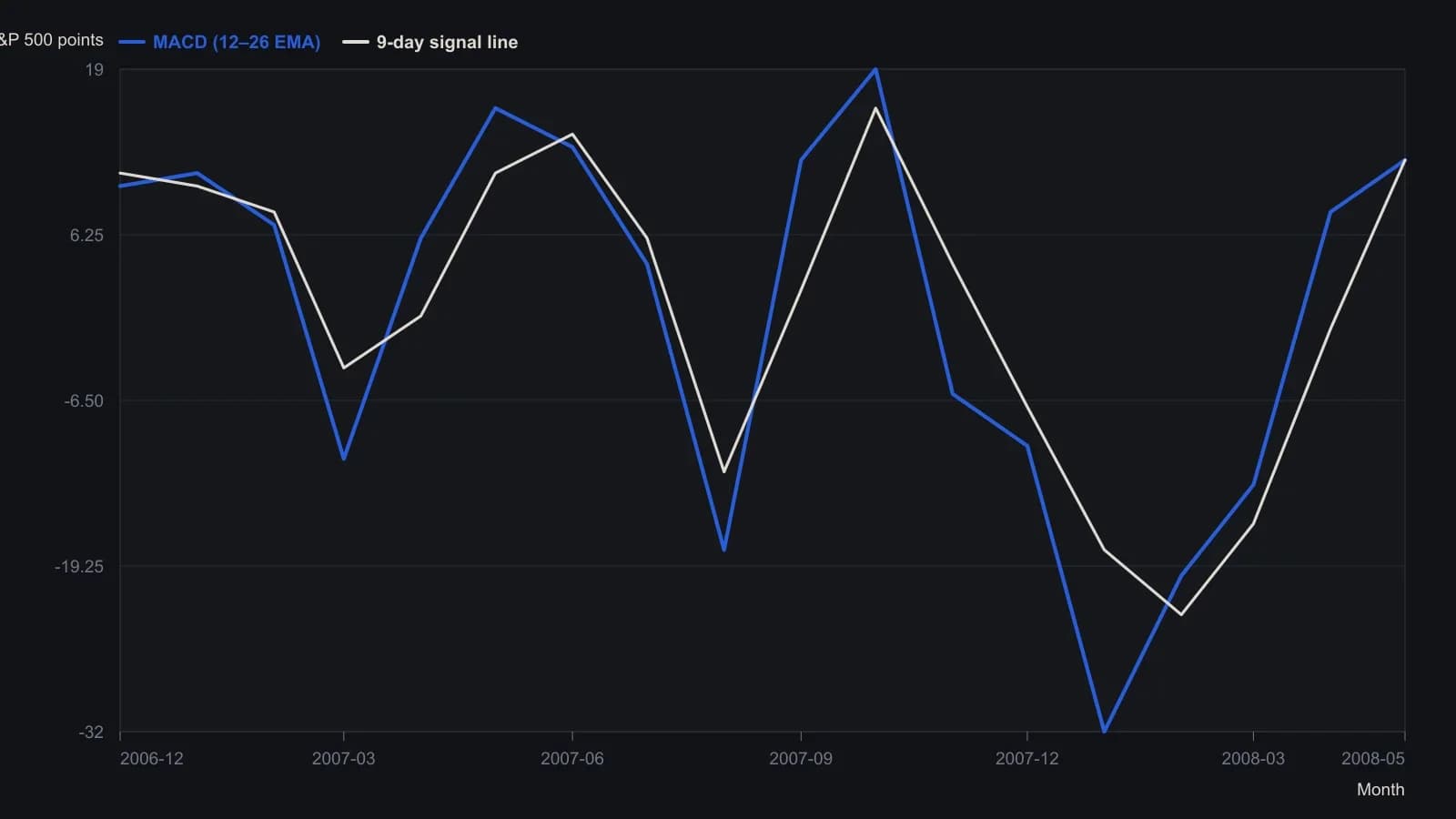
Published lookbacks are a 12-day EMA minus a 26-day EMA of the close, with a 9-day EMA of that spread as the signal. Raster readings are trustworthy to about two index points. Month labels mark 2007 and 2008 year ticks; the plotted high near 1570 and low near 1270 fix the window as late 2006 through spring 2008.
Exponential-smoothing and the seeding moving-average
Exponential-smoothing is a recursive average that applies a weight equal to 2 divided by one plus the lookback to the latest close and the remainder to the prior average. For a 26-period window that weight is 0.075.
When no prior exponential average exists, the recursion is started from a simple moving-average of the same window. A moving-average is the ordered-price smoother used both to seed that exponential series and to set the two MACD lookbacks.
Horizon choices around the same cross logic
The lookback-pair is the two exponential-window lengths that set how quickly the oscillator tracks a chosen hold horizon. Replacing the signal-line cross with a zero-line-cross is presented as one way to stretch the decision horizon. A zero-line-cross is a slower alternative trigger that fires when the MACD difference changes sign.
Default MACD settings can flip during sideways price action even when the intended use is only larger trend turns. A longer-horizon variant replaces the default pair with a 25-period exponential average minus a 120-period exponential average.
Avoiding repeated smoothed-price rules
Knowing how each component is built is framed as a way to avoid stacking rules that repeat the same smoothed-price information. That overlap is multicollinearity: redundant overlap that appears when several rules are built from the same family of smoothed-price inputs.
All readings on this track · 80 readings
- 1988Rebuild MACD-Mo and MACD-H before treating them as signals
- 1989Four-span MACD lookbacks as perishable parameters
- 1989Weekly then daily MACD confirmation on individual stocks
- 1991Regime-gated MACD and stochastic rules inside a checklist
- 1991Constructing MACD signal lines and divergence tests
- 1991MACD parameter order and cycle phase lag
- 1992Lengthened bond MACD as an equity regime filter
- 1992Long-horizon MACD construction from paired exponential averages
- 1993Constructing a signed ten-point trend filter
- 1994Constructing lag-reduced double exponential averages for MACD
- 1994Seeding DEMA2 filters to build a MACD signal
- 1994Constructing MACD from lag-reduced exponential averages
- 1994TEMA1 from nested exponential averages, then a two-horizon MACD
- 1994Constructing entry and exit on a relative-strength MACD
- 1994Constructing a relative-strength MACD crossover spreadsheet
- 1995Consensus presignal filters for Relative Strength Index, MACD and the Stochastic oscillator
- 1997Confirm the MACD turn with price, then exit on the histogram
- 1997Reconstructing a stochastic oscillator, MACD, and a triple-smoothed oscillator
- 1997Moving-average windows before crossovers and MACD
- 1999Second-stage MACD on relative-strength inputs
- 1999Constructing MACD from exponential-average spreads for crossover and divergence
- 1999Coding candlesticks into numeric indicators
- 2001Second-low confirmation with a percentage oscillator and money-flow filter
- 2001Constructing MACD from exponential average spreads and a signal line
- 2002Separate bounded and trend-following oscillator rules
- 2002Sort the regime before assigning MACD and stochastic jobs
- 2002Building classic divergence filters from RSI and MACD
- 2002Weekly highs and lows as trend gates
- 2002Constructing channel-normalized Fisher reversal signals
- 2002Affine-price and the Fisher transform as a constructed companion to MACD
- 2003Regularized EMA construction with a MACD line and a thrust oscillator
- 2003Curvature-penalized exponential averages versus MACD
- 2003MACD, moving averages, and a trend filter as one timing system
- 2003Fractional MACD and linear-regression reversal construction
- 2004Weekly MACD-histogram timing of bear-market rallies
- 2004Candlestick triggers filtered by MACD divergence
- 2004Staging energy-complex tops with trendline, breakout, and MACD
- 2005Selling climax holds versus fails
- 2006Treat a sideways Wave as permission before a breakout
- 2007MACD with a Stochastic oscillator for spotting trend reversals
- 2007Rebuilding an S&P 500 fifth-wave count after a broken target
- 2007Constructing MACD, RSI, and stochastic confirmation for futures
- 2007MACD histogram divergence needs a confirming close
- 2007Write the plan as a stack: ratio, boundary, then oscillators
- 2008MACD divergence and Stochastic oscillator confirmation on lumber futures
- 2008Assign confirmation, timing, and a stop before a currency pair is tested
- 2008Confirm the ten-bagger launch path before the MACD exit
- 2008Reading the offloaded evidence file
- 2008A Leader companion for MACD direction warnings
- 2008Relative strength exits with MACD averages and RSI
- 2008Assign one job per indicator in a three-screens rule set
- 2008Sequencing RSI, MACD, and average crossovers
- 2010Constructing the Schaff Trend Cycle from MACD and a dominant-cycle window
- 2010Schaff Trend Cycle as a MACD and Stochastic oscillator combination
- 2010Combining Relative Strength Index, the stochastic oscillator, and MACD as slope filters
- 2010Short-term wave and ratio clues without direction calls
- 2010A precise pullback entry and an unplanned profit-protection exit
- 2010Filtering MACD false signals with trendline breaks
- 2011Vendor feeds as an input variable in a MACD evaluation
- 2012Out-of-the-money versus in-the-money option sensitivity to implied volatility
- 2012MACD window tuning as hold-time control
- 2012Combining a moving-average crossover with MACD and support-resistance
- 2012Testing a published MACD entry with a histogram and signal-line agreement filter
- 2012Treat sample systems as a lab before live rules
- 2013Constructing moving averages and MACD from one price series
- 2013The next-bar price that forces a MACD signal-line cross
- 2013Constructing next-bar MACD reversal prices
- 2013Constructing inverted MACD reversal prices
- 2014Shared-filter combinations of the stochastic oscillator, MACD, and RSI
- 2014Square-root lookbacks for combined MACD and RSI
- 2015Audit open interest and trend before trusting oscillator crossovers
- 2016MACD without a signal line, confirmed by moving-average trend filters
- 2016Use RSI, MACD, and a moving average as a market-health consensus
- 2016MACD line versus histogram is a display problem first
- 2017Weekly and daily MACD on a single daily chart
- 2017Weekly and daily MACD as a stacked momentum filter
- 2017Nested weekly and daily MACD from paired EMA spreads
- 2018Weekly and daily PPO scale versus MACD, with bounded RSI and stochastic readings
- 2018Constructing a weekly and daily percentage price oscillator
- 2020Constructing Wyckoff tape reading with MACD, moving-average, and RSI filters