2002issue C071-6
Rebuild a smoother by writing the lag into the coefficients
A historical construction starts from a triangular Finite Impulse Response Filter, then changes the weights so a chosen amount of lag is removed. The same idea appears in a recursive Exponential smoothing form that combines a lead-adjusted close with the previous output.
- A six-element symmetrically weighted Finite Impulse Response Filter can be built as a triangular Moving average and implemented as a double-smoothed simple Moving average, or as weights 1, 2, 3, 3, 2, and 1 divided by 12.
- That six-element construction has a lag of 2.5 bars before any further adjustment. Taking the lag all the way to zero is described as producing too much overshoot, so a one-bar residual lag is presented as a compromise.
- An adjustable-lag Finite Impulse Response Filter uses seven coefficients and a lag-reduction input from 0 to 2.5. A minimum-lag set weights seven closes with 1, 3.5, 4.5, 3, 0.5, -0.5, and -1.5, then divides by 10.5.
- A zero-lag recursive form can be written from a period input by making a smoothing constant of 2 divided by periods plus one, then combining a lead-adjusted close with the previous output. One documented Exponential smoothing implementation uses a smoothing parameter of 0.2.
The triangular Finite Impulse Response Filter
These notes reconstruct Finite Impulse Response Filter and Exponential smoothing smoothers from stated weights and a chosen lag, including a triangular Moving average that can be written two ways.
A six-element symmetrically weighted Finite Impulse Response Filter can be constructed as a triangular Moving average. It can also be implemented as a double-smoothed simple Moving average.
The same six-bar triangular Finite Impulse Response Filter can be written as a weighted sum of the current close and five prior closes, with weights 1, 2, 3, 3, 2, and 1, divided by 12.
How far to reduce the lag
A six-element version of that Finite Impulse Response Filter construction has a lag of 2.5 bars before any further lag adjustment.
Reducing that lag all the way to zero is described as producing too much overshoot, so a one-bar residual lag is presented as a compromise.
Seven-coefficient Finite Impulse Response Filter forms
An adjustable-lag Finite Impulse Response Filter construction uses seven coefficients that incorporate a lag-reduction input in the 0-to-2.5 range. A value of 0 leaves the raw triangular average unchanged, and a value of 2.5 targets zero lag.
A minimum-lag Finite Impulse Response Filter construction weights seven successive closes with coefficients 1, 3.5, 4.5, 3, 0.5, -0.5, and -1.5 and then divides by 10.5.
A recursive Exponential smoothing form
A zero-lag infinite impulse response construction can be written from a period input by forming a smoothing constant of 2 divided by periods plus one, then combining a lead-adjusted close with a recursive previous-output term.
A recursive zero-lag Exponential smoothing construction combines a lead-adjusted close with a previous output, using a smoothing parameter of 0.2 in one documented implementation.
Minimum-lag FIR and recursive IIR on daily Microsoft
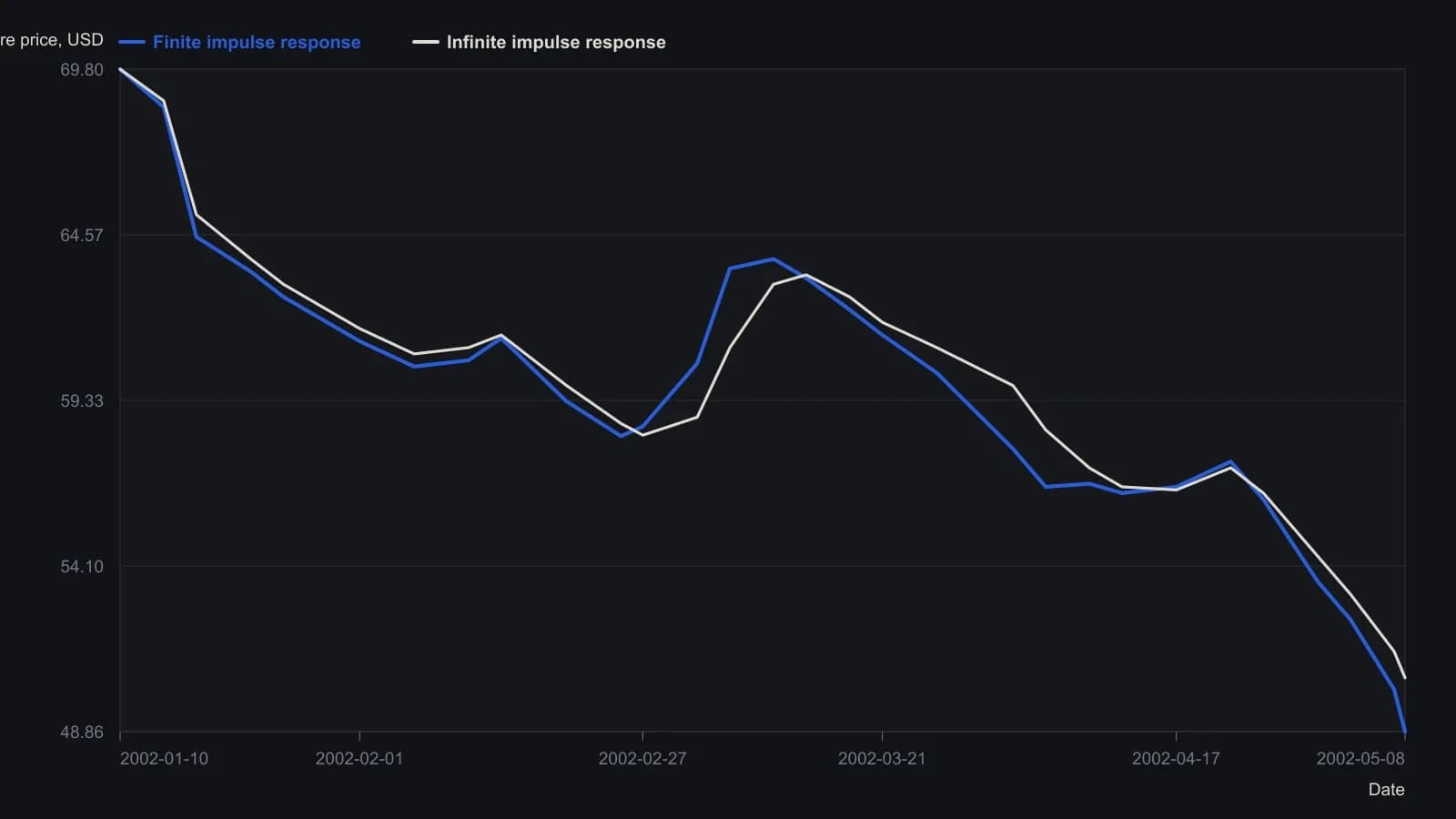
FIR is Ehlers’ seven-coefficient minimum-lag form (weights 1, 3.5, 4.5, 3, 0.5, −0.5, −1.5, divided by 10.5). IIR is 0.2×(2×Close−Close four bars back)+0.8×previous output. Digitized from the raster except the printed 2002-02-27 and final readings; y is good to about 0.3 dollars on the 2.50 grid.
All readings on this track · 10 readings
- 1982An odd-length smoother from a cycle cutoff
- 1989Smoothing filters, cutoff, poles, and sample delay
- 1992Constructing a cycle-aware finite impulse response detrender
- 2002Rebuild a smoother by writing the lag into the coefficients
- 2002Timing market cycles with finite impulse response filters and FFT
- 2002Constructing the relative strength index with an even-order finite-impulse-response prefilter
- 2003Recursive and cascaded moving-average construction
- 2006One second-order transfer function, a family of trend filters
- 2019Constructing the Voss line from a bandpass and a short FIR sum
- 2020Truncated bandpass construction as a finite-length trend filter