2002issue C031-3
Constructing TRIX from triple-smoothing to signal rules
TRIX is the percent rate of change of a closing-price series after triple-smoothing. Build that oscillator first, then treat the zero-line cross, an MACD-style signal line, and price-indicator divergence as competing readouts of the same series.
- TRIX is the percent rate of change of a closing-price series that has already been passed through three successive exponential moving averages.
- Triple-smoothing applies the same-length exponential average three times in sequence, then a one-interval rate of change is taken of the third average.
- Zero-line cross, a shorter signal line, and price-indicator divergence are separate rules on the same oscillator, not a single combined signal.
- Changing the nested average length and the percent-change interval tunes how often the oscillator signals and how long a trend it is meant to stay with.
Build the oscillator before choosing a readout
TRIX is constructed as the percent rate of change of a triple-smoothed exponential moving average of closing price. Triple-smoothing applies the same-length exponential average three times in sequence so each pass is taken on the previous average, not on raw price.
The build order is an n-period exponential average of the close, an n-period average of that result, an n-period average of the second result, then the one-interval percent change of the third average. That last step is a one-interval rate of change: the percent change of the third smoothed average over one sampling bar of whatever chart interval is in use.
Nine-period and twelve-period lengths are presented as common choices for each nested exponential average.
Three readouts of the same series
The finished series oscillates around a zero line. A cross above is treated as a long condition and a cross below as a short condition. That zero-line cross treats a move through the midline as the primary long or short condition.
A shorter moving average of TRIX can replace the zero-line rule, turning the same construction into an MACD-style pair. The shorter average is the signal line. A twelve-period TRIX with a nine-period signal line is one cited pairing.
Positive or negative divergence between closing price and TRIX is offered as a separate timing rule from the zero-line or signal-line cross. Price-indicator divergence is a mismatch in successive highs or lows between closing price and TRIX, used as an early reversal hypothesis rather than a midline cross.
TRIX on Nasdaq 100 Trust, May 2001–January 2002
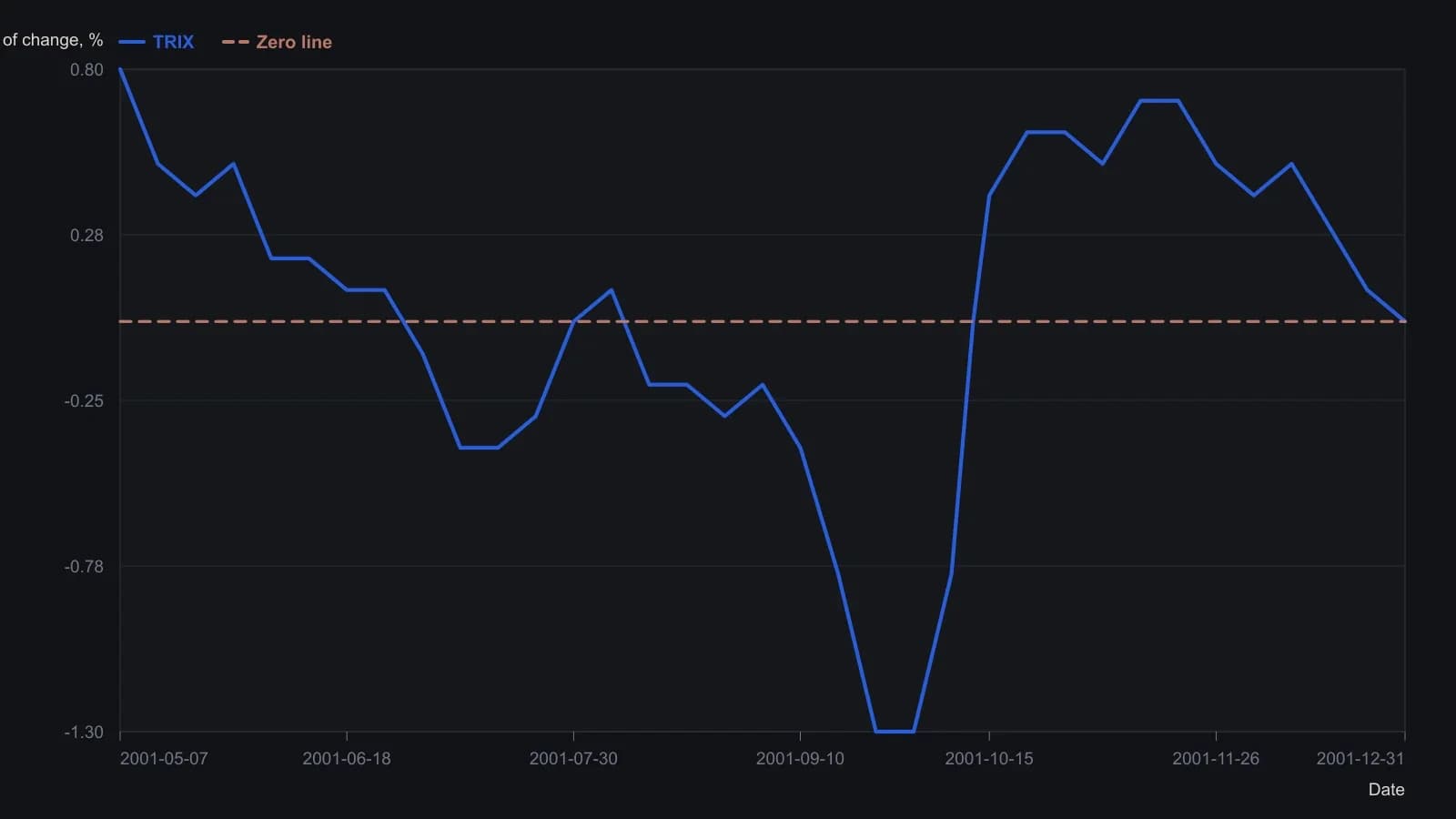
MetaStock pane is labeled TRIX (18,1000). Values are approximate to about 0.1 because they are read off the raster, not taken from a table. The 12 October zero cross is the date the article names.
Length, interval, and what the midline assumes
Changing the nested average length and the percent-change interval is described as the way to tune how often the oscillator signals and how long a trend it is meant to stay with.
In a range-bound example, a zero-line buy can reverse when the oscillator recrosses back below zero, showing that the midline rule assumes a developing trend.
A staged reading can treat a bounce from a TRIX trough as an initial condition, a later zero-line cross as confirmation, and a rollover from a TRIX peak as a reason to reduce the position.
All readings on this track · 15 readings
- 1984Constructing TRIX from a cutoff to one shared alpha
- 1988Isolate nested formulas before judging signals
- 1992Constructing TRIX from triple exponential smoothing
- 1992Constructing a TRIX oscillator from daily declines
- 1992A pre-trade checklist that stays flat until weekly support and TRIX agree
- 1992Constructing TRIX as triple-smoothed log-price momentum
- 1992Building TRIX crossover and momentum entries on a period grid
- 1992TRIX lookback and momentum derivative parameters
- 1994Seeding TEMA and DEMA with time-trend regression
- 1997Constructing the TRIX oscillator from triple smoothing
- 2002Constructing TRIX from triple-smoothing to signal rules
- 2002Lock the TRIX construction before reading a zero-line cross
- 2003Constructing TRIX from nested exponential averages
- 2004Construct TRIX entry, exit, and rest windows as one recipe
- 2004TRIX momentum and fundamental overlays for medium-term stock selection