1997issue C061-5
Constructing the TRIX oscillator from triple smoothing
TRIX is a zero-centered oscillator: the log of price is passed through three Exponential smoothing stages, then the one-bar change of the final smooth is scaled by 10,000 and plotted around a zero line.
- TRIX is built from the log of price, three successive Exponential smoothing stages, and a scaled one-bar change of the final smooth plotted around zero.
- Each Exponential smoothing stage uses a constant equal to 2 divided by the lookback plus one. A 21-period lookback yields 0.090909, and a longer lookback increases lag.
- A close of TRIX across the zero line, a reversal in the oscillator's own direction, and a Moving average overlay are separate trigger constructions.
- A time-series Moving average is the last point of a least-squares regression line, not an arithmetic average of the same points.
How TRIX is assembled
TRIX is built as a zero-centered oscillator. The log of price is passed through three successive Exponential smoothing stages, then the one-bar change of the final smooth is plotted around a zero line.
Each Exponential smoothing stage uses a smoothing constant equal to 2 divided by the lookback plus one. A 21-period lookback yields 0.090909, and the one-bar difference is scaled by 10,000.
Lengthening the lookback used in the triple smooth increases lag. A three-period setting is presented as filtering fluctuations shorter than three bars.
Triggers attached after the oscillator
Two explicit trigger constructions are a close of TRIX across the zero line and a reversal in the oscillator's own direction.
A leading-indicator construction overlays a Moving average of TRIX as a trigger. A time-series average is defined as the last point of a least-squares regression line rather than an arithmetic average of the same points.
Daily and five-minute S&P 500 illustrations
On daily S&P 500 bars from 17 October 1996 through 14 January 1997, a three-period zero-line construction tracked the advance from 708.00 to 760.00, while the direction-change construction produced a November 1996 whipsaw.
On five-minute S&P 500 bars, the 13 January 1997 session is shown as choppy and trendless, with bar-close signals failing until the final bar. The 10 January 1997 session is shown as trending, with the oscillator following most of the upward move.
On daily S&P 500 bars from November 1996 to mid-January 1997, seven TRIX signals were counted, of which two arrived before the turn by one day and by four days.
A Moving average overlay on Station Casinos
On Station Casinos, a three-day TRIX crossing below an eight-day time-series Moving average on 29 December preceded three further up days before the later decline. Replacing that overlay with an eight-day simple Moving average delayed the same sell and missed two lower closes.
Daily S&P 500 three-period TRIX, October 1996–January 1997
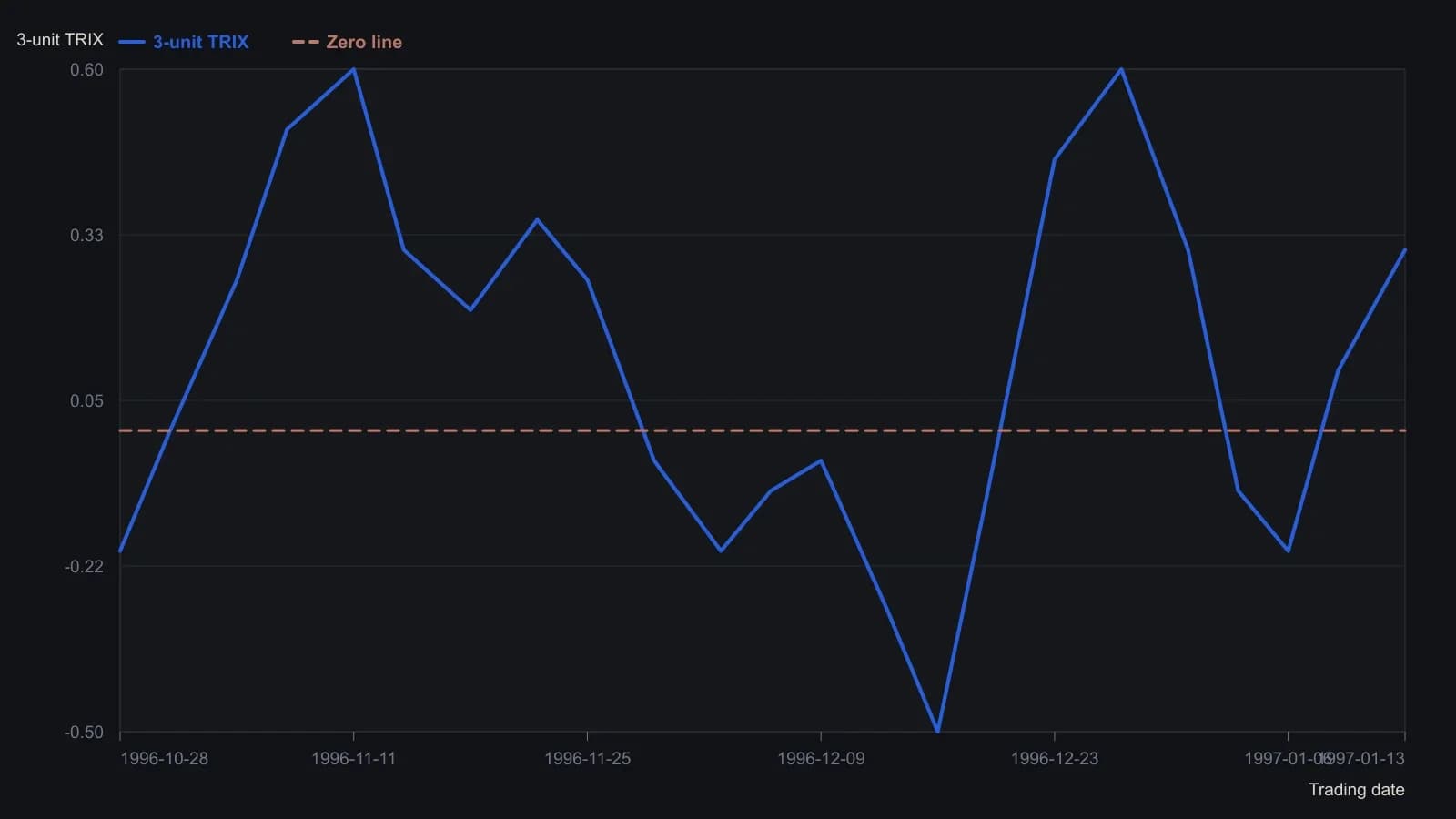
Lookback is fixed at three periods so swings shorter than three days are filtered. Values are approximate visual readings from the published −0.50 to 0.50 scale; the plot is the one-bar change of a triple exponential smooth, not a tabulated series.
All readings on this track · 15 readings
- 1984Constructing TRIX from a cutoff to one shared alpha
- 1988Isolate nested formulas before judging signals
- 1992Constructing TRIX from triple exponential smoothing
- 1992Constructing a TRIX oscillator from daily declines
- 1992A pre-trade checklist that stays flat until weekly support and TRIX agree
- 1992Constructing TRIX as triple-smoothed log-price momentum
- 1992Building TRIX crossover and momentum entries on a period grid
- 1992TRIX lookback and momentum derivative parameters
- 1994Seeding TEMA and DEMA with time-trend regression
- 1997Constructing the TRIX oscillator from triple smoothing
- 2002Constructing TRIX from triple-smoothing to signal rules
- 2002Lock the TRIX construction before reading a zero-line cross
- 2003Constructing TRIX from nested exponential averages
- 2004Construct TRIX entry, exit, and rest windows as one recipe
- 2004TRIX momentum and fundamental overlays for medium-term stock selection