1992issue C011-4
Constructing a TRIX oscillator from daily declines
Daily decline-count is treated as a construction input rather than a chart to be eyeballed. Three exponential-smoothing stages share one smoothing-constant, and a one-day rate-of-change of the last average makes the zero line a defined transform.
- The raw input is the daily decline-count of falling listed issues, not closing price.
- Each of the three exponential-smoothing stages uses the same 35-day length and the same smoothing-constant.
- The oscillator is the one-day percent rate-of-change of the third average, so the zero line is a defined transform.
- The attached long-only rule entered when the oscillator fell below zero and closed when it crossed back above zero.
Noisy internals, not a freehand line
Daily advance and decline counts were treated as noisy series with large random fluctuation, and visual trendline breaks on an advance-decline cumulative line were judged too subjective for systematic use.
The indicator is constructed as the one-day rate of change of a triple exponential smoothing of the daily number of declining stocks. That daily number of falling listed issues is the decline-count: the raw input instead of closing price.
Three identical exponential-smoothing stages
After comparing lookbacks, each of the three exponential averages was set to 35 days as the length that appeared useful on the decline series.
Exponential-smoothing is a recursive average that mixes the latest observation with the prior smoothed value through a constant alpha, often estimated as two divided by one plus the chosen lookback. The exponential weight chosen to approximate a 35-day simple average is alpha equal to 2 divided by 36, or 0.05556, and that same constant is reused at every smoothing stage.
That single alpha is the smoothing-constant: reused at each of the three exponential stages so the stack stays internally consistent.
A one-day rate-of-change around zero
Trix is a one-period rate of change computed on a series that has already been exponentially smoothed three times with the same length or smoothing constant.
Rate-of-change is the period-to-period percent change of the fully smoothed series, used here to turn the third exponential average into a zero-centered oscillator. The oscillator value is the one-day percent change of the third exponential average: today's triple-smoothed value minus yesterday's, divided by yesterday's value, then multiplied by 100.
How the smoother is seeded
When an exponential average is started, the prior smoothed value is seeded with the first observation. Beginning the smoother on a different date can change later values slightly.
35-day TRIX of NYSE daily declines
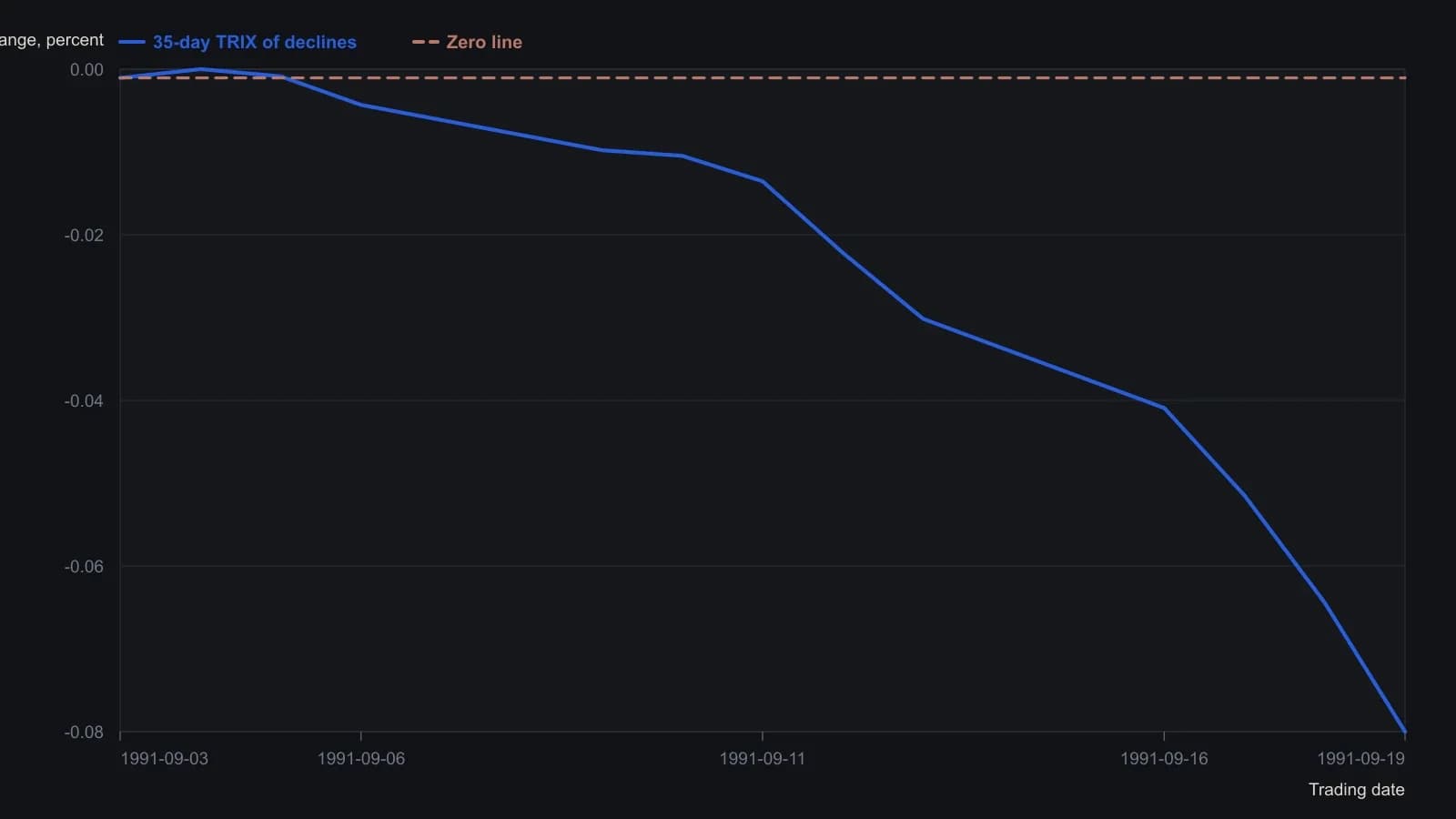
Alpha is 0.05556, the 2/(35+1) stand-in for a 35-day average. All three EMAs are seeded with the first day's 955 declines, so the early readings still include initialization. The source table's last row gave formulas only and is omitted.
A long-only zero-line rule
The long-only rule attached to the 35-day decline oscillator was defined as entering when the oscillator falls below zero and closing the long when it crosses back above zero. Short sales were not taken from this series alone because of an upward market bias.
Four lengths and a large construction space
A one-day iterative search over four length variables from 2 through 60 days expands the construction space to 60 to the fourth power, or 1,296,000 combinations.
All readings on this track · 15 readings
- 1984Constructing TRIX from a cutoff to one shared alpha
- 1988Isolate nested formulas before judging signals
- 1992Constructing TRIX from triple exponential smoothing
- 1992Constructing a TRIX oscillator from daily declines
- 1992A pre-trade checklist that stays flat until weekly support and TRIX agree
- 1992Constructing TRIX as triple-smoothed log-price momentum
- 1992Building TRIX crossover and momentum entries on a period grid
- 1992TRIX lookback and momentum derivative parameters
- 1994Seeding TEMA and DEMA with time-trend regression
- 1997Constructing the TRIX oscillator from triple smoothing
- 2002Constructing TRIX from triple-smoothing to signal rules
- 2002Lock the TRIX construction before reading a zero-line cross
- 2003Constructing TRIX from nested exponential averages
- 2004Construct TRIX entry, exit, and rest windows as one recipe
- 2004TRIX momentum and fundamental overlays for medium-term stock selection