2005issue C091-4
Constructing price-normalized moving-slope hybrids
A rate of change already divides lookback change by price so differently priced series share a scale. Replacing the two-point difference with a rolling least-squares slope, then dividing by a lagged price, keeps that scale-free property while the construction itself chooses smoothness versus timeliness.
- A rate-of-change series is lookback change divided by price, which removes the level bias that appears when two differently priced indexes are compared on raw change.
- A moving slope is the slope of a least-squares line fitted over a chosen lookback and rolled forward one observation at a time; a two-period moving slope equals a one-period change, and that identity rarely holds once the lookback is longer.
- MSROC divides the slope over N plus one observations by the price N periods earlier, so the same scale-free series can rank members, form an equal-weight group slope, or size a pair.
- A moving correlation of two MSROC series can mark intervals when typically aligned series temporarily decouple, and the same construction can be applied to a non-price input such as the monetary base.
A scale-free two-point change
A rate-of-change series is the lookback change divided by price. That division removes the level bias that appears when two differently priced indexes are compared on raw change. The numerator is still a two-point difference. The rest of the construction is about what replaces that difference, and how the result stays comparable across series.
Replace the difference with a moving slope
A moving slope is the slope of a least-squares line fitted over a chosen lookback and then rolled forward one observation at a time. Linear regression supplies the line. The slope is the line’s vertical change over the window divided by the horizontal span. The moving-average idea supplies the roll: a one-shot statistic becomes a continuous series.
A two-period moving slope equals a one-period change. That identity is described as rarely holding once the lookback is longer. On a 25-day window, a moving-slope series of the S&P 500 was presented as smoother than both the matching rate of change and a 25-day Wilder RSI shown for comparison. From 1993 through early 2005, the 25-day rate of change of the S&P 500 reversed direction 1,493 times, while the 25-day moving slope reversed 492 times, with turns described as equally timely.
Moving slopes of daily lows reached larger extremes than moving slopes of daily highs at both peaks and valleys. That pattern was presented as corresponding to narrower daily ranges at tops and wider daily ranges at bottoms.
S&P 500 25-day moving slopes of highs and lows
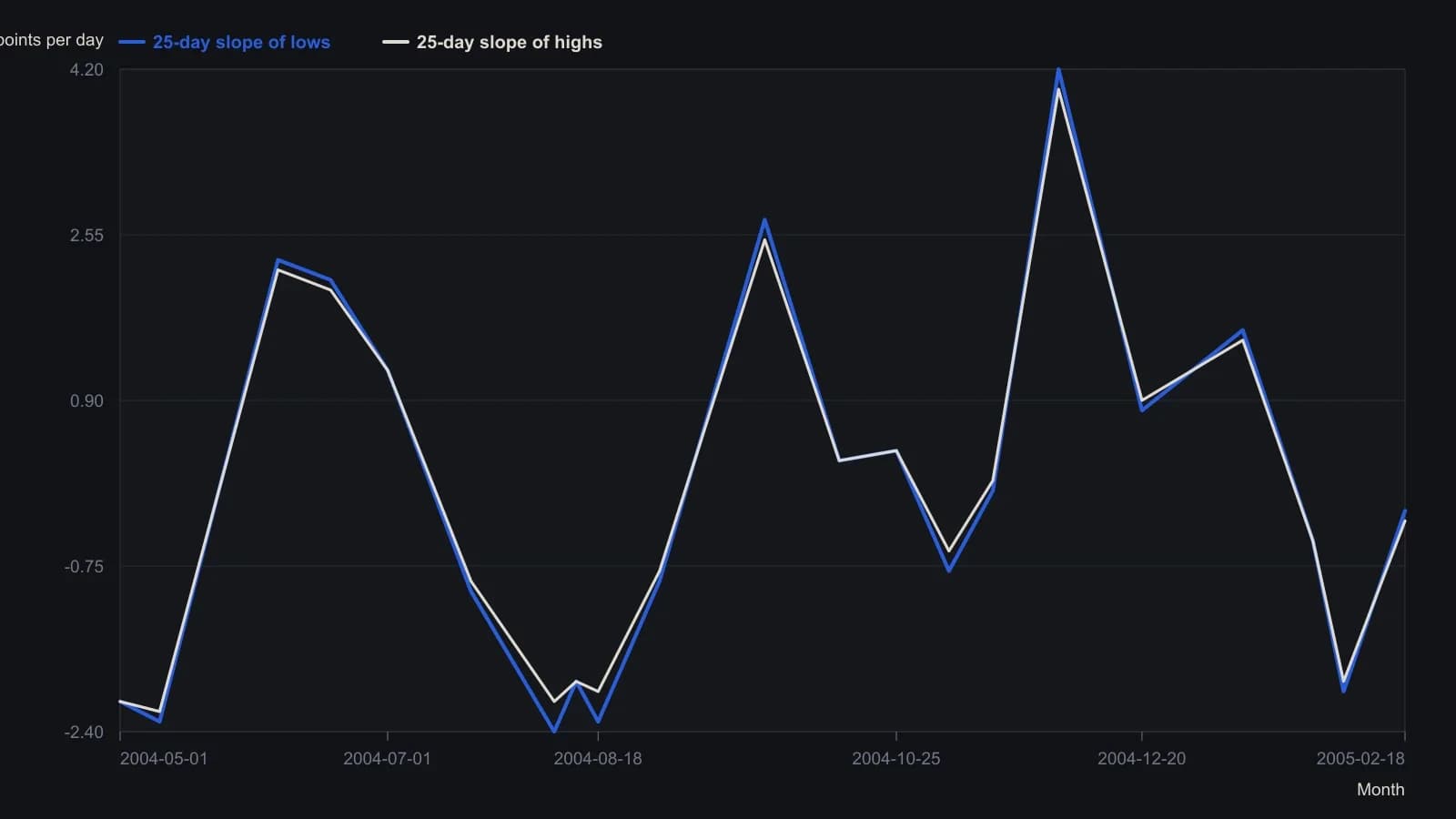
Lookback is the article’s 25-day regression on daily highs versus daily lows. Values are digitized from the raster to the nearest 0.1 slope unit, so peaks and troughs are approximate.
Divide by a lagged price
The moving-slope rate of change, or MSROC, is the moving slope over N plus one observations divided by the price N periods earlier. That lagged divisor makes the slope measure independent of price level. The hybrid keeps the rate-of-change purpose of a common scale, and it does so without sending the slope through a second smoother.
Rank a group, size a pair, or leave price
Group means of that price-independent series create an equally weighted sector slope. That is the moving-average operator applied across members of a group, not only across time.
A pair identity sets PriceA times QuantityA times MSROCA equal to PriceB times QuantityB times MSROCB. The same scale-free series can therefore size a pair.
A moving correlation of two MSROC series, illustrated with 20-day MSROCs and a 10-day correlation window, is used to mark intervals when typically aligned series temporarily decouple. Raw rate-of-change series were described as too jagged for the same profile.
The same MSROC construction can be applied to a fundamental series such as the monetary base by comparing a shorter-window MSROC with a longer-window MSROC and a stated policy target.
All readings on this track · 46 readings
- 1985Constructing excess and momentum difference-curve oscillators
- 1988Five reading rules for smoothed indicator charts
- 1989Momentum overlays that speed moving-average oscillators
- 1990A laboratory template that constructs Rate of Change as a pane module
- 1991Volume-scaled rate of change as a momentum construction
- 1991Three-indicator market overview from tape, sentiment and rates
- 1991Three-component trend model with rate-of-change filters
- 1992A KST oscillator from a weighted rate-of-change stack
- 1992Four-window weighted rate-of-change composite
- 1992Constructing multi-span smoothed rate-of-change filters
- 1992Constructing a four-horizon summed rate of change
- 1992Constructing KST from four weighted smoothed rates of change
- 1992Constructing a composite from weighted smoothed rates of change
- 1992Three-horizon KST maturity alignment
- 1992Construct a bond-led dividend-to-bond-yield regime first
- 1992Constructing relative-strength KST from weighted rate-of-change
- 1993Constructing a volume oscillator from average ratios and smoothed rate of change
- 1994Gold as a cycle clock for commodities and yields
- 1994Constructing a composite from weighted, smoothed rate-of-change windows
- 1994Constructing gold-mining rate-of-change tripwires for Treasury bonds
- 1994A capacity-stress checklist across commodities, bonds, and breadth
- 1994Rate of change parameters for testable entries
- 1994Constructing rate-of-change midpoints, lookbacks and divergence
- 1994Lead oscillator breaks need price trendline confirmation
- 1994Nested averages for an annual momentum curve
- 1994Evaluating a Coppock-style rate of change as a bottom-regime filter
- 1995A weighted eleven-month Dow rate of change as one testable timing procedure
- 1996Named lookbacks, thresholds, and streaks for entry rules
- 1997A midpoint rate-of-change test for bond trend follow-through
- 1997Constructing a short-rate-adjusted equity momentum filter
- 1998Daily momentum rank-churn as a portfolio-construction problem
- 1999Constructing a lagged rate of change cycle system
- 2000A triple delay line then a one-bar elliptic oscillator
- 2001Confirming rate of change divergences with price
- 2001Momentum trendline breaks need price confirmation
- 2001Market breadth, On-balance volume, and Rate of Change as a combined timing framework
- 2001Know Sure Thing with stacked horizons and trendline confirmation
- 2003Constructing a mechanical system from a rate of change condition
- 2003Constructing momentum from two closes and spotting divergence
- 2003Formula choice tilts which momentum mismatches count as divergences
- 2004RSI and momentum agreement as an asymmetric filter
- 2005Constructing price-normalized moving-slope hybrids
- 2005Unsigned speed gates on a fixed average-cross pair
- 2007Rebuilding rate of change as a path-weighted oscillator
- 2008Construct Special K so short-horizon signals stay inside the primary trend
- 2013Restore volume balance before adding another price-time indicator