1995issue C121-5
Commodity channel index construction from typical price to a smoothed zero line
The commodity channel index is a scaled ratio of current typical price versus the lookback mean of typical price, plotted around a zero line. Archive constructions overlay a short exponential moving average, change the lookback, and treat zero-line crosses as the counterpart of price crossing an arithmetic moving average.
- The commodity channel index is a scaled ratio of how far typical price sits from its lookback mean, with mean deviation multiplied by 0.015 so the series plots around a zero line.
- Typical price averages the bar high, low, and close, and a zero-line cross is treated as the counterpart of price crossing an arithmetic moving average.
- Plus and minus 100 percent lines mark one mean deviation from that moving-average reference, while a five-period exponential moving average of 20-period values turns the same series into a zero-line alert.
- Lengthening or shortening the lookback can confirm trend or divergence, but lookbacks shorter than 14 days become excessively spiky and overly long lookbacks reduce responsiveness.
Typical price and the scaled deviation
The commodity channel index is built as a ratio of how far the current typical price sits from the mean typical price of a chosen lookback. Mean deviation is multiplied by 0.015 so the series plots around a zero line.
Typical price uses the average of a bar high, low, and close rather than the close alone. That average is the input compared with the lookback mean of typical price.
Zero line and one-hundred-percent bands
A zero-line cross of the commodity channel index is treated as the counterpart of price crossing an arithmetic moving average. The plus and minus 100 percent lines mark one mean deviation from that moving-average reference.
Most software defaults the lookback to 20 periods. Readings can extend beyond plus or minus 300 percent.
An original band rule
One original threshold rule treats a move through plus 100 percent as a long-side trend condition and a move through minus 100 percent as a short-side trend condition. The same rule notes that 70 to 80 percent of price action stays between those bands.
A moving-average overlay on the same series
One illustrated construction applies a five-period exponential moving average to 20-period commodity channel index values and uses that smoothed series crossing zero as the alert. That pairing is a dual commodity channel index: the daily series plotted with a five-period exponential moving average of those same values.
Alerts were also described when the daily series and its moving average cross each other or diverge from price. Divergence is disagreement between the dual commodity channel index path and the underlying price path, used as an alert or confirmation condition.
Weekly lookbacks and a moving-average comparison
Independent weekly tests compared a 90-week commodity channel index rule with a 40-week moving-average crossover. Those tests alternatively proposed initiating at the zero-line cross with a 53-week lookback.
A daily OEX path
On a daily OEX chart, the five-period exponential moving average of a 20-period commodity channel index stayed above zero through an uptrend from late November 1994 until it crossed below zero on 2 August 1995. It then stayed below zero through an August range until a later upside cross coincided with a new advance.
Daily OEX CCI and 5-period EMA around the zero line
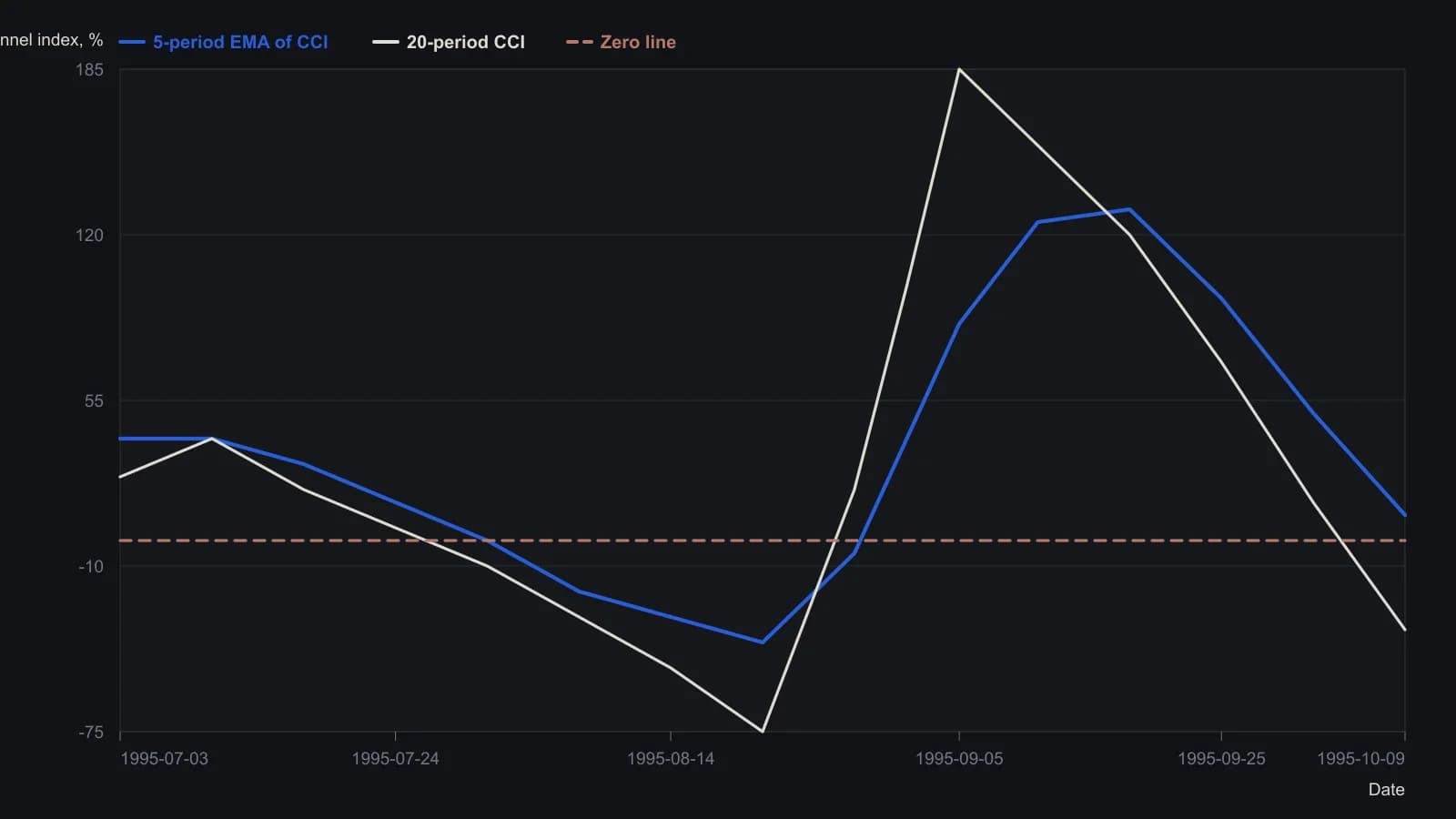
Author’s construction is a 20-day CCI smoothed with a 5-day EMA. The trading alert is a decisive zero-line cross by the EMA. Readings are approximate; the raster supports roughly 5-point CCI resolution.
Lookback length and incomplete first bars
Lengthening or shortening the lookback can confirm trend or divergence. The lookback is the number of bars used to compute the mean typical price and mean deviation, so changing it alters trend confirmation versus false-signal frequency.
Intraday use was illustrated with 60-minute studies and by joining the prior session last hour to the current session so the first bar is not computed from incomplete data.
All readings on this track · 39 readings
- 1982Three gates on a 1982 pork-belly short
- 1982Scale-free Commodity Channel Index construction
- 1986Constructing a commodity channel index and a regression price channel
- 1987Constructing scaled OHLC matrices for study overlays
- 1987Constructing the commodity channel, average directional, and relative strength indexes on a shared cycle scale
- 1992Eleven-bar commodity channel index from typical price and mean deviation
- 1992Evaluating Commodity Channel Index breakout versus range rules
- 1992Evaluating breakout and CCI rules as complete mechanical procedures
- 1993Constructing stochastic, RSI and CCI inputs for forecasts
- 1993Nested centered channels with a commodity channel index confirmation gate
- 1993Listed-option timing as three separable clocks
- 1994Constructing an eleven-period commodity channel index
- 1994Confirming Elliott wave turns with channels and the commodity channel index
- 1995Commodity Channel Index band rules lag zero-line timing
- 1995Building the commodity channel index from typical price
- 1995Staged reversal rules with commodity channel index and average channels
- 1995Commodity channel index construction from typical price to a smoothed zero line
- 2001Reader tests for unfinished lookback oscillators
- 2002Constructing the commodity channel index from typical price
- 2003Breadth-filtered commodity channel index entry and exit rules
- 2003Constructing the Commodity Channel Index from typical price and scaled deviation
- 2003A shallow, poorly participated advance is an unconfirmed trend
- 2003CCI and RSI parameter defaults as scaling conventions
- 2003A cost and capital audit of a Commodity Channel Index trade engine
- 2003Commodity channel index peak divergence as an exit after twin patterns
- 2004Constructing the Commodity Channel Index from typical price
- 2004Constructing the Commodity Channel Index from typical price and mean deviation
- 2006Building custom indicators from the Commodity Channel Index, a least squares moving average and a rule-based entry
- 2012Confirming breakouts and retracements with CCI, ADX, and averages
- 2012Stacking oscillator lookbacks into a heatmap mosaic
- 2013Constructing a consensus and volatility-normalized value oscillator
- 2013Walk-forward system evaluation with a commodity channel index and chandelier exits
- 2014Dual detrended oscillators and dual Bollinger Band channels
- 2014RSI, CCI, and moving-average trend-filter construction
- 2014Dual RSI, a moving average, and CCI as a confirmation stack
- 2017Constructing dual-average cross and channel-index filters
- 2018Treat CAM as a classification layer before confirmation becomes an entry
- 2018Four-state slope labels gated by a moving average and a commodity channel index
- 2018Deviation-Scaled Moving Average construction from a two-bar difference