2015issue C0948-54
Constructing decycler oscillators from highpass and bandpass filters
A decycler keeps trend by subtracting a highpass filter from price. A second, shorter highpass turns that residual into a scaled bandpass oscillator, and a paired overlay lets students inspect relative timing instead of one zero-line reading.
- A simple decycler is price minus a highpass filter, so high-frequency cyclic energy is removed and the lower-frequency trend is what remains.
- A decycler oscillator is a second highpass, with half the original lookback, applied to that residual and then scaled, which is a bandpass construction rather than a new trend line.
- Implementations treat a 125-bar lookback as the default dominant-cycle cutoff, overlay the decycler on price, and plot the oscillator in a separate pane.
- A paired-oscillator overlay compares two decycler oscillators with different periods or scale factors so relative timing can be inspected instead of a single zero-line reading.
Subtract a highpass stage to keep the trend
The simple decycler is a construction, not a separate smoothing study. A highpass filter first isolates shorter-period, higher-frequency variation in an ordered price series. That highpass output is then subtracted from the input series so only lower-frequency trend components remain. The residual is the decycler: price with cyclic energy removed by subtraction rather than by averaging.
Implementations compute an alpha coefficient from the cosine and sine of 0.707 times 360 degrees divided by a lookback period, then apply a two-bar recursive highpass to closing prices. The decycler is formed as the close minus that highpass output. Because the cycle is taken out by subtraction, the series is presented as a way to mark trend direction with little delay relative to moving averages.
Reuse a shorter highpass as a bandpass oscillator
A decycler oscillator is built by sending the decycler through a second highpass whose lookback is half the original period, then scaling the result. That second stage is a bandpass filter: a shorter-period highpass applied to the already-decycled series, leaving a mid-band residual that can be scaled as an oscillator.
The decycler oscillator is therefore a bandpass residual of two successive highpass stages. It is used as a timing overlay, not as a replacement for the trend line that the first subtraction was meant to keep.
Lookback, overlay, and portable ports
The dominant cycle is the longer lookback, expressed in bars, that sets the first highpass cutoff and therefore the cycle length treated as the trend-versus-cycle boundary. Multiple platform translations use a 125-bar lookback as the default dominant-cycle cutoff for that first highpass. They overlay the simple decycler on price and plot the oscillator in a separate pane.
The same highpass-then-subtract, then shorter-period highpass sequence is restated across EasyLanguage, formula, script, and spreadsheet ports. That repetition presents the method as a portable filter construction rather than a platform-specific study.
Paired oscillators as a timing overlay
A paired-oscillator construction uses two decycler oscillators with different periods or scale factors. Their relative timing, rather than a single zero-line reading, is what can be inspected as a market-response overlay.
Spreadsheet reconstructions expose the second-oscillator cutoff constants as explicit cells. Period, scale factor, and band-spread can then be changed without rewriting the recursive filter.
SPY daily pair of decycler oscillators, 125 vs 100
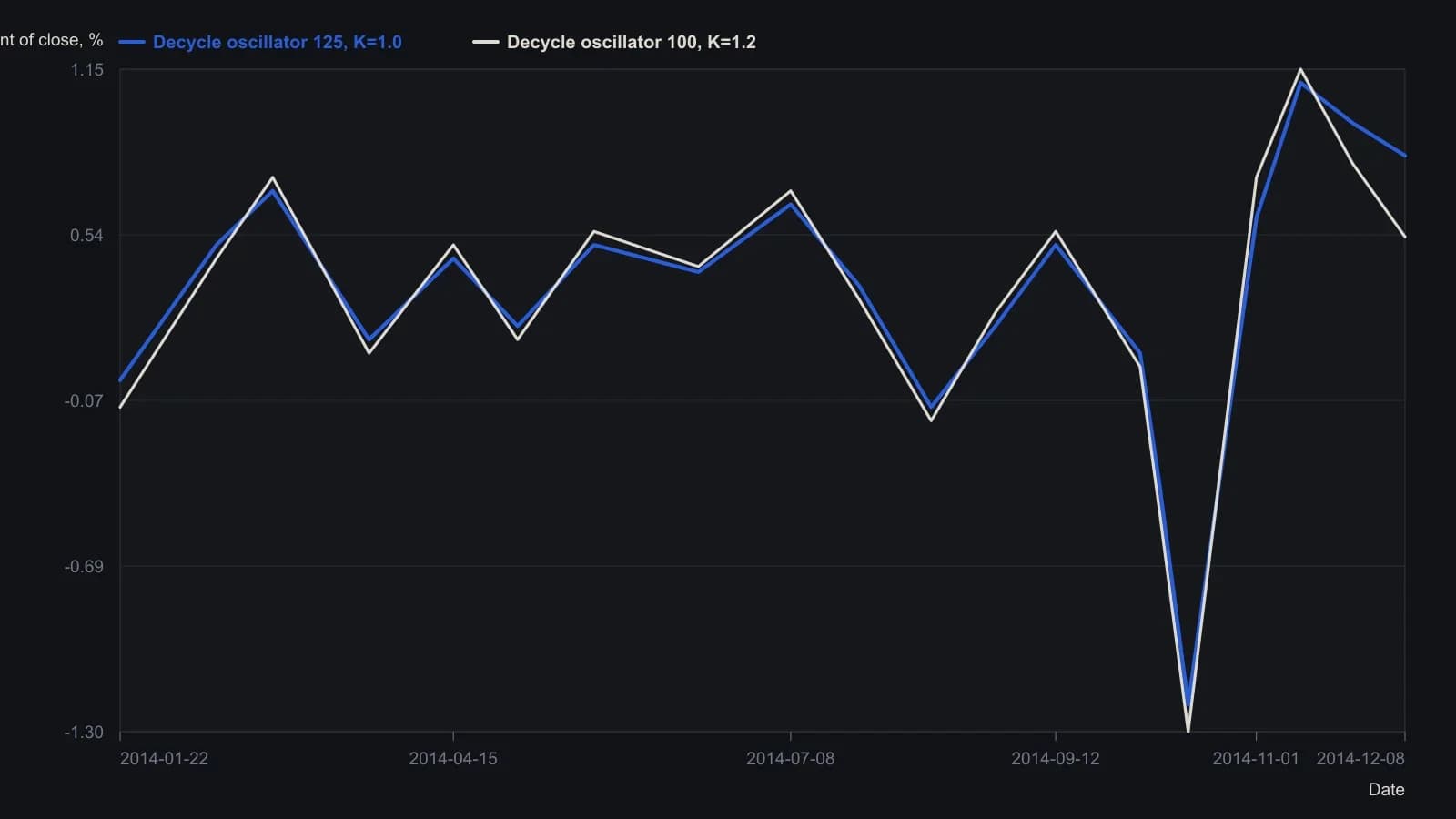
AmiBroker plots 100×K×high-pass(decycle)÷close. Period/K pairs are 125/1.0 and 100/1.2. Intermediate points are raster readings to 0.1 percent; only the last bar uses the quoted status values.
All readings on this track · 7 readings
- 2006Constructing lowpass, highpass, and finite impulse response filters from one recurrence
- 2006Constructing a trend filter from a cycle-length moving average and a highpass residual
- 2014Constructing a roofed stochastic from highpass and lowpass stages
- 2014The dual-K highpass roofing filter is unfinished until three choices are written together
- 2015Constructing a decycler from high-pass cancellation
- 2015Constructing decycler oscillators from highpass and bandpass filters
- 2020Finite-memory truncation for cycle filters