1988issue C061-8
Constructing simple and exponential moving averages as specified filters
Treat each plotted average as a specified filter. Name the observation window or smoothing factor, state whether memory is finite or recursive, and measure phase delay on a known cycle so a simple-window baseline can be compared with an exponential smoother on the same lookback.
- A moving average is a low-pass construction that lets slower variation through and attenuates high-frequency variation.
- A simple average has finite-impulse-response memory inside a fixed observation window, while exponential smoothing mixes the latest observation with the prior average so older samples never fully leave.
- On a pure sine-wave input, a simple average is most sensitive when the window equals one half-cycle, and the averaged series lags the input by a quarter cycle.
- A smoothing factor can be matched to a window length so a simple-window baseline and an exponential smoother can be compared on the same lookback, with similar overall attenuation but different phase-delay behavior.
A moving average as a low-pass filter
A moving average is constructed as a low-pass filter that lets slower variation through and attenuates high-frequency variation. The construction maps ordered price observations over a defined lookback into one filtered value at each sampling interval.
Finite memory in the simple average
A simple moving average has a finite-impulse-response. It is nonzero only while an impulse remains inside a fixed observation window, and it can be updated by adding the newest sample and dropping the oldest. The filter reaction lasts only while that single impulse remains inside the window.
Cycle response and phase delay
On a pure sine-wave input, a simple moving average is most sensitive when the observation window equals one half-cycle, and the averaged series lags the input by a quarter cycle. That lag is the phase delay of the filtered series relative to the generating cycle.
A simple moving average cancels to zero when an even number of complete cycles fills the window and leaves a residual fluctuation at odd cycle multiples. The frequency response follows a sin(x)/x shape, where x is pi times the frequency-ratio, meaning how many input cycles fit inside one observation window.
Recursive memory in exponential smoothing
An exponential moving average is formed recursively as a mix of the latest observation and the previous average, so older samples never fully leave the calculation. That recursive reaction is an infinite-impulse-response: after an impulse it theoretically never reaches exact zero.
The smoothing factor is the constant that sets how much of each new exponential average comes from the latest observation. An exponential smoothing factor can be matched to a window length by setting the factor approximately equal to two divided by that length.
A same-lookback comparison
Simple-average phase delay increases linearly with frequency, whereas exponential-average phase delay is nonlinear and stays nearly constant at high frequencies. Simple and exponential averages have similar overall attenuation except for periodic peaks in the simple average, and both constructions lag the generating series because they combine historical observations.
SMA vs EMA amplitude attenuation versus normalized window length
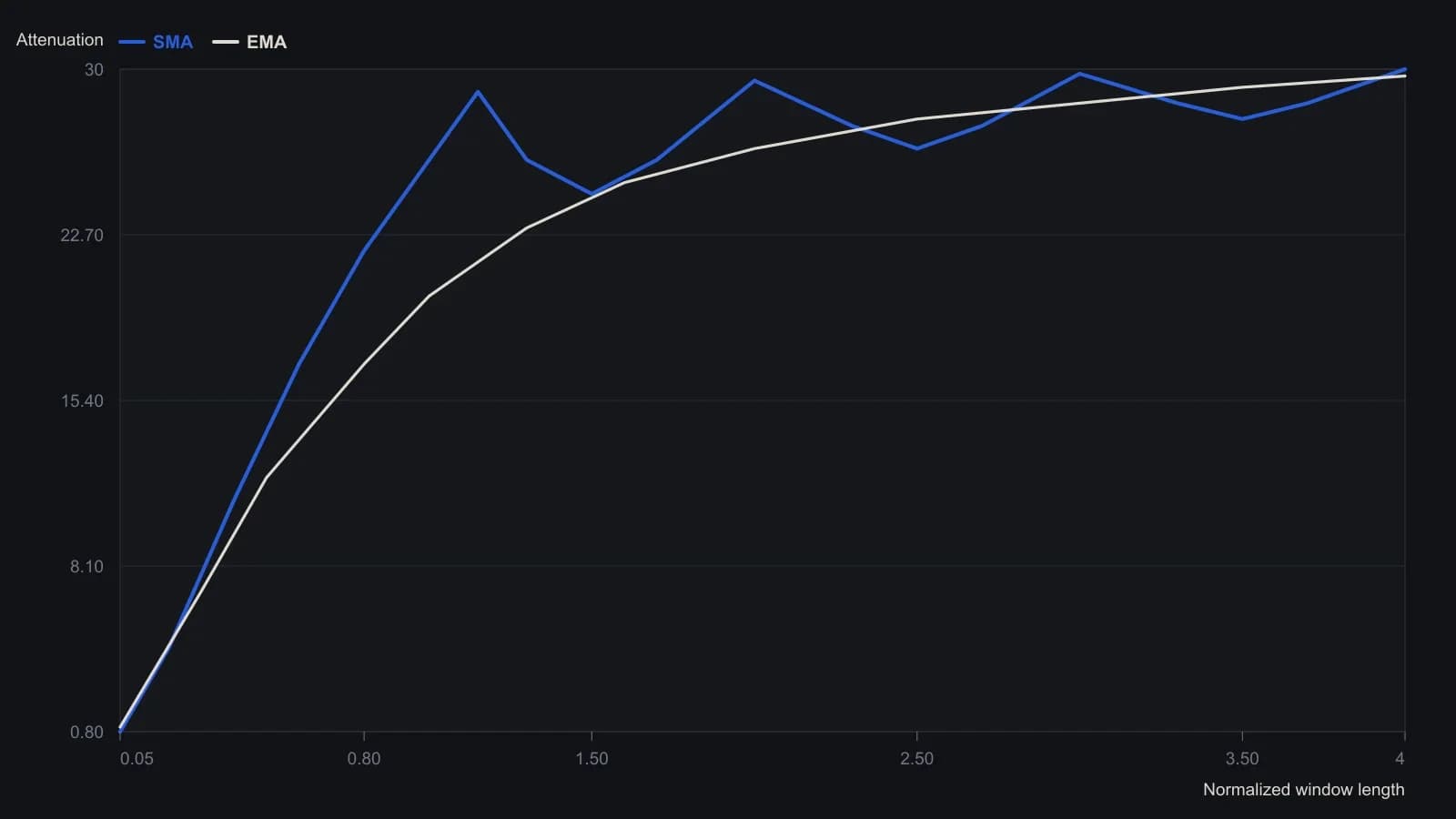
Y-axis numbers on the scan run 0–30 with no unit printed; they are treated as relative attenuation as labeled. Horizontal axis is the article’s normalized window length (window divided by input period). SMA zeros at even integers match the sin(x)/x notches the text states for complete cycles in the window.
All readings on this track · 41 readings
- 1984Matching average age across price filters
- 1984Residual-impact construction of exponential smoothers
- 1988Constructing simple and exponential moving averages as specified filters
- 1989Evaluating smoothed free reserves and funds-discount spreads
- 1990Integer construction of moving averages and exponential smoothing
- 1990Constructing incremental moving average filters
- 1991Constructing a double-smoothed stochastic oscillator
- 1991Constructing an exponential average from a smoothing weight
- 1991Constructing a double-smoothed momentum oscillator family
- 1991Competing certainty rules from exponential-average conditions
- 1991Hybrid construction of a mechanical timing system from smoothed signals
- 1991Constructing an exponential smoother from a moving-average length
- 1991Equivalent relative-strength-index constructions from a ratio and from smoothed momentum
- 1991Constructing the true strength index from double-smoothed momentum
- 1991True strength index from signed, double-smoothed momentum
- 1992Constructing exponential averages from simple lookbacks
- 1992Constructing exponential averages by the smoothing constant, startup length and lag
- 1992Nested range smoothing and windowed high-low damping
- 1992A weekly equity stance from the discount-bill spread
- 1993Double-smoothed stochastics momentum index construction
- 1993Constructing the true strength index with double exponential smoothing
- 1994Polarized fractal efficiency with a shared exponential smoother
- 1994Five-interval exponential smoothing of ten-interval signed path-efficiency
- 1994Hand-ranked price-volume series with stacked smoothing and stochastic
- 1995Range expansion filter on multi-horizon averages
- 1995The exponential smoothing constant from averaging lag
- 1997Construct a nested-average rainbow band and oscillator
- 1998Filter stacks that combine a moving average with exponential smoothing
- 2002Smoothed relative-strength construction from wilder-averaging and a price prefilter
- 2003Reverse-engineered RSI price targets
- 2004Piecewise trend quality from moving-average reversals
- 2004Nested smoothing recipes versus unaudited oscillator experiments
- 2008Weight construction beyond the N-day label
- 2010A consensus filter for objective RSI and smoothing construction
- 2012Sentiment-zone oscillator from signed closes
- 2012Classic RSI one-over-N smoothing versus the standard exponential average
- 2013Why exponential smoothing uses two over n plus one
- 2015Constructing ratio indicators with moving-average and exponential-smoothing weights
- 2015Slow relative-strength index from an exponentially smoothed price
- 2017Rebuilding the relative strength index as open-scale buy-sell pressure
- 2017Comparing Wilder and exponential smoothing inside a relative-strength index