1992issue C061-8
Constructing moving averages with weighting schemes and extra filters
A moving average is built from sequential prices to damp small fluctuations. Construction then chooses a weighting scheme, a lookback, and any extra clearance, wait, or confirmation rules that must fire before a crossing is treated as a change of direction.
- A moving average is constructed from sequential prices so that small fluctuations are damped and an underlying directional path can be isolated.
- Simple, linear-weighted, and exponential forms change how much the newest price can move the average, while lookback length lowers or raises sensitivity to new prices.
- A data filter can require a close or full-session range beyond the average, a stated penetration, a wait of one to three extra periods, or independent confirmation before a change counts as a signal.
- Editorial reading: more smoothing and more filters quiet random crossings, but they also postpone the moment the builder is willing to act.
A specification rather than a finished signal
A moving average is constructed from sequential prices so that small fluctuations are damped and an underlying directional path can be isolated. In the wording used here, a moving average is a rolling summary of ordered prices that damps short-run fluctuations so a directional path can be read.
Editorial reading: treat the average as a construction specification rather than a finished signal. First choose how past prices are weighted. Then decide which extra clearance, wait, and confirmation rules must fire before a crossing is allowed to count as a regime change.
Daily price bars with a single moving average
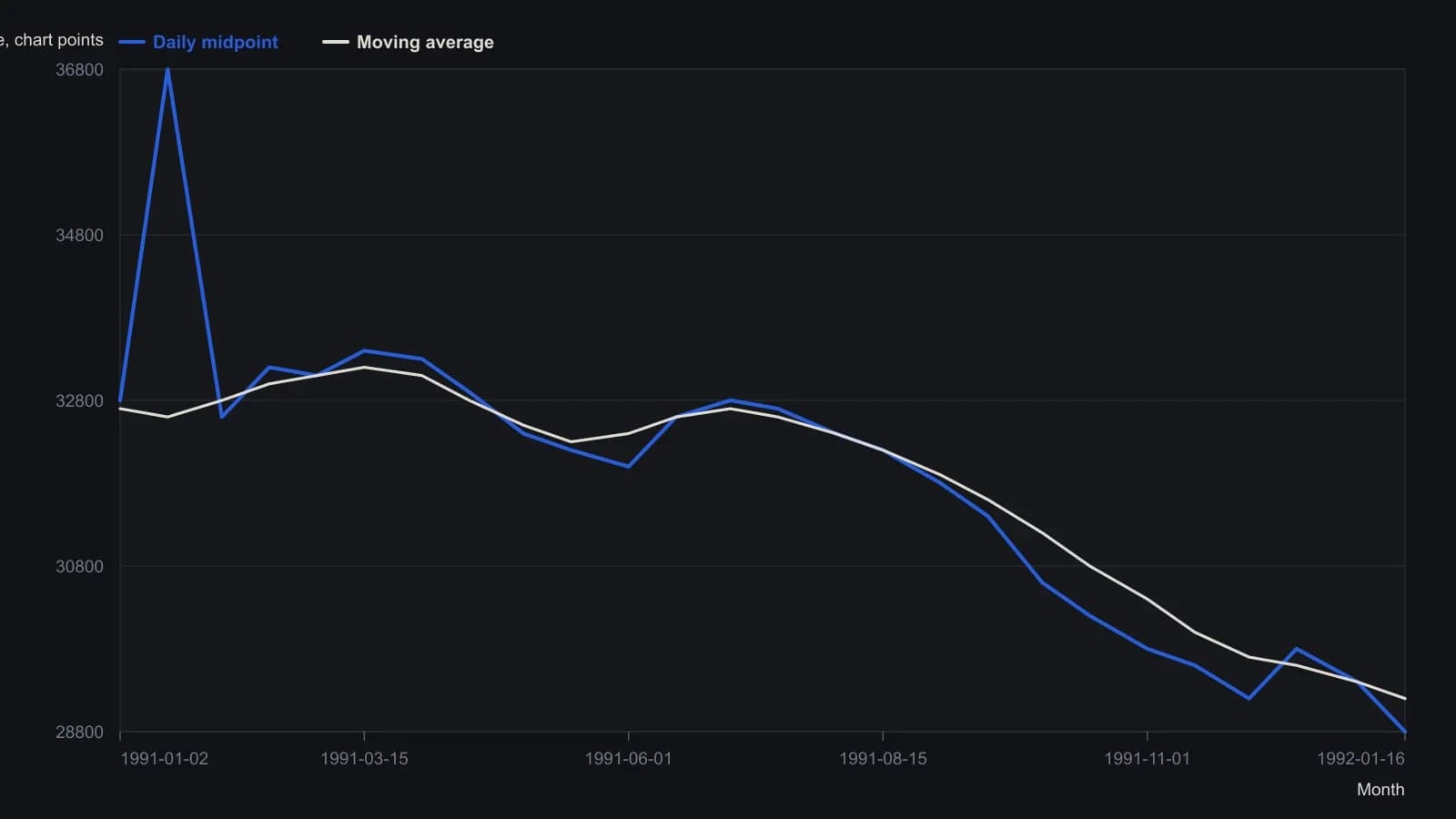
Daily high-low ranges were collapsed to a midpoint at each sample so a single primary series could be plotted. The moving-average overlay is the supporting series. Month ticks are those printed on the figure; intra-month x values are approximate. Y readings are limited to the 50-point resolution the raster can support.
How past prices are weighted
Named construction variants include simple, linear-weighted, and exponential averages, with triangular and step-weighted forms also listed.
A weighted moving average is a rolling summary that assigns larger weights to more recent observations and smaller weights to older ones. A linear weighted moving average assigns weight 1 to the oldest included price and a weight equal to the lookback to the newest price, then divides the weighted sum by the sum of those weights.
Exponential smoothing is a recursive update that blends the latest price with the previous smoothed value using a fixed decay weight. An exponential average is updated as a blend of the latest price and the previous exponential value. A five-period illustration uses 0.333 on the latest price and 0.667 on the prior average.
Lookback sets sensitivity and delay
Lookback is the count of ordered observations included in the average. Lengthening the lookback lowers sensitivity to new prices and delays the resulting signal. Shortening the lookback raises sensitivity.
A shorter lookback is associated with sideways price ranges and a longer lookback with prices that have begun to trend.
Clearance, wait, and confirmation rules
A data filter is an extra rule that must be satisfied before a change in the average is treated as a signal. Builders can require a close beyond the average, a full-session range beyond it, a stated dollar or percent penetration, a wait of one to three extra periods, or an independent confirmation before treating a change as a signal.
Penetration is a required dollar or percent distance that price must travel beyond the average before a signal counts. Confirmation is an independent second condition required alongside the average before a change is accepted.
Bands and a second average
A percentage envelope is a pair of parallel bands placed a stated percent above and below the average, leaving a buffer zone with no position. Examples include a 40-day average plus or minus 1.5 percent and a 20-day average plus or minus 3 percent.
A high-low band is a pair of averages built from session highs and session lows instead of the close. In the construction described here, the two averages are built from daily highs and daily lows rather than the close, with a close above the higher average treated as a long trigger and a close below the lower average as a short trigger.
A double crossover is a rule that fires when a shorter leading average crosses a longer lagging average. A two-average construction can plot a leading window of 3 to 14 days against a lagging window of 20 to 200 days and treat a cross of the leading series through the lagging series as a change in direction.
All readings on this track · 20 readings
- 1988Indicator smoothing: lookback, weight, and scale
- 1990Recency weighting in simple, linear, and exponential moving averages
- 1990Seed and recurrence construction for moving averages
- 1990Constructing a five-day step-weighted moving average
- 1992Constructing simple, weighted, and exponential moving averages
- 1992Constructing moving averages with weighting schemes and extra filters
- 1992Constructing a weighted-average TRIN10 with Bollinger envelopes
- 1992Constructing a banded weighted open-TRIN oscillator
- 1993Evaluating a weighted dual rate-of-change momentum filter
- 1993Constructing equal, linear and exponential moving averages
- 1993Constructing a general weighted moving average from one exponent
- 1993Calibrating the weighted-moving-average exponent
- 1993Constructing an exponent-weighted average of put-call ratios
- 1994Cycle-tuned momentum with spectral peaks
- 1999How a five-bar sine-weighted average is assembled
- 2003Same-scale trend filter from a rolling least-squares endpoint
- 2003How a rolling linear-regression endpoint is assembled as a moving-trend
- 2004Constructing a volume-weighted moving average as a forecast baseline
- 2005Constructing a move, volume and recency weighted average
- 2016MACD as a zero-line filter with dual moving averages