1989issue C101-5
Constructing a suggest-then-confirm Money Flow Index
Build Money Flow Index against its own running mean so a cross is only a suggestion, then add a percent-volume-change gate that can confirm or reject the idea when participation does not support the money-flow reading.
- Money Flow Index maps the money ratio onto a 0-100 scale, and the money ratio is accumulated positive money flow divided by accumulated negative money flow.
- AvgMFI is the mean of every Money Flow Index reading from the sample start through the current bar, and an MFI-AvgMFI cross is only a suggestion.
- A later material percent volume change confirms or rejects that suggestion according to how the volume move affects Money Flow Index.
- Weighted on-balance volume is a visual check that should move with Money Flow Index, and it can replace the money-flow input so flow sign follows the change in average price.
Build money flow from the bar
A bar's money flow equals volume times average price. Average price is the mean of high, low, and close. Over a trader-chosen window, positive money flow and negative money flow are the sums of the hourly money-flow observations in each category.
The money ratio is positive money flow divided by negative money flow. Money Flow Index is constructed by mapping the money ratio onto a 0-100 scale as 100 minus 100 divided by one plus that ratio.
Compare Money Flow Index with AvgMFI
AvgMFI is the average of all Money Flow Index values from the start of the series to the current bar. Percent volume change can be averaged the same way.
A shorter window makes Money Flow Index more sensitive versus AvgMFI. A longer window reduces that sensitivity. An MFI-AvgMFI cross is only a suggestion.
Add a percent volume change gate
The stack was built to reduce false moving-average-cross signals by suggesting first and confirming or rejecting later. After the suggestion, a later material percent volume change confirms or rejects it according to how that volume move affects Money Flow Index.
If participation does not support the money-flow reading, the percent volume change gate can reject the idea.
Use weighted on-balance volume as a visual check
Weighted on-balance volume is volume times the change in average price. It is intended as a visual check that should move with Money Flow Index.
Substituting weighted on-balance volume for the money-flow input ties positive flow to a rise in average price and negative flow to a decline.
Worked May 1989 sequence
The worked May 1989 example used a three-day window equal to 21 collected points. One sequence showed Money Flow Index falling to 30 with a 300 percent volume change. A later sequence treated an 800 percent volume change as the stronger confirmation reading.
Chevron Money Flow Index, May 1989
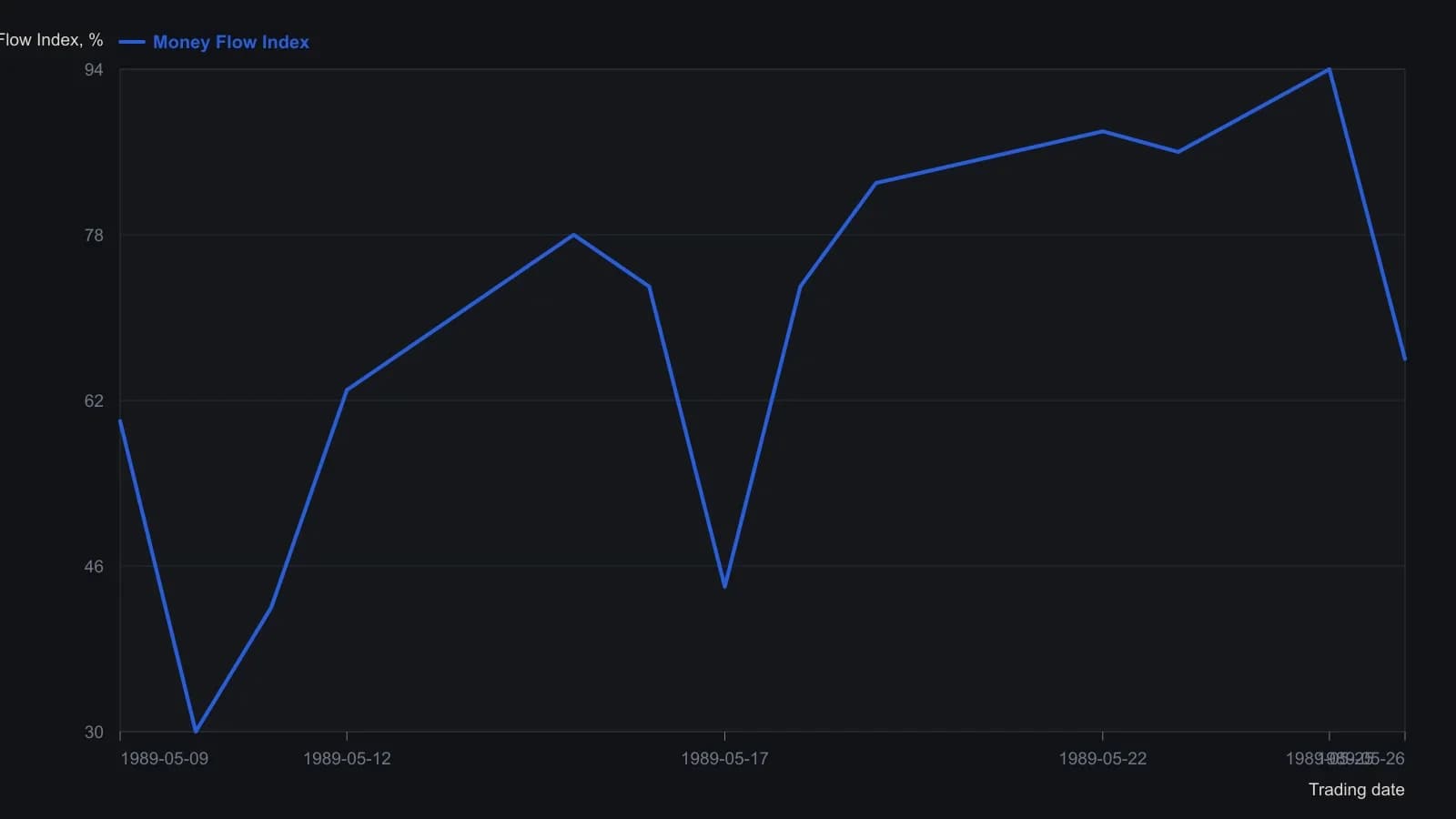
The author used a three-day MFI window, equal to 21 hourly LiveWire points, on this rally. AvgMFI is not printed in the blotter; he marks the May 12 reading of 63 as the cross above that running mean.
Editorial reading of the two-gate lab
Editorial. This TradersWeek reading treats the construction as a lab sequence, not as a finished trading rule. The first gate publishes a candidate when Money Flow Index crosses AvgMFI. The second gate asks whether a material percent volume change then moves Money Flow Index in a way that supports that candidate.
Window length belongs to the construction. A shorter window raises sensitivity versus AvgMFI and a longer window damps it, so the suggestion itself changes with the chosen window.
All readings on this track · 13 readings
- 1988Constructing tick-weighted money flow and price divergences
- 1989Four-state money-flow-index as permission for a next-bar breakout-system
- 1989Constructing a suggest-then-confirm Money Flow Index
- 1993Five-rung money flow from signed print volume
- 1993Physics analogies for building cycle and money flow indicators
- 1994Keep a wave count as a draft until money flow and a trendline agree
- 1999Take the rectangular-base breakout from money-flow confirmation, not from a late strength average
- 2004Constructing a volume-flow rule from money flow
- 2006Classify the regime before the bar read
- 2015Constructing a bounded money-flow oscillator from range and volume
- 2016Combining RSI, moving averages, and money flow
- 2018Five-rule technical rating as a rotation filter
- 2020Combining money-flow, RSI, and breadth for dynamic pressure zones