1994issue C021-3
Seeding TEMA and DEMA with time-trend regression
A 52-week quadratic time-trend seeds three nested exponential averages. A 26-week straight-line fit seeds two. Both stacks share one smoothing weight, and the same averages can start from the first weekly close instead.
- Linear regression of weekly closes on time, and on time squared in the triple case, is used only to initialize the nested averages.
- Every nested exponential update in both constructions shares one smoothing weight equal to 2/(26+1).
- The triple combination is three times the first nested average, minus three times the second, plus the third. The double combination is twice the first nested average minus the second.
- The same nested averages can start from the first weekly close instead of from the regression-implied seeds.
Seeding with linear regression
The triple exponential construction is seeded by a multiple linear regression of 52 weekly closes on time and time-squared, producing three coefficients used only to initialize the nested averages.
The double exponential construction is seeded by a simple linear regression of 26 weekly closes, a shorter window than the 52-week fit used for the triple version.
Linear regression, in this workflow, is a least-squares fit of weekly closes against time, and against time squared in the triple case, used only to seed the first nested averages. The regression-seed is the closed-form first value of each nested average implied by the fitted time-trend coefficients and the smoothing weight.
Nested exponential updates
Every nested exponential update in both constructions shares one smoothing weight equal to 2/(26+1). Exponential smoothing is a recursive average that blends the newest observation with the prior average using that one fixed weight.
After the seed, the first nested average tracks the weekly close, the second tracks the first average, and the third tracks the second, each as a weighted blend of the new input and the prior average.
Triple and double combinations
The triple combination equals three times the first nested average, minus three times the second, plus the third. TEMA is that combination of three nested exponential averages when it starts from a 52-week quadratic time-trend seed.
The double combination equals twice the first nested average minus the second nested average. DEMA is that combination of two nested exponential averages when it starts from a 26-week straight-line seed.
TRIX is a forecast-style construction whose core is three nested exponential averages. This dossier builds that stack and stops at the combined smoother rather than adding a rate-of-change overlay.
NASDAQ weekly close with TEMA1 and DEMA1
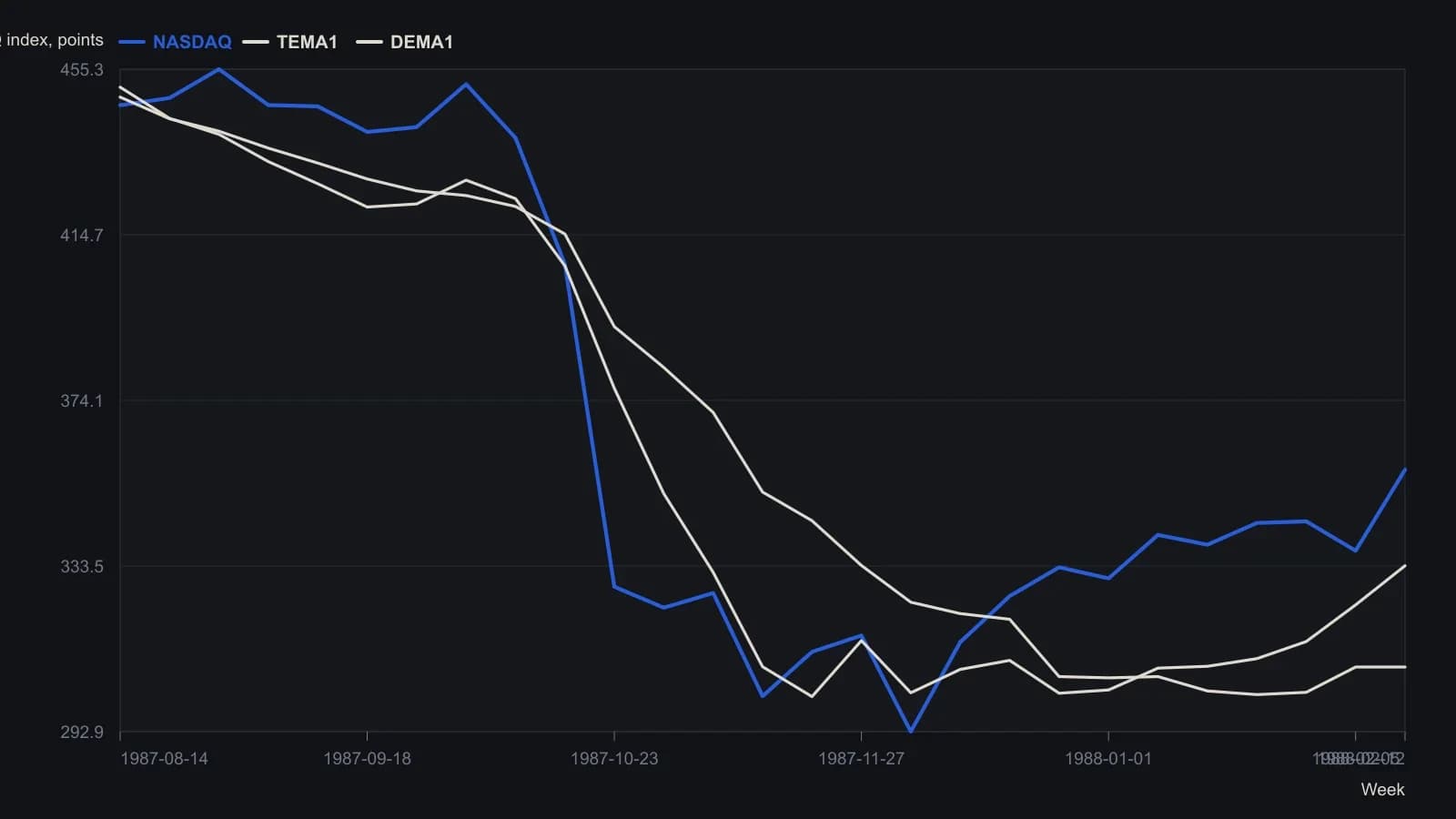
TEMA1 is seeded from a 52-week quadratic LINEST on closes; DEMA1 from a 26-week straight-line LINEST. Both stacks share alpha = 2/(26+1). Dates are the worksheet’s YYMMDD codes.
Starting from the first weekly close
The same nested averages can be started from the first weekly close instead of from the regression-implied seeds.
All readings on this track · 15 readings
- 1984Constructing TRIX from a cutoff to one shared alpha
- 1988Isolate nested formulas before judging signals
- 1992Constructing TRIX from triple exponential smoothing
- 1992Constructing a TRIX oscillator from daily declines
- 1992A pre-trade checklist that stays flat until weekly support and TRIX agree
- 1992Constructing TRIX as triple-smoothed log-price momentum
- 1992Building TRIX crossover and momentum entries on a period grid
- 1992TRIX lookback and momentum derivative parameters
- 1994Seeding TEMA and DEMA with time-trend regression
- 1997Constructing the TRIX oscillator from triple smoothing
- 2002Constructing TRIX from triple-smoothing to signal rules
- 2002Lock the TRIX construction before reading a zero-line cross
- 2003Constructing TRIX from nested exponential averages
- 2004Construct TRIX entry, exit, and rest windows as one recipe
- 2004TRIX momentum and fundamental overlays for medium-term stock selection