2006issue C081-6
A dominant-cycle split into a trend filter and residual Relative Strength Index
Ordered price is split with one dominant-cycle lookback into a lag-corrected trend filter and a shorter cyclic residual. Relative Strength Index is then taken on that residual and withheld when the trend-filter slope points the other way.
- A dominant-cycle length is the common lookback that splits ordered price into a low-pass trend filter and a high-pass cyclic residual.
- A simple average equal to that period cancels the cycle and its harmonics. Adding half the slope across the same window offsets the average's half-length lag.
- The cyclic residual can be smoothed with a four-weight finite-impulse-response average, then used as the input to Relative Strength Index instead of raw price.
- Long oscillator signals are withheld when instantaneous-trendline slope is down, and short oscillator signals are withheld when that slope is up.
How price is split
Observed price can be treated as the sum of a freely curving trend component and a cyclic component whose period is allowed to vary. The dominant cycle is the prevailing oscillatory period taken from ordered price, and that length is the common lookback for both the low-pass and high-pass paths.
A fixed dominant-cycle length can be supplied as an input, with a demonstration default of 20 bars. If the period later varies, the simple average must be recomputed over the full window rather than updated by adding the newest bar and dropping the oldest.
The trend filter and its slope
A simple moving average whose length equals the dominant-cycle period cancels that cycle and its harmonics and passes lower-frequency components, acting as a tunable low-pass trend filter.
That simple-average trend filter lags by half its length. The instantaneous trendline offsets the lag by adding half the slope taken across the same dominant-cycle window.
Slope across one dominant-cycle interval equals current price minus the price one period earlier. That difference is the same at a cycle peak, trough, or intermediate phase. The trend filter therefore supplies both a lag-compensated trendline and its slope.
The cyclic residual
The cyclic residual is a high-pass output that keeps components shorter than the dominant cycle. It can be smoothed with a four-weight finite-impulse-response average that removes two-bar and three-bar fluctuations at a lag of 1.5 bars.
The reconstructed series is the instantaneous trendline plus the smoothed high-pass residual, which can be overlaid on the original price bars for visual comparison.
Relative Strength Index on the residual
Relative Strength Index and related oscillators can be computed on the cyclic residual instead of raw price. The oscillator is then gated so long signals are withheld when instantaneous-trendline slope is down and short signals are withheld when that slope is up.
Stochastic RSI on the cyclic residual, e-mini S&P daily
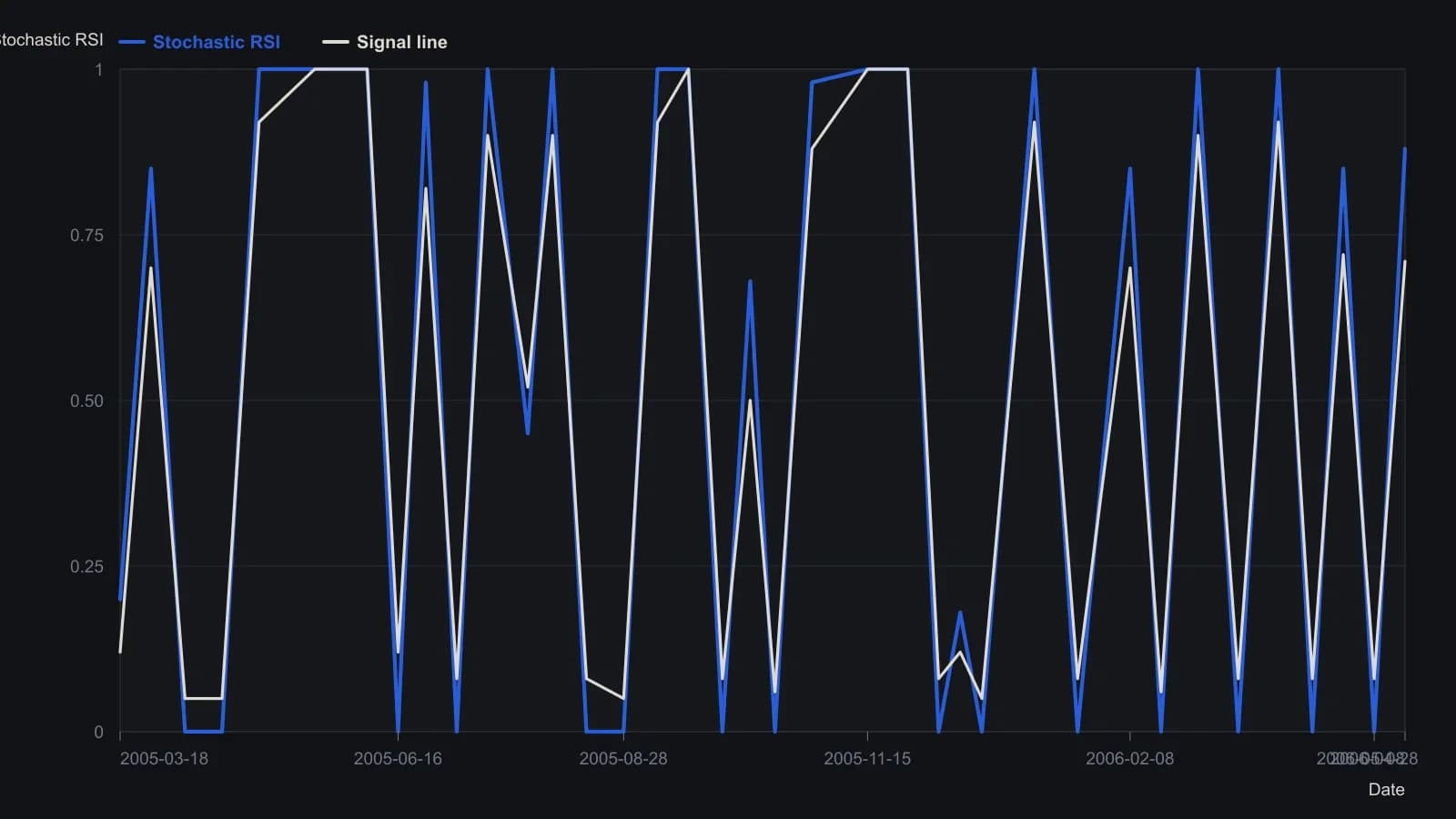
Residual is a 15-bar high-pass of (H+L)/2 with a 4-bar FIR smooth; the pane title shows Stochastic RSI length 20. Mid-scale readings are only good to about 0.05.
All readings on this track · 31 readings
- 1982Cycle phase windows for chart signal filters
- 1987Constructing a cycle-scaled trend oscillator
- 1987Constructing a dominant-cycle grid from marked lows
- 1988Cycle lead from staggered exponential averages
- 1988Auditing the forty-month stock-price cycle
- 1989When long-wave dominant cycles cannot be disproved
- 1991Half-cycle average plot shift versus cycle attenuation
- 1991Half-cycle average contact as an amplitude-ratio test
- 1993Building a restoring-pull indicator from cycle frequency and volume
- 1995Regime filters for a dominant long wave
- 1995A cycle-tuned lead filter from bounded oscillators
- 1998Testable cycle rules instead of fear and greed
- 1999Nested Euro cycle timing as one checkable procedure
- 2002Constructing an instantaneous trendline from a dominant cycle
- 2002Half-cycle center of gravity oscillator from moving-average balance
- 2004Testing a locked forty-week cycle with a hold-or-sit-out rule
- 2005Nested timing bands for dominant-cycle confirmation
- 2005Dominant-cycle baselines versus policy-news narratives
- 2006Pairing a dominant-cycle horizon with trend and oscillators
- 2006A dominant-cycle split into a trend filter and residual Relative Strength Index
- 2007Construct a momentum difference from the dominant cycle
- 2007Naive dominant-cycle rules fail without crowd tests
- 2012Constructing a dominant-cycle forecast as a timing window
- 2012Open-parameter construction of dominant-cycle baselines
- 2013Using a second-term election to check a predeclared dominant-cycle forecast
- 2014Constructing a dominant-cycle forecast baseline
- 2014Quotient transform as an early-onset trend filter
- 2014Construct a trough-to-trough cycle map with the Detrended Price Oscillator
- 2015Dominant-cycle alignment before an earnings catalyst
- 2017Causal reverse exponential average for cycle and trend
- 2020Constructing a cycle-plus-trend oscillator from a one-wavelength chord