1992issue C011-2
Constructing TRIX from triple exponential smoothing
Triple exponential smoothing applies the same exponential moving average three times so short-lived fluctuations are reduced while the series still tracks trend direction. The constructed indicator is the one-period percentage change of that triple-smoothed series.
- Triple-smoothing applies the same exponential moving average three times, each pass taking the previous pass as its input, so short-lived fluctuations are reduced while the series still tracks trend direction.
- The smoothing-constant can be taken from a simple moving-average length n by the conversion 2 divided by n plus 1, and that constant is reused on every pass.
- TRIX is the one-period percentage change of the triple-smoothed series: the latest triple-smoothed value minus the previous one, divided by the previous value, then multiplied by 100.
- The seed-value is the first observation used as the prior average when the recursion starts, and beginning the smoothing at a different point can change later values slightly.
What the oscillator is built from
TRIX is an oscillator formed from the one-period percentage change of a series after three successive exponential averages that share one smoothing constant. Triple-smoothing is three stacked applications of the same exponential moving average, each pass taking the previous pass as its input.
Triple exponential smoothing applies that same exponential moving average three times so short-lived fluctuations are reduced while the series still tracks trend direction.
The shared smoothing constant
Exponential-smoothing is a recursive average that blends the latest observation with the previous smoothed value using a constant strictly between zero and one. An exponential moving average equals the smoothing-constant times the current observation plus one minus that constant times the previous average. The complementary weight stays on the prior average.
A moving-average lookback can be mapped so a simple-average horizon and an exponential recurrence stay comparable. The smoothing-constant can be taken from a simple moving-average length n by the conversion 2 divided by n plus 1. In the declining-issues example, a 35-period simple-average length yields a smoothing constant of 0.05556 that is reused on every pass.
Three passes then a percentage change
After the first exponential average of the raw series, the same constant is applied to that average and then again to the second average to produce the triple-smoothed series.
The constructed indicator is the one-period percentage change of the triple-smoothed series: the latest triple-smoothed value minus the previous one, divided by the previous value, then multiplied by 100.
The seed that starts the recursion
The first observation is used as the prior average when the recursion starts. That seed-value initializes the recursion, and beginning the smoothing at a different point can change later values slightly.
Triple EMA construction on NYSE declining issues
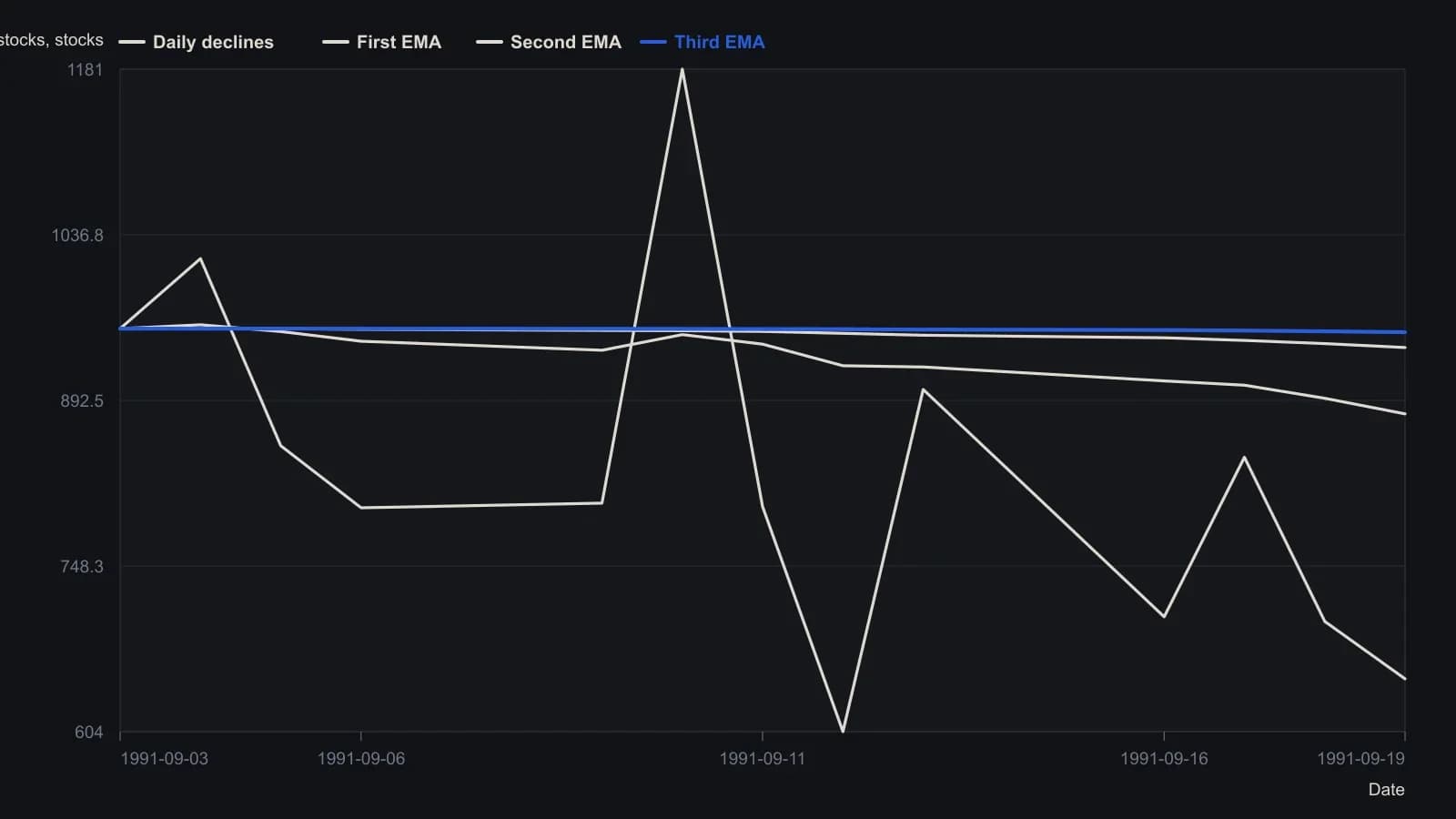
Smoothing constant α = 0.05556, from 2/(35+1), standing in for a 35-day simple average. The 3 September 1991 averages are seeded with that day’s raw decline count of 955. The printed 20 September row showed only spreadsheet formulas, so it is omitted.
All readings on this track · 15 readings
- 1984Constructing TRIX from a cutoff to one shared alpha
- 1988Isolate nested formulas before judging signals
- 1992Constructing TRIX from triple exponential smoothing
- 1992Constructing a TRIX oscillator from daily declines
- 1992A pre-trade checklist that stays flat until weekly support and TRIX agree
- 1992Constructing TRIX as triple-smoothed log-price momentum
- 1992Building TRIX crossover and momentum entries on a period grid
- 1992TRIX lookback and momentum derivative parameters
- 1994Seeding TEMA and DEMA with time-trend regression
- 1997Constructing the TRIX oscillator from triple smoothing
- 2002Constructing TRIX from triple-smoothing to signal rules
- 2002Lock the TRIX construction before reading a zero-line cross
- 2003Constructing TRIX from nested exponential averages
- 2004Construct TRIX entry, exit, and rest windows as one recipe
- 2004TRIX momentum and fundamental overlays for medium-term stock selection