2004issue C061-10
Constructing a volume-flow rule from money flow
The volume-flow construction modifies on-balance volume with a typical-price money-flow test, a volatility cutoff, and a volume cap, then optionally flips long or short when a smoothed reading crosses zero.
- Volume-flow is presented as a modified on-balance-volume calculation that uses money flow to assess trend strength.
- Typical price change is tested against a volatility cutoff, and volume is curtailed before it can enter the signed term.
- The raw reading is a period sum of directional volume divided by a prior volume average, then optionally smoothed.
- When a listing has little history, a cumulative signed-volume total based only on typical-price direction replaces the full cutoff-and-cap construction.
A modified on-balance-volume construction
The volume-flow construction is presented as a modified on-balance-volume calculation that uses money flow to assess trend strength. On-balance volume is a signed running volume total that adds volume on up bars and subtracts it on down bars.
The modification follows volume-price analysis: a construction that pairs price change with volume so that only volume accompanying a qualifying price move contributes to the signal. The money-flow index supplies that price-change input. It is a typical-price money-flow construction used here to decide whether volume is treated as up, down, or ignored.
Typical-price change and the cutoff band
Typical price change (MF) is compared with a cutoff built from a coefficient times the 30-bar standard deviation of log typical-price change times close.
How volume is curtailed
Volume is curtailed at a multiple of a prior volume average before it is allowed to enter the signed directional-volume term. Directional volume is set to curtailed volume, its negative, or zero according to whether money flow is above, below, or inside the cutoff band.
From directional volume to a reading
The raw volume-flow value is a period sum of directional volume divided by the prior volume average, then optionally smoothed with an exponential average. A companion volume plot compares the curtailed volume series with total volume so the construction's volume cap can be inspected bar by bar.
A thinner total for new listings
An IPO-oriented variant replaces the full cutoff-and-cap construction with a cumulative signed-volume total based only on typical-price direction, because new listings have little history.
A zero-line flip
One implementation treats a smoothed volume-flow crossing through zero as the long/short flip rule for the construction.
S&P 500 volume-flow indicator, July 2003 to April 2004
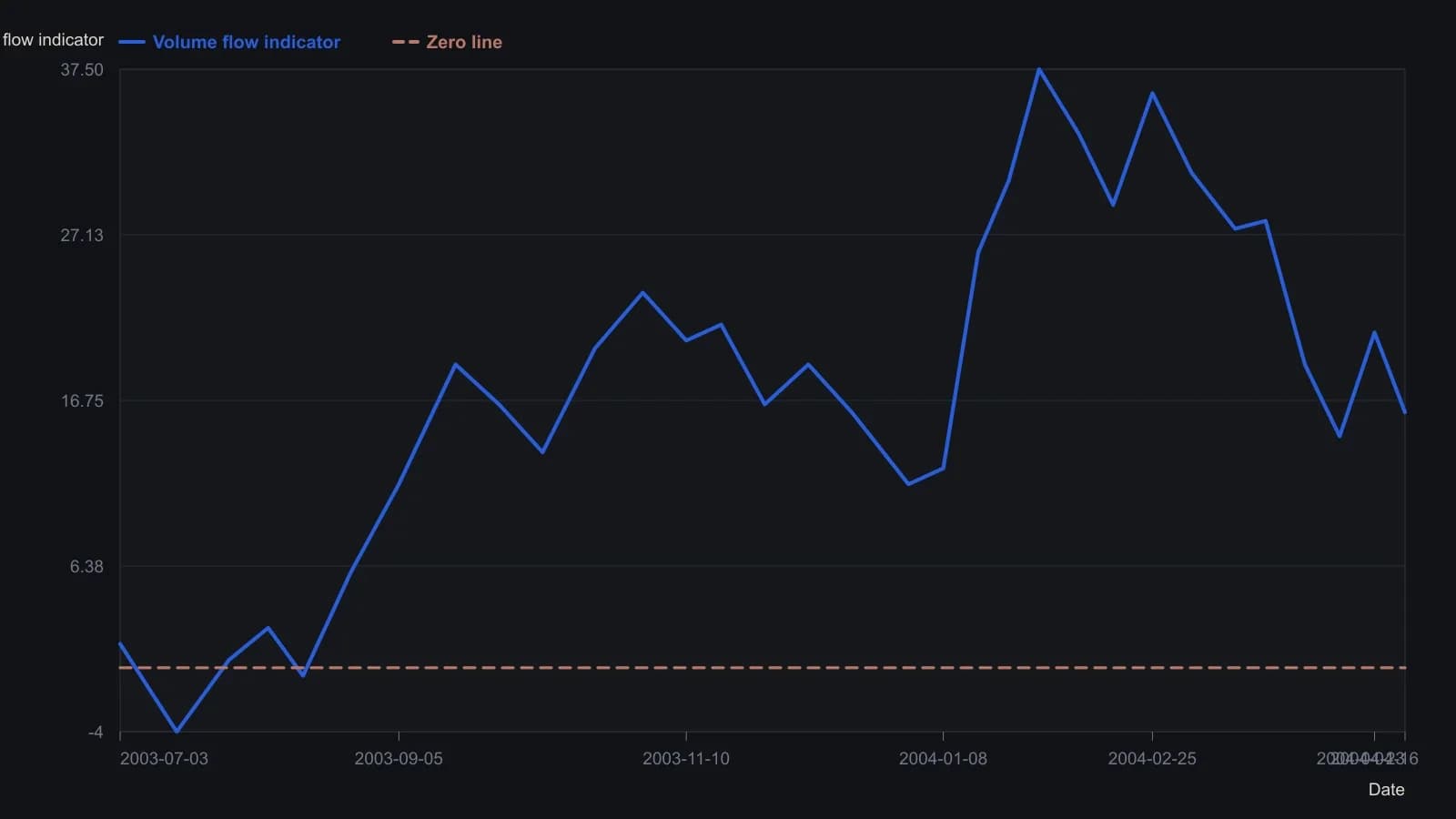
Read from the plotted line to the nearest half unit. The source macro uses a 130-bar volume average, a 0.2 volatility coefficient, a 2.5-times volume cap, and a three-bar exponential smooth.
All readings on this track · 13 readings
- 1988Constructing tick-weighted money flow and price divergences
- 1989Four-state money-flow-index as permission for a next-bar breakout-system
- 1989Constructing a suggest-then-confirm Money Flow Index
- 1993Five-rung money flow from signed print volume
- 1993Physics analogies for building cycle and money flow indicators
- 1994Keep a wave count as a draft until money flow and a trendline agree
- 1999Take the rectangular-base breakout from money-flow confirmation, not from a late strength average
- 2004Constructing a volume-flow rule from money flow
- 2006Classify the regime before the bar read
- 2015Constructing a bounded money-flow oscillator from range and volume
- 2016Combining RSI, moving averages, and money flow
- 2018Five-rule technical rating as a rotation filter
- 2020Combining money-flow, RSI, and breadth for dynamic pressure zones