2005issue C041-4
Constructing a move, volume and recency weighted average
A moving-average becomes a directional forecast only after extra inputs are written into the weights. Keep move-share, volume-share and recency as three series, then average them so lag can be read as a classroom design variable.
- A moving-average of past values can serve as a directional forecast only after extra inputs are added whose changes are correlated with later changes in the series.
- Moma weights each lookback close by that bar's share of total absolute change. Voma weights each close by that bar's share of lookback volume. A weighted-moving-average weights by order in the window so newer bars dominate.
- Lag for a simple average equals half the lookback. A recency-weighted average shrinks that delay, and wevomo turns a few bars earlier than vomoma in the idealized range cases.
- When volume rises with price toward range extremes, both vomoma and wevomo show larger amplitude, and the recency blend still turns a few periods sooner.
Why a plain lookback is late
A moving-average is a lookback smoother of ordered prices that reports where a series has already been unless extra leading inputs are written into the weights. Lag is the delay between a turn in the raw series and the matching turn in the average. For a simple average, that delay equals half the lookback.
A moving average of past values can serve as a directional forecast only after extra inputs are added whose changes are correlated with later changes in the series.
Move-share and volume-share
Moma is a move-adjusted average that reallocates lookback weight by each close's absolute preceding change as a share of the window's total absolute change. Each lookback close is multiplied by that bar's absolute preceding change divided by the sum of those absolute changes.
Volume-price-analysis is the construction rule that treats each bar's volume as a share of lookback volume when deciding how hard that price should pull the average. Voma is the matching volume-adjusted average: each lookback close is multiplied by that bar's volume as a share of total lookback volume.
Averaging the move-adjusted and volume-adjusted series and dividing by 2 produces vomoma, the double-adjusted blend later combined with recency weights.
Recency weights shrink the delay
A weighted-moving-average is a recency smoother that multiplies each observation by its order in the window so newer bars dominate and the delay versus a simple average shrinks.
A simple average lags by half the lookback. A 10-period simple average of a sine wave with frequency 20 lags by five periods. A 10-period weighted average multiplies the newest observation by 10 and the oldest by 1, divides by 55, and lags by about half as much as the matching simple average.
On a four-period worksheet the recency multipliers are 1 through 4 and the divisor is 10.
The three-component mean
Wevomo is the equal blend of the move-adjusted average, the volume-adjusted average and a recency-weighted average. The triple-component series is the arithmetic mean of those three component averages. On the four-period worksheet the final series is that same three-way mean.
In an idealized range where volume is lowest at price extremes, adding recency weights makes the triple-component series turn a few bars earlier than the double-adjusted series.
When volume rises with price toward range extremes, both the double-adjusted and triple-component series show larger amplitude, and the recency blend still turns a few periods sooner.
Editorial reading: the first contrast isolates timing. The second contrast isolates amplitude. Keeping moma, voma and the recency series visible before the blend is what makes those two effects separable.
Four-period MOMA, VOMA, WMA and their mean (WEVOMO)
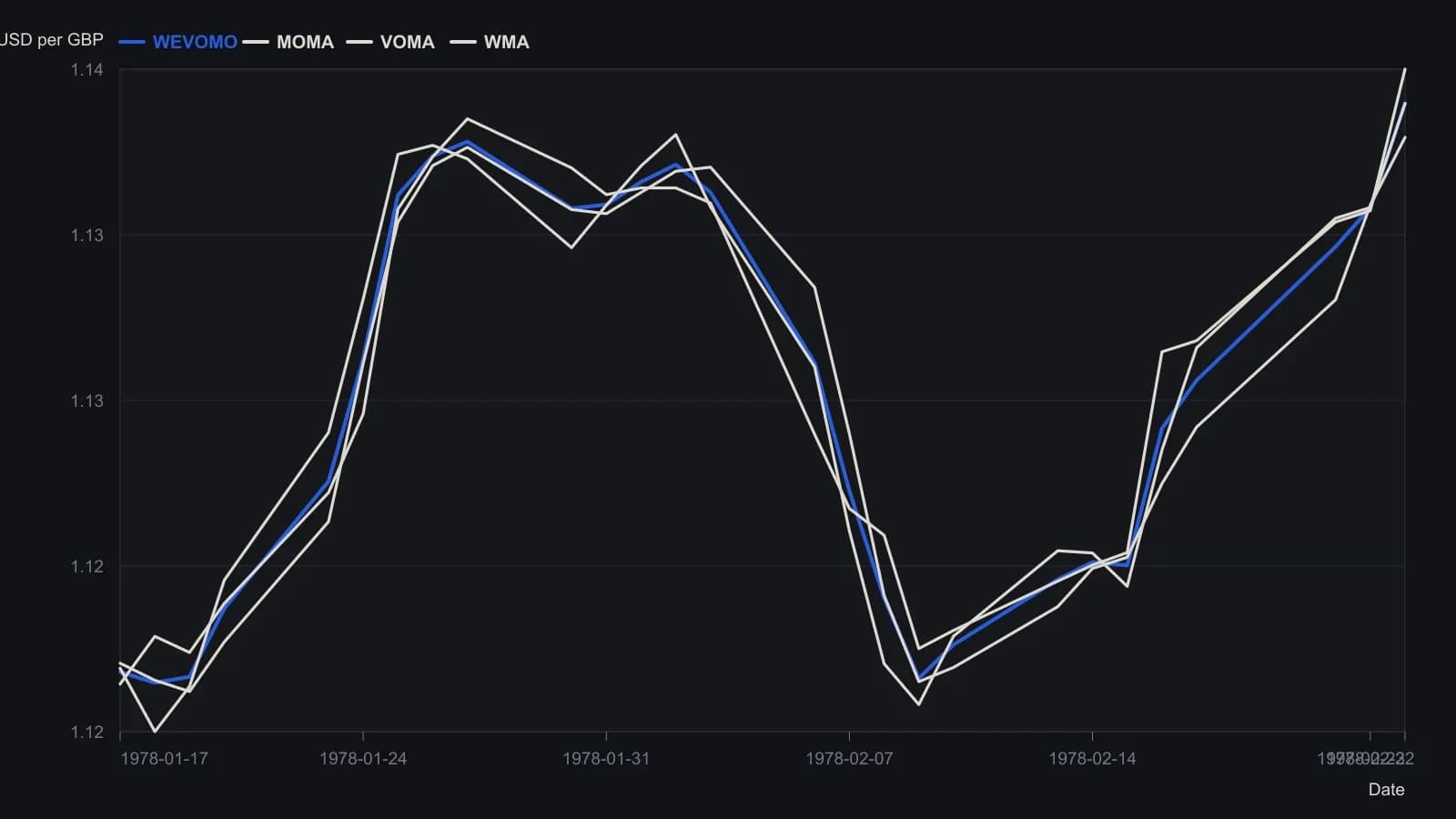
Lookback is four periods, as in the published worksheet: MOMA weights each close by its share of absolute close-to-close change, VOMA by share of period volume, WMA by rank 1..4 (divisor 10). WEVOMO is (MOMA+VOMA+WMA)/3. Calculated columns begin only once the window is full.
All readings on this track · 20 readings
- 1988Indicator smoothing: lookback, weight, and scale
- 1990Recency weighting in simple, linear, and exponential moving averages
- 1990Seed and recurrence construction for moving averages
- 1990Constructing a five-day step-weighted moving average
- 1992Constructing simple, weighted, and exponential moving averages
- 1992Constructing moving averages with weighting schemes and extra filters
- 1992Constructing a weighted-average TRIN10 with Bollinger envelopes
- 1992Constructing a banded weighted open-TRIN oscillator
- 1993Evaluating a weighted dual rate-of-change momentum filter
- 1993Constructing equal, linear and exponential moving averages
- 1993Constructing a general weighted moving average from one exponent
- 1993Calibrating the weighted-moving-average exponent
- 1993Constructing an exponent-weighted average of put-call ratios
- 1994Cycle-tuned momentum with spectral peaks
- 1999How a five-bar sine-weighted average is assembled
- 2003Same-scale trend filter from a rolling least-squares endpoint
- 2003How a rolling linear-regression endpoint is assembled as a moving-trend
- 2004Constructing a volume-weighted moving average as a forecast baseline
- 2005Constructing a move, volume and recency weighted average
- 2016MACD as a zero-line filter with dual moving averages