1999issue C061-6
Fixed-lag construction of moving-average smoothers
A moving average is a lookback average of ordered price observations used to suppress short-lived fluctuations while introducing delay. This archive article first reads that lag from a known turning-point path, then compares weighting schemes by counting data-direction reversals at a matched delay.
- Smoothness can be operationalized by coding each observation as up or down versus the prior one and summing the times that binary state changes.
- Fair smoothness comparisons held lag fixed rather than holding the moving-average period fixed.
- At a 3-day lag the shortest windows that produced that delay were 9 for exponential, 6 for simple, 10 for linear or weighted, 22 for endpoint, and 6 for both triangular and sine-weighted.
- On the daily close sample, at each matched lag from 2 through 7 days, the linear, triangular, endpoint, and sine-weighted series each showed a longer average interval between reversals than both the simple and exponential series.
What a moving average spends in delay
A moving-average is a lookback average of ordered price observations used to suppress short-lived fluctuations while introducing delay. Lag is the number of sampling intervals between a turning point in the unsmoothed series and the corresponding turning point in the smoother.
Six constructions were specified: simple, exponential with coefficient 2/(n+1), endpoint least-squares, linear (also called weighted), triangular, and sine-weighted. An endpoint-moving-average is the newest fitted value of a least-squares straight line through a lookback window. A sine-weighted-moving-average is a finite-window average that weights observations with a sine function that is low at both ends of the window and high in the middle.
Two finite-window weight patterns
A triangular-moving-average is a finite-window average whose weights rise to a peak at the center of the window and then fall, then are divided by the sum of those weights. For odd windows a triangular moving average uses palindromic integer weights such as 1-2-1, 1-2-3-2-1, or 1-2-3-4-3-2-1. The five-point form is (P5 + 2P4 + 3P3 + 2P2 + P1)/9.
A weighted-moving-average is a finite-window average that assigns linearly declining integer weights from the newest observation back to the oldest, then divides by the sum of the weights. A five-point linear moving average, also called a weighted moving average, is (5P5 + 4P4 + 3P3 + 2P2 + P1)/15, where the divisor is the sum of the weights.
A synthetic path that makes lag visible
Lag was read from a 199-point synthetic path that rose by 1 each day from 1 to 100 and then fell back to 1. A 14-day linear moving average turned 4 days after that peak.
Fair smoothness comparisons held lag fixed rather than holding the moving-average period fixed. At a 3-day lag the shortest windows that produced that delay were 9 (exponential), 6 (simple), 10 (linear/weighted), 22 (endpoint), 6 (triangular), and 6 (sine-weighted).
Smoothness as fewer data-direction reversals
Smoothness can be operationalized by coding each observation as up or down versus the prior one and summing the times that binary state changes. Each such change is a data-direction-reversal: a change from an up step to a down step, or the reverse, between consecutive observations of a series.
Across 7254 daily closes from 17 March 1970 through 30 November 1998, the raw series reversed direction 3332 times, averaging 2.18 days between reversals. An 11-day simple moving average left 883 reversals, averaging 8.21 days between reversals.
On daily closes from 17 March 1970 through 30 November 1998, at each matched lag from 2 through 7 days, the linear, triangular, endpoint, and sine-weighted series each showed a longer average interval between reversals than both the simple and exponential series.
On 1066 weekly closes from 29 September 1978 through 24 December 1998, a 39-week simple moving average produced 47 reversals (22.7 weeks apart) while a 39-week sine-weighted moving average with the same lag produced 18 reversals (59.2 weeks apart).
Five-point sine-weighted average versus daily close
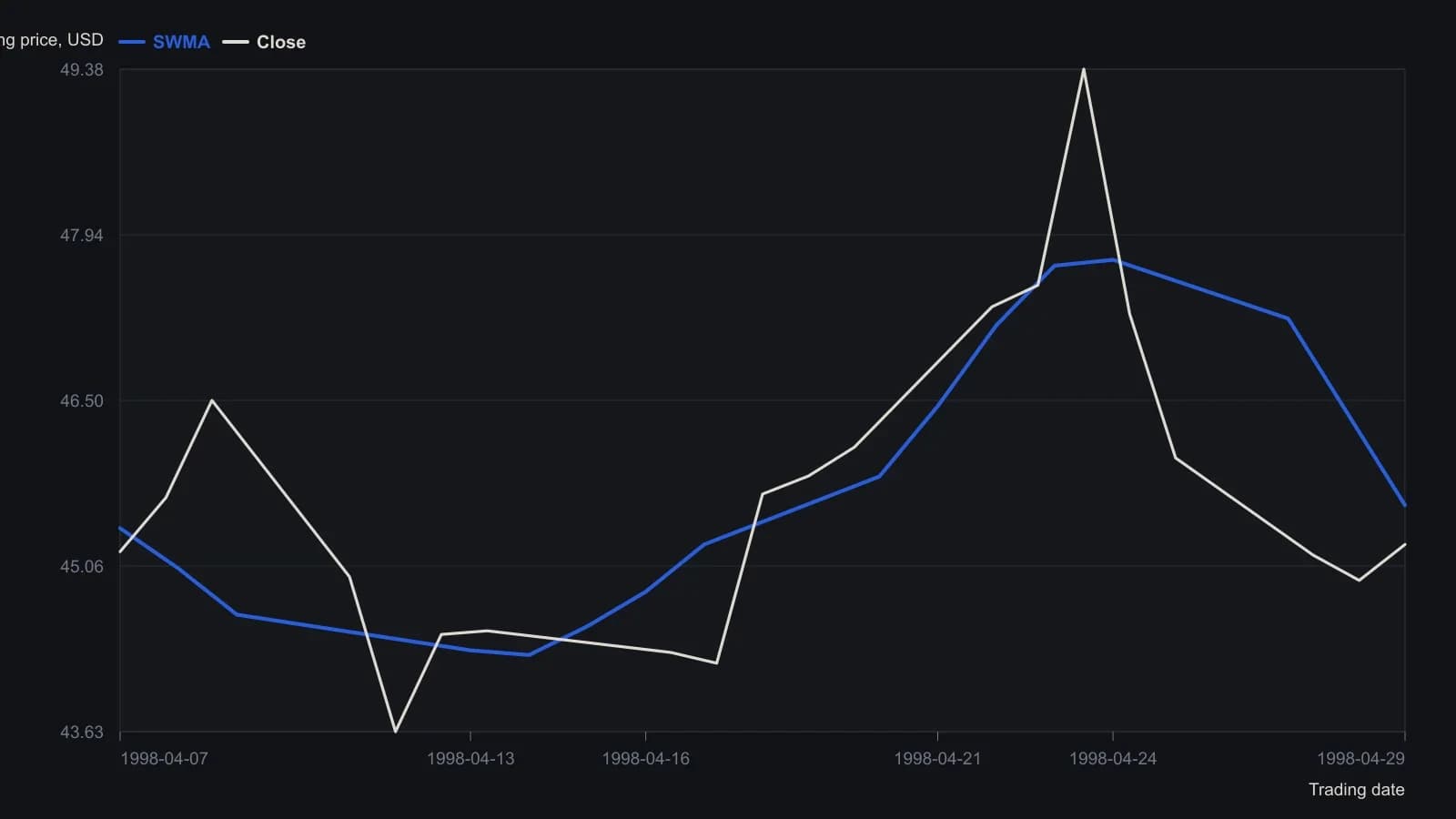
The five-point sine-weight window leaves the first four sessions blank. The printed denominator is 3.73, the sum of sin(n·180°/6) for n = 1 through 5.
All readings on this track · 8 readings
- 1989Constructing lag-matched triangular moving averages
- 1990Lag-aligned MACD from triangular moving averages
- 1990Constructing triangular moving average weights
- 1990Constructing a lag-aligned triangular MACD
- 1998Paired tests for moving-average lag and smoothness
- 1999Fixed-lag construction of moving-average smoothers
- 2003Weighting recipes inside one moving-average lookback
- 2010Assembling a smoothed percent-b oscillator from Heikin-Ashi and stacked averages