1994issue C031-3
Five-interval exponential smoothing of ten-interval signed path-efficiency
This article reconstructs a displayed series in construction order. A ten-interval signed-efficiency reading is formed first. A five-interval exponential-smoothing layer is then applied, with its own start value, smoothing-weight, and horizontal reference levels.
- Form signed-efficiency on a fixed lookback before any smoothing is applied.
- Treat exponential-smoothing as a separate forecast-style layer with an explicit first-bar start value and a fixed smoothing-weight.
- Place the horizontal 50 and -50 reference levels next to the smoothed series, not on the unsmoothed efficiency geometry.
- Worked chart notes treat readings near zero as low-efficiency congestion and extreme readings as high-efficiency travel.
Construction order
TradersWeek editorial framing treats the displayed series as a two-step construction rather than a single chart story. The archive workflow first forms a ten-interval polarized path-efficiency reading, then shows a five-interval exponential-smoothing of that signed-efficiency series.
The two steps stay distinct. Path-efficiency is a geometry on a lookback. Exponential-smoothing is a recursive filter applied afterward.
Signed path-efficiency on a fixed lookback
Path-efficiency is the ratio of net displacement over a lookback to the summed length of the one-bar path that produced that net move. The lookback here is ten sampling intervals, used for both the net move and the path-length sum.
Net displacement is formed as the hypotenuse of the nine-bar close-to-close change and a fixed side whose square is 100. Path length is the sum of nine successive hypotenuses, each pairing a one-bar close change with a unit time step.
The efficiency ratio is scaled by 100 and signed by whether the nine-bar close change is positive. That signed-efficiency series is the input to the smoother.
Exponential-smoothing as a second layer
Exponential-smoothing is a recursive filter that blends the newest observation with the prior filtered value using a fixed weight, producing a regularly sampled forecast-style series. It is applied to the signed-efficiency readings, not to the raw close path.
On the first bar the smoother is set equal to the current signed ratio. Afterward each update uses a 0.333 smoothing-weight on the new ratio and a 1 minus 0.333 weight on the prior smoothed value, then rounds to a whole number.
Reference levels and chart notes
The construction plots horizontal reference levels at 50 and -50 next to the smoothed series.
A worked chart note treats readings near zero as low-efficiency congestion. A second worked chart note treats extreme readings as high-efficiency travel.
Five-interval EMA of 10-day polarized fractal efficiency on OEX
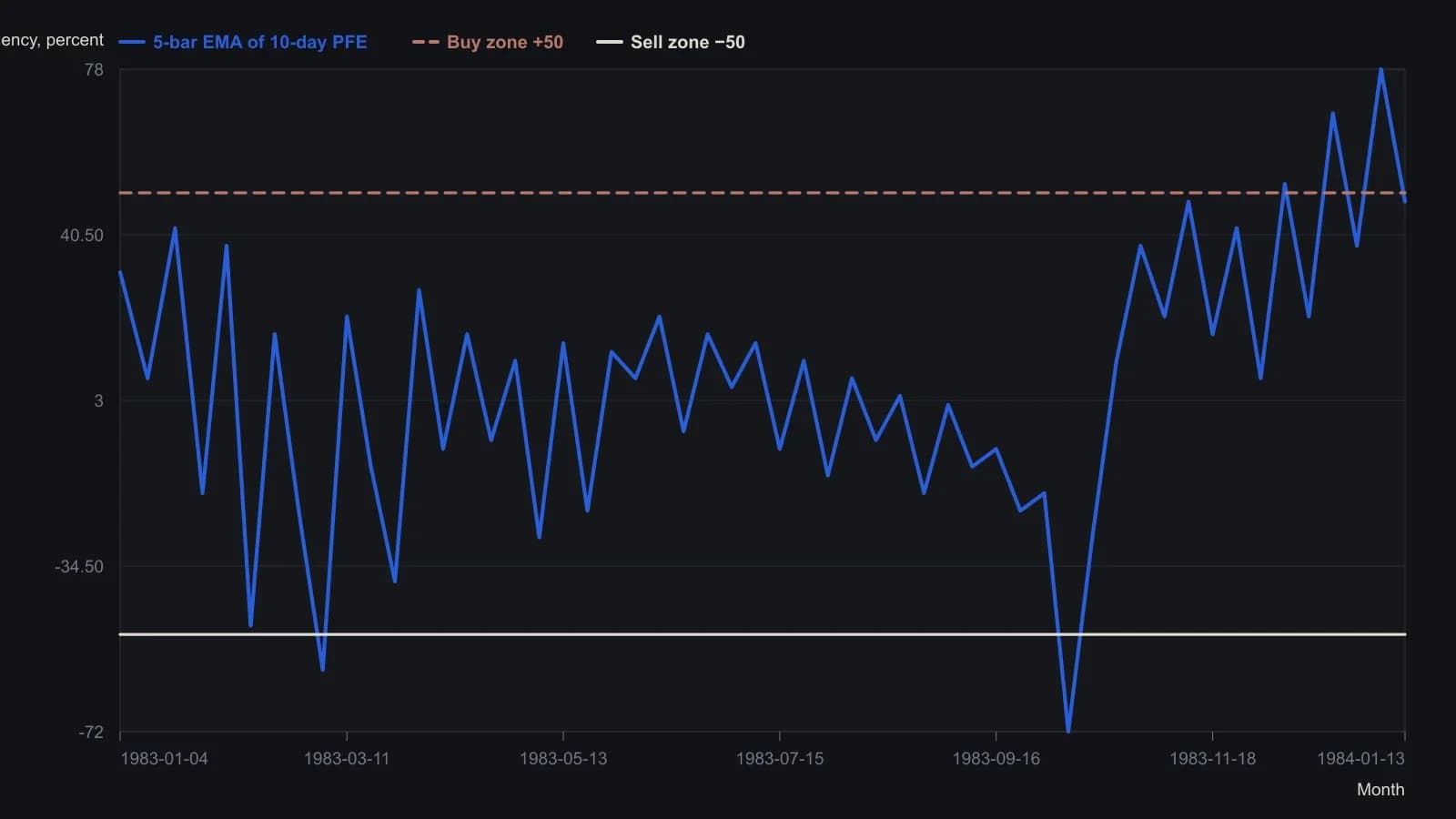
TradeStation layer uses a five-bar exponential average of 10-day PFE, initialized on the first bar at the raw signed reading, then EMA = round(0.333×PFE + 0.667×prior EMA). Horizontal overlays are the published +50 buy zone and −50 sell zone. Digitized from the magazine raster; expect a few PFE points of read error.
All readings on this track · 41 readings
- 1984Matching average age across price filters
- 1984Residual-impact construction of exponential smoothers
- 1988Constructing simple and exponential moving averages as specified filters
- 1989Evaluating smoothed free reserves and funds-discount spreads
- 1990Integer construction of moving averages and exponential smoothing
- 1990Constructing incremental moving average filters
- 1991Constructing a double-smoothed stochastic oscillator
- 1991Constructing an exponential average from a smoothing weight
- 1991Constructing a double-smoothed momentum oscillator family
- 1991Competing certainty rules from exponential-average conditions
- 1991Hybrid construction of a mechanical timing system from smoothed signals
- 1991Constructing an exponential smoother from a moving-average length
- 1991Equivalent relative-strength-index constructions from a ratio and from smoothed momentum
- 1991Constructing the true strength index from double-smoothed momentum
- 1991True strength index from signed, double-smoothed momentum
- 1992Constructing exponential averages from simple lookbacks
- 1992Constructing exponential averages by the smoothing constant, startup length and lag
- 1992Nested range smoothing and windowed high-low damping
- 1992A weekly equity stance from the discount-bill spread
- 1993Double-smoothed stochastics momentum index construction
- 1993Constructing the true strength index with double exponential smoothing
- 1994Polarized fractal efficiency with a shared exponential smoother
- 1994Five-interval exponential smoothing of ten-interval signed path-efficiency
- 1994Hand-ranked price-volume series with stacked smoothing and stochastic
- 1995Range expansion filter on multi-horizon averages
- 1995The exponential smoothing constant from averaging lag
- 1997Construct a nested-average rainbow band and oscillator
- 1998Filter stacks that combine a moving average with exponential smoothing
- 2002Smoothed relative-strength construction from wilder-averaging and a price prefilter
- 2003Reverse-engineered RSI price targets
- 2004Piecewise trend quality from moving-average reversals
- 2004Nested smoothing recipes versus unaudited oscillator experiments
- 2008Weight construction beyond the N-day label
- 2010A consensus filter for objective RSI and smoothing construction
- 2012Sentiment-zone oscillator from signed closes
- 2012Classic RSI one-over-N smoothing versus the standard exponential average
- 2013Why exponential smoothing uses two over n plus one
- 2015Constructing ratio indicators with moving-average and exponential-smoothing weights
- 2015Slow relative-strength index from an exponentially smoothed price
- 2017Rebuilding the relative strength index as open-scale buy-sell pressure
- 2017Comparing Wilder and exponential smoothing inside a relative-strength index