1991issue C081-13
Three-component trend model with rate-of-change filters
A long-term outlook can be split into tape, sentiment, and monetary blocks, then simplified into a rate-of-change tape filter, a sentiment-contrarian-overlay, and a monetary-climate-filter, while optional targets give way if the primary trend turns first.
- Composite-thirds split the long-term outlook among a tape block, a sentiment-extremes block, and a monetary-economic block, with at least half the weight on market-derived technical inputs.
- A rate-of-change-filter, a sentiment-contrarian-overlay, and a monetary-climate-filter form a simplified three-indicator overview of that structure.
- Price and time targets stay optional context. If the tape turns first, primary-trend models override the forecast.
- Nonconfirmation among related averages, capitalization groups, or world markets is a mixed-message caution, not proof that a reversal is complete.
Weight the outlook toward the tape
The described modeling practice assigns at least half of the weight in any built model or outlook to market-derived technical inputs such as momentum, moving averages, and deviation from trend. That tape-based share is the internal-component, so positioning stays aligned with the primary trend.
The long-term evaluation is described as composite-thirds. One part is a tape composite of momentum and moving-average indicators. One part is a sentiment composite of optimism and pessimism extremes. One part is a monetary-economic composite.
Assemble a three-indicator overview
A simplified three-indicator overview is assembled from a 30-week Value Line rate-of-change, a bulls-over-bulls-plus-bears sentiment ratio, and a 26-week change in short-term government bonds.
The Value Line 30-week rate-of-change is specified as a rate-of-change-filter. It is a buy after the reading falls below -1% and then rises back above -1%, and a sell after it rises above 16% and then falls back below 16%.
The advisor-sentiment ratio is used as a sentiment-contrarian-overlay. It is specified as a purchase cue when it falls below 42 and a sale cue when it rises above 67, treating those readings as pessimism and optimism extremes.
The 26-week change in short-term government bonds is used as a monetary-climate-filter, with a reading above 1.7% labeled healthy and a reading below -0.6% labeled hostile. A related figure also marks a falling-rate climate above +2% and a negative climate below -0.5%.
Add intermediate bands and average tests
A 40-day smoothed Arms Index is used as an intermediate-term overbought-oversold-band, with buys when the index rises to 112 or at least to 96.8 and then reverses, and sells when it falls below 79.8 or declines to at least 92.8 and then turns back up.
Index-specific moving-average tests are used to judge confirmation versus reversal, including a 23-week front-weighted average on the New York Financial Index that requires a 0.5% cross and a 29-week average on the New York Utilities Index that requires a 1% reverse.
Keep targets optional when the tape turns
Price and time targets from valuation ratios or a one-, four-, and ten-year cycle composite are treated as optional context. If the tape turns before a target is reached, the primary-trend models override the forecast. That revision habit is dynamic-modeling: changing a target or swapping an indicator when other composites contradict a single valuation or time-price estimate, instead of waiting for a pre-announced level.
Lack of confirmation among related averages, small-capitalization versus large-capitalization stocks, and major world markets is treated as nonconfirmation. It is a mixed-message caution rather than proof that a completed trend reversal has already occurred.
S&P 500 weekly close, 1989–1991
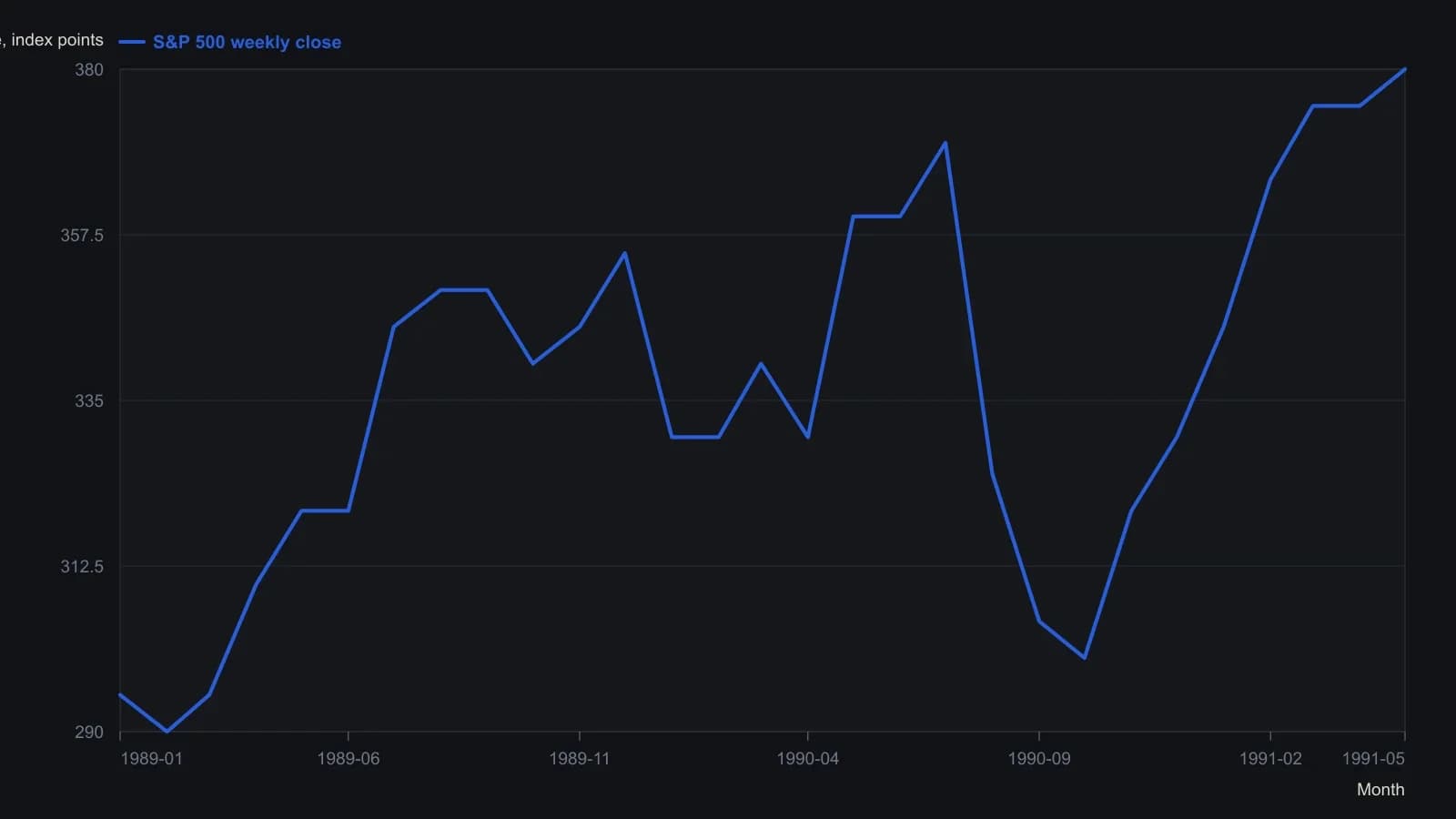
Values were read off the weekly plot and rounded to the nearest five index points. The source marks the same tape with Lindsay's numbered count; the interview treats the late-August 1991 dome target as optional if the primary trend turns first.
All readings on this track · 46 readings
- 1985Constructing excess and momentum difference-curve oscillators
- 1988Five reading rules for smoothed indicator charts
- 1989Momentum overlays that speed moving-average oscillators
- 1990A laboratory template that constructs Rate of Change as a pane module
- 1991Volume-scaled rate of change as a momentum construction
- 1991Three-indicator market overview from tape, sentiment and rates
- 1991Three-component trend model with rate-of-change filters
- 1992A KST oscillator from a weighted rate-of-change stack
- 1992Four-window weighted rate-of-change composite
- 1992Constructing multi-span smoothed rate-of-change filters
- 1992Constructing a four-horizon summed rate of change
- 1992Constructing KST from four weighted smoothed rates of change
- 1992Constructing a composite from weighted smoothed rates of change
- 1992Three-horizon KST maturity alignment
- 1992Construct a bond-led dividend-to-bond-yield regime first
- 1992Constructing relative-strength KST from weighted rate-of-change
- 1993Constructing a volume oscillator from average ratios and smoothed rate of change
- 1994Gold as a cycle clock for commodities and yields
- 1994Constructing a composite from weighted, smoothed rate-of-change windows
- 1994Constructing gold-mining rate-of-change tripwires for Treasury bonds
- 1994A capacity-stress checklist across commodities, bonds, and breadth
- 1994Rate of change parameters for testable entries
- 1994Constructing rate-of-change midpoints, lookbacks and divergence
- 1994Lead oscillator breaks need price trendline confirmation
- 1994Nested averages for an annual momentum curve
- 1994Evaluating a Coppock-style rate of change as a bottom-regime filter
- 1995A weighted eleven-month Dow rate of change as one testable timing procedure
- 1996Named lookbacks, thresholds, and streaks for entry rules
- 1997A midpoint rate-of-change test for bond trend follow-through
- 1997Constructing a short-rate-adjusted equity momentum filter
- 1998Daily momentum rank-churn as a portfolio-construction problem
- 1999Constructing a lagged rate of change cycle system
- 2000A triple delay line then a one-bar elliptic oscillator
- 2001Confirming rate of change divergences with price
- 2001Momentum trendline breaks need price confirmation
- 2001Market breadth, On-balance volume, and Rate of Change as a combined timing framework
- 2001Know Sure Thing with stacked horizons and trendline confirmation
- 2003Constructing a mechanical system from a rate of change condition
- 2003Constructing momentum from two closes and spotting divergence
- 2003Formula choice tilts which momentum mismatches count as divergences
- 2004RSI and momentum agreement as an asymmetric filter
- 2005Constructing price-normalized moving-slope hybrids
- 2005Unsigned speed gates on a fixed average-cross pair
- 2007Rebuilding rate of change as a path-weighted oscillator
- 2008Construct Special K so short-horizon signals stay inside the primary trend
- 2013Restore volume balance before adding another price-time indicator