2011issue C1162-71
Building a put-call ratio indicator stack
The same put-call series can be clipped, rainbow-smoothed, and recast as a fast oscillator, a slow oscillator, and an inverse-Fisher variant. This archive article treats that stack as a construction lesson.
- Three related oscillators can be built from the same put-call series: a fast version, a slow version, and a slow version passed through an inverse Fisher transform.
- The put-call input is clipped at 0.90 on the high side and 0.45 on the low side before any smoothing is applied.
- The fast path uses a triple exponential average, a ten-pass two-period weighted rainbow, and an averaged relative-strength calculation. The slow path rainbow-smooths the clipped series directly, then applies a short weighted average.
- The inverse-Fisher variant recenters a relative-strength reading of the slow series around 50 and rescales the hyperbolic transform onto a 0-100 range. The same three constructions can be reproduced once the put-call series is available as a second data stream.
Three oscillators from one series
The archive construction starts from a single put-call ratio series. From that series it builds three related oscillators: a fast version, a slow version, and a slow version passed through an inverse Fisher transform.
In this workflow the put-call ratio is an options-volume sentiment input that is clipped, rainbow-smoothed, and then transformed into those three variants. A relative-strength index is used as a bounded oscillator on a smoothed put-call series so the stacked averages become a comparable 0-100 reading.
Clip the put-call input first
Before any smoothing is applied, the construction clips the put-call input at 0.90 on the high side and 0.45 on the low side. Values outside that band do not enter the averages that follow.
The fast path
The fast path first applies a triple exponential average to the clipped series. It then applies a ten-pass two-period weighted rainbow. A relative-strength calculation is applied next, and that relative-strength reading is itself averaged.
The slow path
The slow path skips the triple exponential step. It rainbow-smooths the clipped put-call series directly, then applies a short weighted average.
The inverse-Fisher variant
The inverse-Fisher variant starts from a relative-strength reading of the slow series. That reading is recentered around 50. The hyperbolic transform is then rescaled back onto a 0-100 range.
Inverse-Fisher slow PCRI on the S&P 500, summer 2011
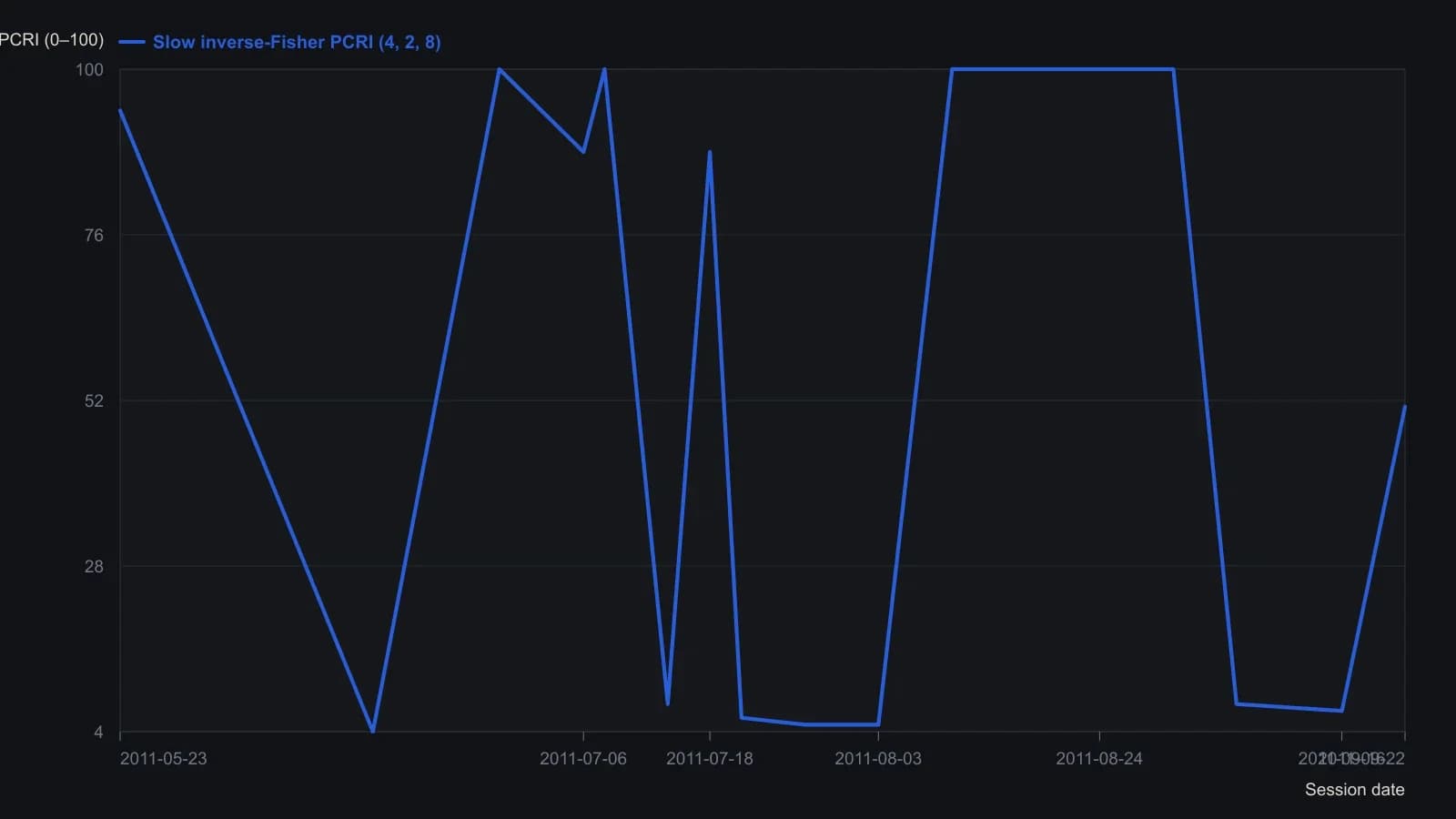
Printed inputs are rainbow length 4, PCRI smooth 2 and RSI length 8. The source clips the raw put/call ratio to 0.45–0.90 before the rainbow average. Interior dates follow the June–September ticks and the 22 September 2011 session label; every y other than the final 51.09 readout is approximate to the raster.
Reproduce the stack
The same three constructions can be reproduced across charting platforms and a spreadsheet once the put-call series is available as a second data stream.
Editorial reading
Editorial reading: clamping the extremes, stacking successive averages, and then overlaying a relative-strength transform is one way to turn a raw put-call series into a cycle-phase oscillator. That framing is editorial. The archive specifies only the construction.
All readings on this track · 31 readings
- 1989Constructing an open-interest-scaled put-call ratio
- 1990Open-interest put/call ratio as an intermediate sentiment overlay
- 1990Activity-weighted call-put ratio for options regime context
- 1990Stacking moving averages, put-call regimes, and double bottoms
- 1991Constructing put-call open-interest regime filters
- 1991Constructing an activity-weighted call-put sentiment reading
- 1991Fund-index regime, put-call confirmation, then the tracking fund
- 1992A seven-vote sentiment score for fund-sleeve regimes
- 1992Construct an activity-weighted call-put ratio before reading crowd conviction
- 1992Pair action with opinion in a composite sentiment index
- 1992Crowd extremes as a three-gate contrary procedure
- 1993Constructing a put-volume average regime filter
- 1993Neural-net inputs and rule trees for mechanical systems
- 1994Failed Treasury put-call signal and a dollar regime shift
- 1994Separate survey, put-call, and premium ledgers before a regime call
- 1994Repeated option-premium prints and a four-zone regime map
- 1995Consecutive-day regimes in the put-call premium ratio
- 1995Construct a put-call ratio for regime-aware contrarian signals
- 1996Treat one options idea as a regime-aware portfolio decision
- 1997Options open interest, put-call sentiment, and contrarian context
- 2000A two-layer put-call construction for intermediate market conditions
- 2002Sentiment confirmation for trend-following options
- 2003Construct a regime overlay from implied volatility and the put-call ratio
- 2004Dollar-weighted Put-call ratio construction
- 2006Debit put spreads inside put-call regimes
- 2011Put-call ratio cycle phases for index context
- 2011Constructing a put-call ratio cycle indicator
- 2011Building a put-call ratio indicator stack
- 2011Put-call ratio regime context with oscillator and band confirmation
- 2018Reading seasonal regimes with put-call divergence and bands
- 2020Treat close-only volume as a hypothesis, then choose regime or phase