1992issue C121-11
Constructing nested stochastic lookbacks
A nested-lookback-stack repeats one stochastic formula at several horizons, keeps one smoothing convention, and shares the same extreme-band levels so concurrence can be read on one chart. The construction lesson is how those clocks are nested, not which single length to treat as a default.
- A nested-lookback-stack computes the same stochastic formula at several horizons and draws the series together so short, intermediate, and long windows can be compared.
- One simple-average-smoothing convention and shared extreme-band levels of 80 and 20 make concurrence, not a single default length, the object of the overlay.
- A longer-window-gate accepts a shorter-length band cross only when the next-longer series is already beyond the same band.
- The archive described the construction as an oscillator rather than a trend-following rule, so it would not stay with an entire directional run.
A stack of nested clocks
The archive built a nested-lookback-stack: the same stochastic formula computed at several horizons and drawn together so short, intermediate, and long sampling windows can be compared. Several stochastic lengths were observed to reach an extreme reading at the same time, which motivated overlaying those series on one chart.
Editorial: read that overlay as a stack of nested clocks. Choose several lookbacks, keep one smoothing convention, and share the same extreme-band levels, then study only the moments those clocks agree. Lookback design is the lesson, not a search for one default length.
Calendar-matched lookbacks
A 14-bar monthly stochastic, a 59-bar weekly stochastic, and a 294-bar daily stochastic were treated as comparable lookbacks because 59 weeks and about 294 trading days each span about 14 months.
Editorial: those three series are different sampling clocks aimed at roughly the same span. Comparability comes from matching the window, not from forcing every chart to use one bar length.
Unoptimized pairs and simple-average-smoothing
Four unoptimized parameter pairs were assigned to long, intermediate, short, and very-short horizons: 150/5, 50/5, 13/5, and 5/5. Each pair states the percent-k lookback and the percent-d smoothing length.
The overlaid series were calculated with simple moving averages rather than exponential averages. That choice is simple-average-smoothing. Percent-d is a smoothed transform of percent-k, formed here with a simple moving average of a stated length.
How percent-k and percent-d were stated
Percent-k locates the latest close inside the highest high and lowest low of a chosen lookback, scaled from 0 to 100. In the archive statement, percent-k is 100 times the latest close minus the n-period lowest low, divided by the n-period high-low range. A three-period percent-d was formed from the summed numerators and denominators of that ratio.
Shared extreme bands and a short trigger
An extreme-band is a fixed threshold, here 80 or 20, used to mark when a series is stretched inside its own lookback range. On the illustrated daily index overlay of 150/5, 50/5, and 13/5, concurrence above 80 or below 20 was the condition of interest, and the 13/5 series crossing those bands was used as the trigger.
The longer-window-gate
A longer-window-gate accepts a shorter-length band cross only when a longer-length series is already beyond the same band. An intermediate-horizon rule accepted a 50/5 cross of 80 or 20 only if the next-longer 150/5 series was already above 80 or below 20, respectively. A 50/5 cross of the 20 line was rejected as a buy condition when the 150/5 series had not yet fallen below 20.
An oscillator, not a full-run companion
The construction was described as an oscillator rather than a trend-following rule, so it would not stay with an entire directional run. Daily screening for a specified multi-length stochastic pattern typically selected fewer than 1 percent of names in the database, and on some days selected none.
Editorial: asking several clocks to agree, then applying a longer-window-gate, is a construction that stays quiet most days. The archive recorded that sparsity as a property of the overlay, not as a performance result.
Nested 50/5 and 150/5 stochastics on Bally
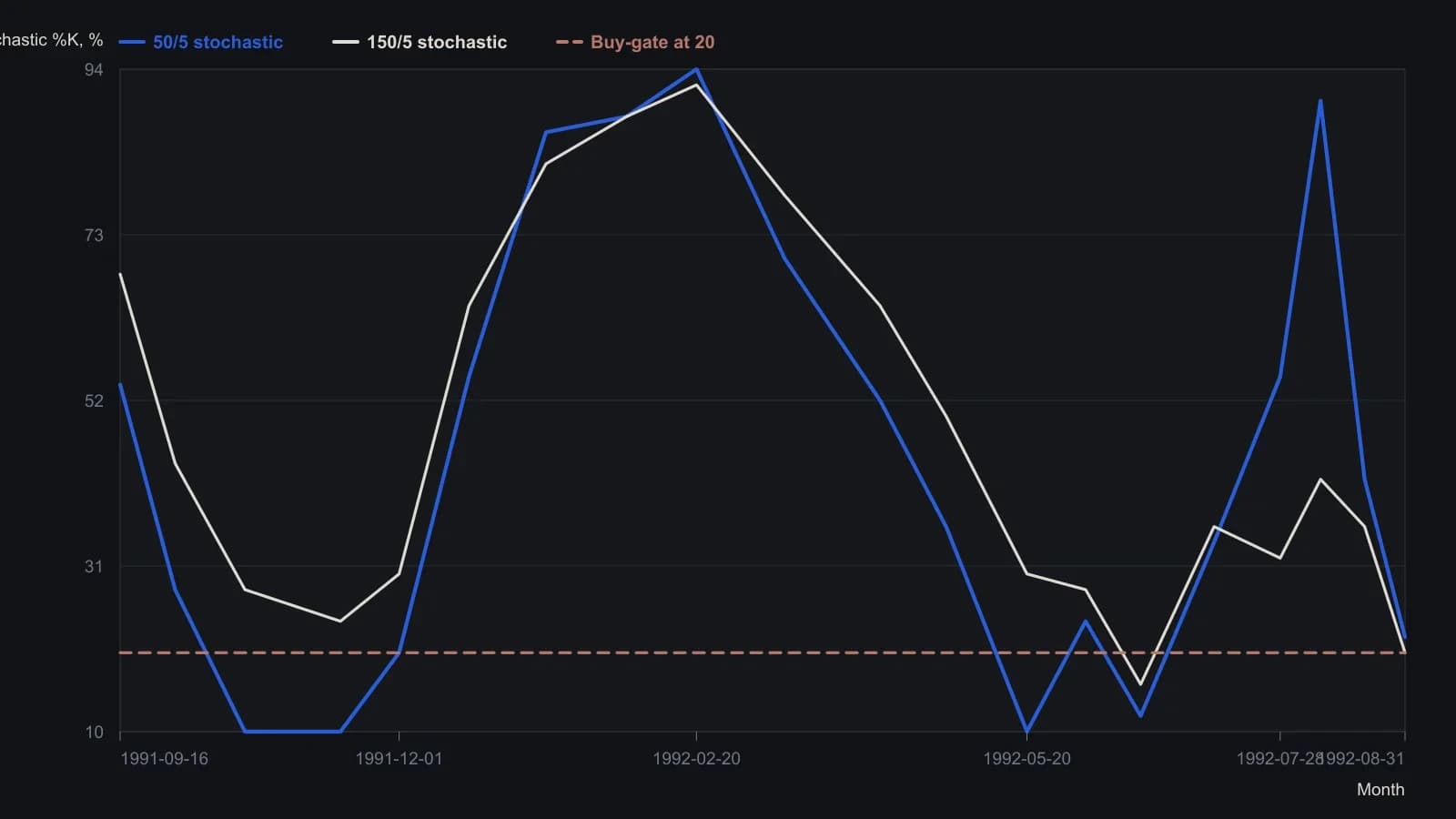
Meibuhr left the 150/5 and 50/5 pair unoptimized and smoothed both with simple averages; the 20 line is his longer-window buy gate. Values are approximate readings off a 10-point grid.
All readings on this track · 42 readings
- 1987Stochastic fast and slow construction as a rebuildable stack
- 1989Building the stochastic oscillator from close location
- 1990Monthly stochastics as a multi-year bond regime filter
- 1990Walk-forward screen for yen indicator rules
- 1990Slow stochastic construction for index pullback entries
- 1991Random Walk Index construction with an adaptive lookback
- 1991Building a two-stage stochastic oscillator from close location
- 1992Constructing fast and slow stochastic oscillator lines
- 1992Constructing nested stochastic lookbacks
- 1994Construct the four-state price-volume rank before filtering it
- 1996Crowded stochastics, false breakouts, and hidden stops
- 1997Fade and follow entries from stochastic extremes
- 1998Oversold confirmation as a staged rule-based-entry case
- 1999Constructing regular and slow stochastic oscillators
- 2001Construct a variable-interval simple moving average from stacked extremes
- 2001Threshold RSI and stochastic setups with next-bar stops
- 2001Two tests of a rate-adjusted earnings-yield gap
- 2002Constructing a two-line stochastic from a range-normalized close
- 2002Inspect mechanical stochastic daytrade rules on one bar
- 2003Constructing an adaptive stochastic RSI
- 2003Four parameters that construct a stochastic oscillator
- 2004Volume breakout as signal, pullback as entry
- 2004A first currency-market checklist with two averages and a slow stochastic
- 2005Shared-scale cycle indexes with companion oscillators
- 2005Current-bar versus prior-bar range construction for the stochastic oscillator
- 2005Two-session moving-average pullback short
- 2006Market condition as a permission layer for moving averages and oscillators
- 2008Lock the stop at support before sizing a stochastic entry
- 2010Construct a center-line volume oscillator and read it with a stochastic oscillator
- 2010Sharpened RSI turns with rainbow averages and a slow stochastic
- 2011Build a Spearman rank oscillator from ordered closes
- 2012Gold as a regime-dependent hedge in the euro-area crisis
- 2012Pairing moving averages with variable-length stochastics
- 2014Two-leg stochastic stress oscillator as a rebuild drill
- 2014Ingress dates as price bases for relative strength, stochastics, and moving averages
- 2017Constructing a dual EMA stochastic from range normalization
- 2018Constructing a two-stage stochastic RSI for comparable price-oscillator divergences
- 2018Combining a weekly stochastic, a long moving average, and two-day resistance
- 2018Weekly and daily stochastic readings with a long moving average and support
- 2018A confirming workflow for rotating from discretionary to staples
- 2019Stochastic scan thresholds, averages, and formula syntax
- 2020Constructing Slow %K as a two-stage helper