2000issue C111-5
Cycle-scaled lookbacks for a channel-breakout rule
A dominant-cycle estimate can pass current cycle length into a channel-breakout signal so entry and exit lookbacks follow day-to-day conditions. The archive keeps that path on a switch, locks conventional fixed lookbacks first, and only then searches cycle-scale multipliers one side at a time.
- A cycle-period function estimates the current market cycle length and can pass that length to a channel-breakout signal so lookbacks follow day-to-day conditions.
- Entry and exit lookbacks may be set independently, so the two sides of the rule can produce trades at different frequencies.
- A positive fixed lookback ignores the matching cycle-scale multiplier; a lookback of zero uses the multiplier instead.
- The documented search first optimizes fixed entry and exit lookbacks, then zeros the unused side and searches the cycle-scale multipliers one at a time until those multipliers are stable.
A measurement layer on an existing rule
A cycle-period function can estimate the current market cycle length and pass that length to a signal that sizes its lookbacks from day-to-day market conditions. That running estimate is the dominant cycle: it is used here to size how far back a breakout channel looks.
The receiving filter is adaptive because its effective length updates with measured market conditions instead of remaining at a single preset. The signal that uses that length remains a channel breakout.
The channel-breakout rule
The worked rule is a channel breakout. It enters when price exceeds the highest high of the entry lookback and exits when price falls below the lowest low of the exit lookback.
Entry and exit lookbacks may be set independently. The two sides of the rule can therefore produce trades at different frequencies.
How the cycle-scale path is switched
A fixed lookback is a preset number of bars that forms an entry or exit channel when the cycle-scale path is switched off. A cycle-scale multiplier is a coefficient applied to the estimated cycle length when the matching fixed lookback is set to zero.
When a fixed lookback input is a positive number, the matching cycle-scale multiplier is ignored. When that lookback is set to zero, the multiplier is used instead.
A staged search over the same inputs
System optimization is handled as a staged search over the rule inputs. The documented search first optimizes the fixed entry and exit lookbacks. It then zeros the unused side and searches the exit and entry cycle-scale multipliers one at a time until those multipliers are stable.
Hilbert-channel GE daily: dollar results after cycle-scale lookbacks
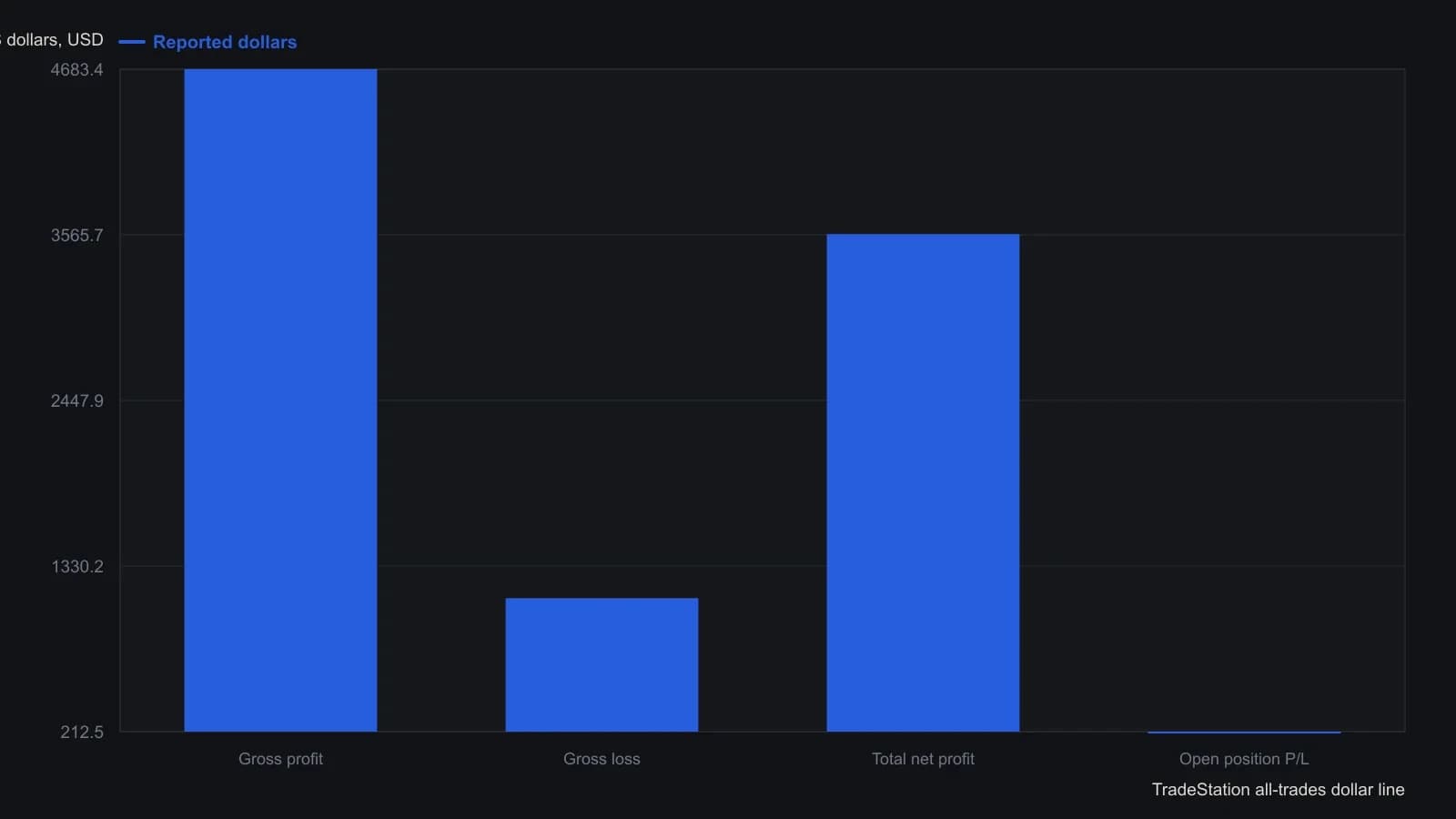
Report is the Hilbert-parameter run on GE daily, 100 contracts, no money-management, breakeven, or trailing stops. Profit factor 4.21 and 707.91% return on the $504.30 account-size requirement sit in the same table but are omitted here because they are not dollar amounts.
Bar-level diagnostics and a companion plot
Bar-level diagnostics can report whether the system is long or flat, the bar high versus the entry channel, and the bar low versus the exit channel.
A companion plot can display the same adaptive channels and marks without issuing orders. It should reuse the optimized inputs and the same maximum reference-bar setting as the signal.
All readings on this track · 9 readings
- 1982Constructing moving averages with weights, alignment, and adaptive lookbacks
- 1990Constructing adaptive filters from equal-weight averages
- 2000Cycle-scaled lookbacks for a channel-breakout rule
- 2000When charting code breaks the adaptive trendline
- 2001Nonlinear Ehlers filter construction from momentum and distance weights
- 2001How a fixed smoother becomes a living parameter surface
- 2005A three-part workshop for adaptive-filter length search
- 2010Rebuilding an exponential average as a bounded error-correcting filter
- 2018Assembling a recursive median oscillator as a two-stage adaptive filter