2014issue C0860-61
Construct a dual quotient-copy trend filter under a frequency roof
After a supersmoother removes aliasing-band energy, the finished filter imposes a frequency-roof. Two quotient copies at different linearity-control settings then supply zero-cross rules for admission and exit, with a trailing-stop specified in parallel.
- After higher-frequency content is isolated, a supersmoother removes remaining very high frequencies treated as aliasing noise, and the finished filter imposes a frequency-roof on what may remain.
- In an upward-bias setting, the long-entry zero-cross-rule is the first quotient-copy crossing above zero, and the long-exit rule is a less sensitive second copy crossing below zero.
- A trailing-stop is specified in parallel because the slower-copy exit can close a position before a larger directional move has finished.
- With linearity-control set to negative values, the same stack is inverted: a short opens when the first copy falls through zero and closes when the second copy rises back through zero.
Roof the frequencies that may remain
The finished filter is constructed to impose a frequency-roof on the band of frequencies that may remain in the output. After higher-frequency content is isolated, a supersmoother is applied so the remaining very high frequencies, treated as aliasing noise, are removed.
Pair two quotient copies as zero-cross rules
In an upward-bias setting, the long-entry rule is a first quotient-copy crossing above zero. A second quotient-copy is built with a slightly less sensitive linearity-control setting, and the long-exit rule is that second copy crossing below zero.
Each of those tests is a zero-cross-rule. Entry or exit is defined only by a named quotient-copy moving through zero in a specified direction. Linearity-control is the signed sensitivity setting that tilts each quotient-copy toward an upward or downward market bias.
Keep a trailing-stop as a parallel exit
The slower-copy exit can close a position before a larger directional move has finished, so a trailing-stop rule is specified as a parallel way to leave the trade. The trailing-stop is a separate exposure bound that can close a position even when the slower quotient-copy has not yet crossed back through zero.
Invert the same stack under a downward bias
In a downward-bias setting, linearity-control is set to negative values and the signal logic is inverted. Under the inverted rules, a short is opened when the first quotient-copy falls through zero and is closed when the second copy rises back through zero.
SPY with dual quotient-copy filters, upward bias
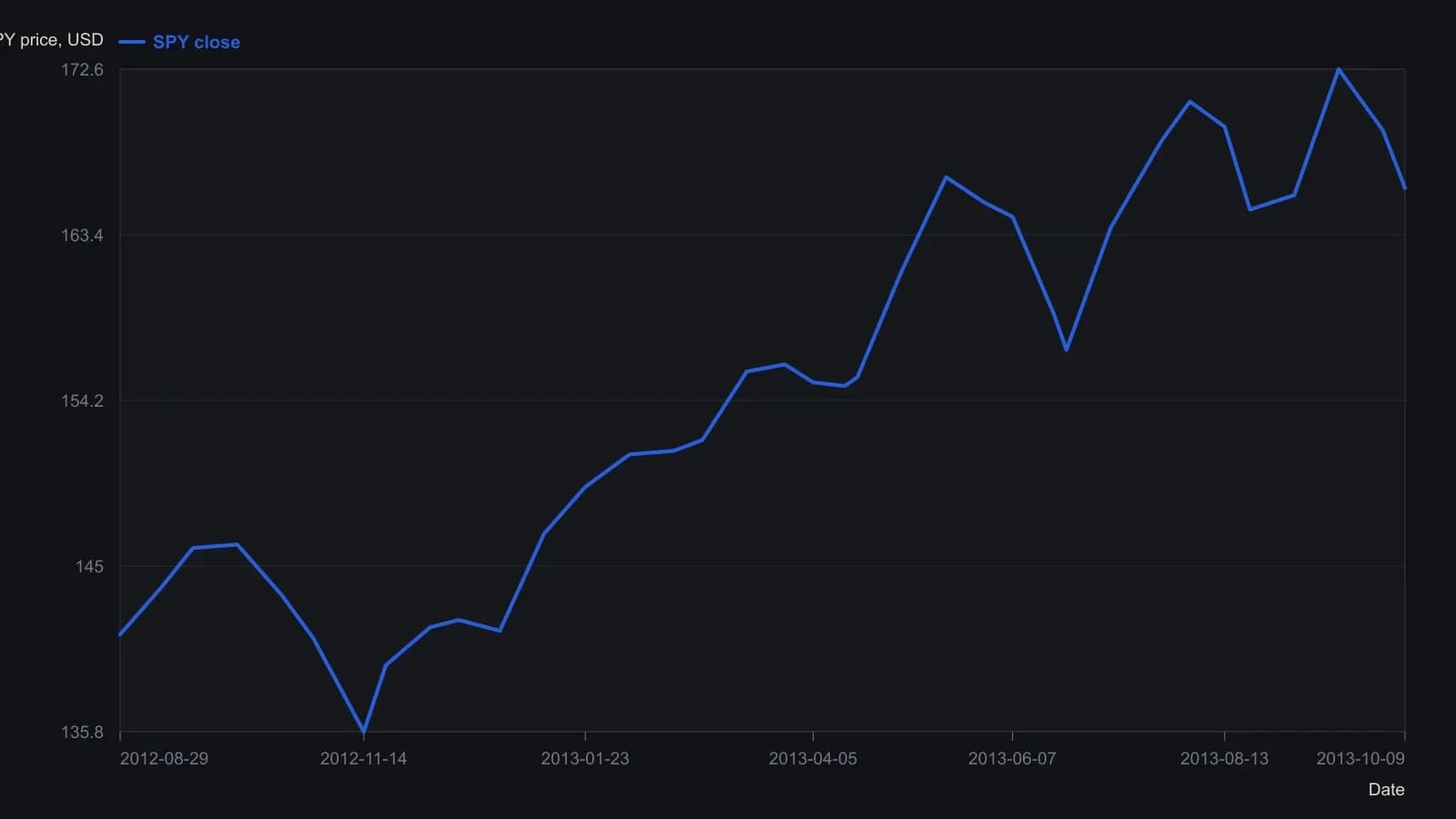
Digitized from the Excel price pane (First 29 Aug 2012, Last 9 Oct 2013; reported window high 177.60, low 130.70). Quotient-copy levels are described in the caption but not plotted here because the oscillator pane cannot be read to honest price units without inventing precision. The 19 Apr 2013 zero-cross is stated in the accompanying text.
All readings on this track · 36 readings
- 1988Half-day bars, a midpoint gate, and a bar-based trail
- 1989Packaging two-bar reversals into testable entry and exit rules
- 1989Weekly high and low averages as stop-and-reverse levels
- 1991Constant false-alarm rate for dominant-cycle stops
- 1992Tick-index extremes as continuation and turn hypotheses
- 1993Constructing layered stops from equity and structure
- 1993Filter crossovers with moving-average slope
- 1993Precommit stop bounds from equity and structure
- 1998Evaluating a trendline barrier that can only tighten a capped stop
- 1999Constructing common-number support and resistance
- 2001Four-step opening-hour bias and trailing stops
- 2004Make the trading system the star
- 2005A beginner stock case: stop, trail, and the pre-trade checklist
- 2006Sell stops that trail support after the buy
- 2006Treat a wave-3 label as unfunded until the stop rails are written
- 2008Test medium-term divergence with a trendline break and a trailing stop
- 2010Rule-based forex entry, stop and trail
- 2012Precommitting stops when one currency range templates another
- 2012Cat-ears as a downtrend continuation hypothesis
- 2013Three-average swing entry and a trailing average exit
- 2014Construct a dual quotient-copy trend filter under a frequency roof
- 2014Stop distance, size, and trailing swing invalidation
- 2014Long-only RSI pullback, reversal-bar-entry, and staged-trail construction
- 2015Dual-average regime, trigger candle, and trail as one daily script
- 2015Three-gate trend system: filter, trigger, and trailing stop
- 2016Construct HHLLS crossover and breakout entry rules
- 2017An appointment-trade around a scheduled political close
- 2017Golden-cross breakout rules for a swing entry
- 2017Breakout confirmation above round numbers, with nines as sell shelves
- 2018Classify diamond geometry before the breakout
- 2019When trails and stops betray the support read
- 2019One-triggers-the-other pairs for preplanned swing entries
- 2019One-triggers-the-other orders for a breakout and its stop
- 2019When the second decision unbounds planned risk
- 2020Last-Hour Breakout With a Same-Session Flatten
- 2020Couple the slow period to stop-loss and trailing-stop settings