1993issue C111-2
A random-walk index that uses true range as its scale
This archive article reconstructs a random-walk index that scales the move from an earlier opposite extreme to the current high or low by the lookback average of true range and the square root of that lookback. The working reading is the largest of the one-through-nine period values on the current bar, and a reading above one is the construction's rule for a trend indication.
- On the low side, the random-walk index tests whether the current low is occurring in a trend or in a random trading range.
- True range is the greater of the current high minus low and the prior close minus the current low, so a gap-down with a narrow session does not shrink the average range.
- Each lookback divides the displacement from a prior opposite extreme to the current extreme by the lookback average of true range multiplied by the square root of the lookback length, and the working index is the largest reading from one through nine periods.
- Any reading above one classifies the current extreme as a trend indication; in the simulated example the largest value is 1.25.
A trend filter built on true range
The random-walk index is a lookback-scaled ratio of the move from an earlier opposite extreme to the current high or low, divided by average true range times the square root of that lookback length.
On the low side, the index is built to test whether the current low is occurring in a trend or in a random trading range. Used as a trend filter, the largest random-walk index across a set of lookbacks is treated as a call on whether the latest extreme is trending or still consistent with a random range.
True range keeps a gap in the average
True range is the greater of the current high minus low and the prior close minus the current low, so a gap-down with a narrow session does not shrink the average range.
That choice keeps a gap inside the average range that later scales every lookback reading.
Each lookback is a scaled displacement
Each lookback reading divides the displacement from a prior opposite extreme to the current extreme by the lookback average of those true ranges multiplied by the square root of the lookback length.
The working index is the lookback maximum
Readings are computed for lookback lengths of one through nine periods on the current bar, and the working index is the largest of those readings. That largest value is the lookback maximum.
Any reading above one is the construction's rule for classifying the current extreme as a trend indication. In the simulated example the largest value is 1.25.
High-side readings and longer lookbacks
The high-side version keeps the same true-range denominator and replaces the numerator with the current high minus the low from n periods earlier.
Lookbacks longer than eight periods are treated as the window for longer-horizon trend readings, and the same construction can be extended beyond the nine-period worksheet.
Random-walk index of today's low by lookback
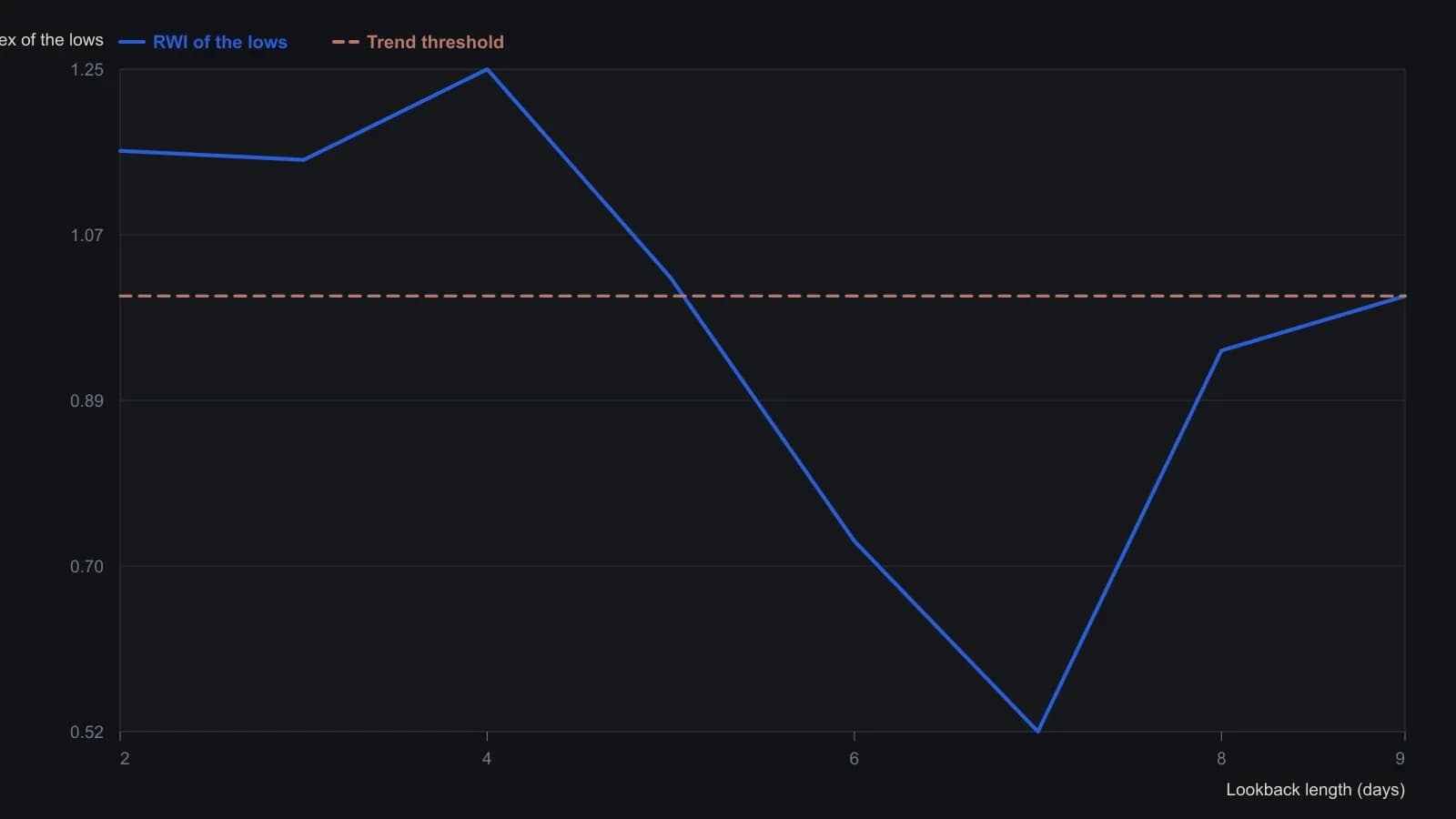
Columns G through N tabulate lookbacks of two through nine days only; a one-day length is not shown. Today's close is blank because the last bar is still open. The working index is the maximum of those lookbacks.
All readings on this track · 36 readings
- 1988Constructing unsigned true range for directional models
- 1989Evaluate an always-in ATR breakout as one procedure
- 1992Variable lookback and average true range as a trend-filter construction
- 1993A random-walk index that uses true range as its scale
- 1993A shared harness for trend-filter construction
- 1998Finish a trend with a volatility trail, wave permission, and a slower-frame veto
- 1999A trend filter that switches tactics and scales ATR targets
- 2001Filter higher lows with linear regression, then judge the exit
- 2003A Mechanical trading system is a maintained procedure, not only an entry trigger
- 2005Construction of a volatility-bounded long entry
- 2005Six-zone encoding of open, high, low, and close
- 2006Normalized average true range as a pre-entry volatility bound
- 2006Chandelier exits, ATR position sizing, and trailing stops
- 2007Constructing a rule-based entry with Relative Strength Index and ATR position sizing
- 2008Constructing a zero-lag TMA and heikin-ashi crossover as a complete rule set
- 2010Use the session-range percent stop as a pre-trade filter
- 2011OCA exit groups, trailing limits, and ATR stops
- 2011ATR bands around support and resistance for stops and targets
- 2013Algorithmic head-and-shoulders construction with bounded exits
- 2013Constructing ATR-scaled swing pivots and linear-regression divergence
- 2013Constructing volatility bands from typical price
- 2014Constructing true-range contraction filters before expansion
- 2015Constructing touch plans from modified true range
- 2015One checklist for breakout entry and ATR risk
- 2015Percentage true-range construction for cross-market volatility filters
- 2015Construct a percentage true range for cross-market volatility
- 2015Percentage true range as a pre-entry exposure filter
- 2016Constructing ATR-filtered breakout entries
- 2017A dividend date as a pairs-trading classroom
- 2018Range-based volatility as a true-range construction
- 2018Moving average support and volatility-band construction
- 2018Construct a lifecycle breakout from compression
- 2018Pair the book first and let volatility or range set the size
- 2019Trend systems need a no-trade rule
- 2020Average true range as a shared unit for size, pairs, and stops
- 2020Volatility sizing and target-risk leverage as a pre-trade gate