2016issue C057-11
MACD as a zero-line filter with dual moving averages
This lesson restyles the MACD line so it can be read against zero, then pairs that reading with a slower exponential moving average and a nearer weighted moving average. The archive treats zero-line polarity as a tape state and the averages as a gate. An editorial aim is a sequencing habit that keeps every oscillator wiggle from becoming a trade.
- Remove the conventional signal overlay so the MACD line is read against its zero line rather than against a second average of itself.
- Treat MACD above zero as a generally constructive tape state and MACD below zero as a generally negative one, and treat bars that hover near zero as weak, sideways momentum.
- Authorize long setups only when price is above the slower exponential average and MACD bars are positive, and short setups only when price is below that average and MACD bars are negative.
- Treat a close through the nearer weighted average, or price in the inter-average zone, as a caution that retracement, consolidation, or chop may be underway.
The MACD line versus its zero line
A conventional MACD line is the difference between a 12-period exponential moving average and a 26-period exponential moving average, with a 9-period exponential average of that line used as a signal overlay.
Changing the signal average from a 9-period exponential setting to a 1-period exponential setting removes the overlay. The reading that remains is the MACD line versus its zero line.
SCG MACD line versus zero and the signal
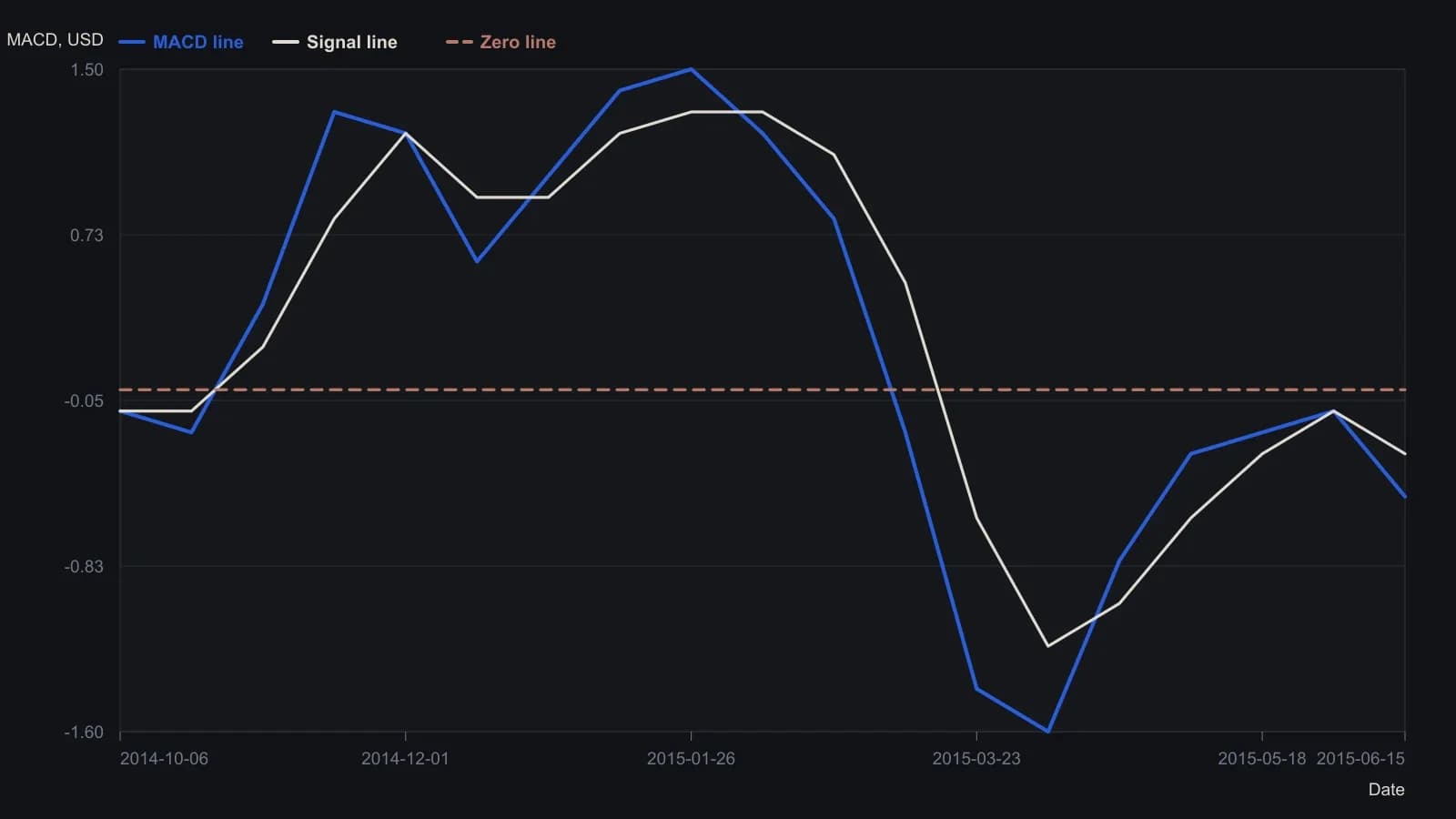
Figure 1 is the ordinary 12–26 MACD with a 9-period signal, in dollars. Dates follow the printed October 2014–June 2015 window and the 15 April 2015 marker. The pane’s last oscillator print is −0.50.
A histogram of the line, not of the spread to the signal
Displaying that MACD line in a histogram-line style, and scaling it as a percentage of movement rather than a currency change, is presented as a way to make zero-line crossings easier to see.
A 12-period versus 26-period price-percent oscillator plotted as a histogram is offered as a substitute when charting software cannot restyle the MACD line itself.
That restyled display is a bar plot of the MACD line itself above and below zero. It is not the common MACD-histogram function that subtracts the signal line from the MACD line.
Polarity, near-zero bars, and unconfirmed extremes
Zero-line polarity is whether the MACD line sits above or below zero. MACD above zero is treated as a generally constructive tape state and MACD below zero as a generally negative one. A turn back toward zero after a directional run is treated as fading momentum rather than an automatic reversal.
Histogram bars that hover or fluctuate near zero are associated with weak momentum and sideways or range-bound price action.
A new price extreme that the MACD line does not confirm is presented as momentum divergence. It marks a shift in momentum, not a guaranteed trend reversal.
A slower exponential gate and a nearer weighted caution line
A 34-period weighted moving average and a 55-period exponential moving average are added to price. Long setups require price above the 55-period exponential moving average with MACD-positive bars. Short setups require price below the 55-period exponential moving average with MACD-negative bars.
The weighted moving average is the nearer caution line. A close through that 34-period average, or a warning mark when price occupies the inter-average zone between the two averages, is used as a caution that a retracement, consolidation, or choppy stretch may be underway.
All readings on this track · 20 readings
- 1988Indicator smoothing: lookback, weight, and scale
- 1990Recency weighting in simple, linear, and exponential moving averages
- 1990Seed and recurrence construction for moving averages
- 1990Constructing a five-day step-weighted moving average
- 1992Constructing simple, weighted, and exponential moving averages
- 1992Constructing moving averages with weighting schemes and extra filters
- 1992Constructing a weighted-average TRIN10 with Bollinger envelopes
- 1992Constructing a banded weighted open-TRIN oscillator
- 1993Evaluating a weighted dual rate-of-change momentum filter
- 1993Constructing equal, linear and exponential moving averages
- 1993Constructing a general weighted moving average from one exponent
- 1993Calibrating the weighted-moving-average exponent
- 1993Constructing an exponent-weighted average of put-call ratios
- 1994Cycle-tuned momentum with spectral peaks
- 1999How a five-bar sine-weighted average is assembled
- 2003Same-scale trend filter from a rolling least-squares endpoint
- 2003How a rolling linear-regression endpoint is assembled as a moving-trend
- 2004Constructing a volume-weighted moving average as a forecast baseline
- 2005Constructing a move, volume and recency weighted average
- 2016MACD as a zero-line filter with dual moving averages